the RCIA, pilgrims and prospects

DBBMAPThe past few months have been a whirlwind as I’ve landed firmly within a new diocese. Much time has been invested in engaging with staff members, clergy and lay leaders, discerning and weighing a vision for mission that will be responsive as well as challenging to our context, and considering critical issues of governance, structure and resources.

The highlights of this time have included meeting the parish communities of the diocese who have offered tremendous hospitality and welcome, and the opportunity to speak with a number of ecclesial movements and other potential partner organisations that offer the kind of evangelical energy we want to see flourish in northern Sydney.

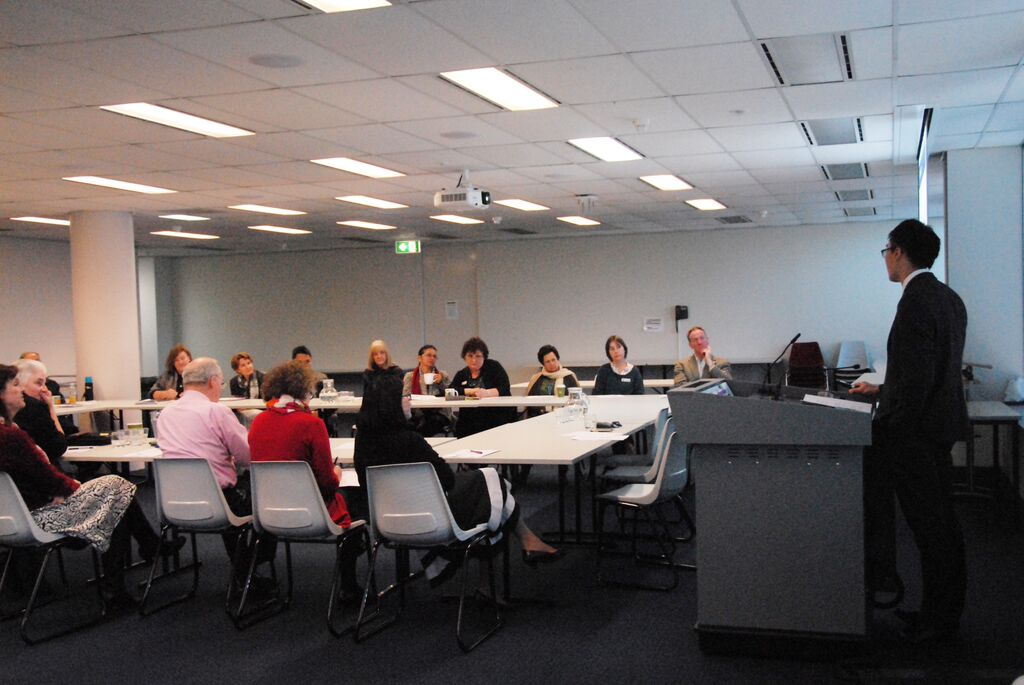
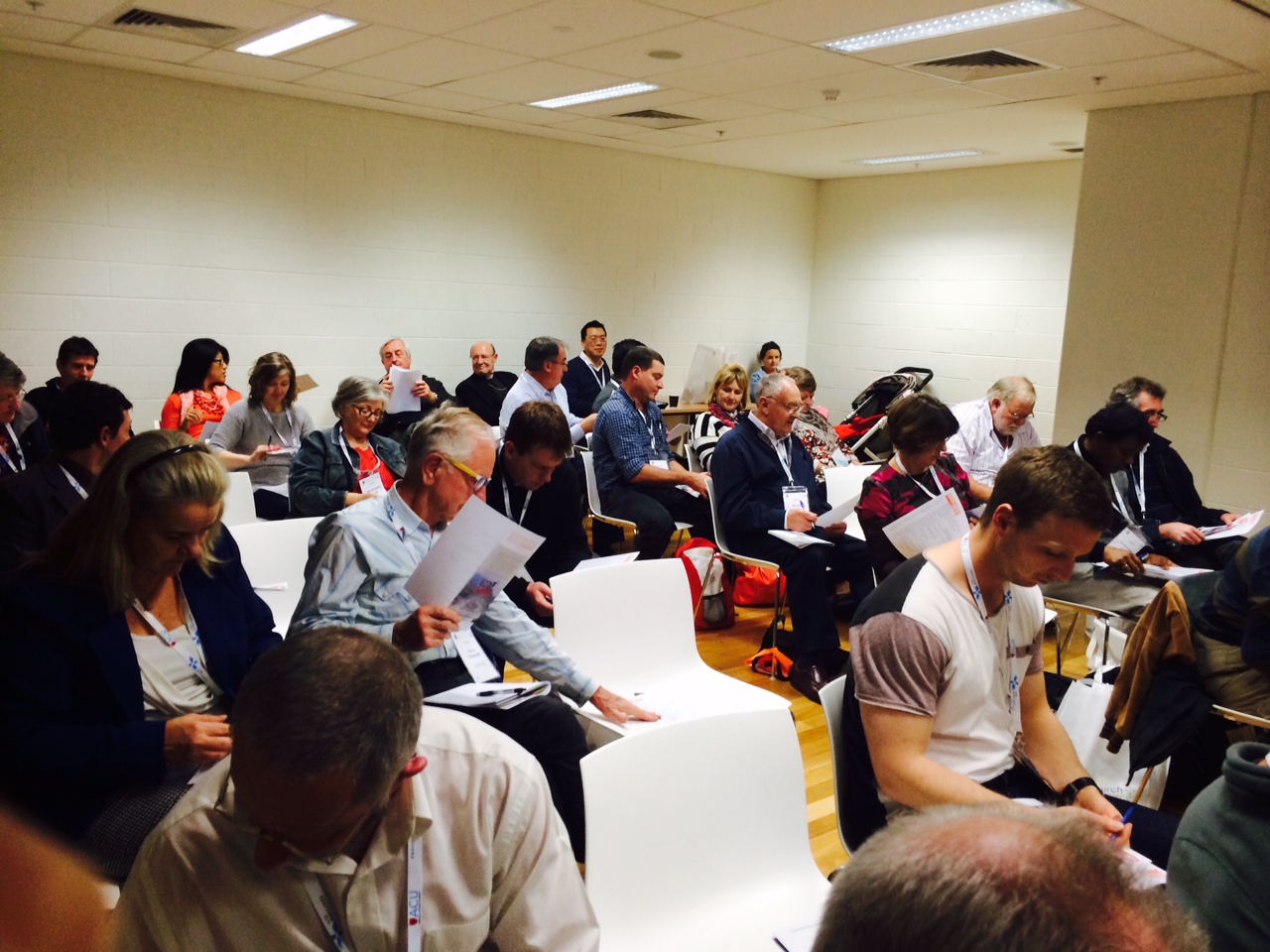
This weekend I’ll be delivering a keynote address at an RCIA conference held biennially and hosted by the Diocese of Broken Bay. It will be a great opportunity to discuss the ways in which we seek to accompany people in their encounter with Christ. It is a ministry of the Church for which I have great passion and respect for it is at the forefront of the Church’s outreach. I owe a great deal personally to my experience of the RCIA. Below are some thoughts that I will share and I hope they may spur your own thinking on the dynamics and helps of Christian initiation.

Evangelisation in a New Time: Pilgrims and Prospects

baptism-adultThere is nothing as joyous as the initiation or reception of adults into the life of Christ. I stand here as a beneficiary of that process when I was baptised and confirmed on a Wednesday night in November of 1999. Heralding from a family of Buddhist and Taoist heritage, I entered the Church on the eve of the new millennium at the age of twenty, gathered with a priest, sponsor, fellow catechumens and a mixed group of close friends, mostly of no religious background.

A small but powerful group had accompanied me through conversion and initiation and I was fully conscious and grateful for the fact that in God and this community I had been granted something which I would spend the rest of my life learning to be faithful to, learning to enter into, and learning to trust. In sharing this portion of my own story and in the following reflections on RCIA in the context of the new evangelisation I hope to affirm your dedication to the RCIA as a vital sign and mirror of the Church in its deepest identity as a community of evangelising disciples.

A Developing Faith

In the wake of the Second Vatican Council, and the prophetic zeal of Pope Francis, it is today commonplace to speak of the Church and its need of development or reform, that is, change. From the laments and incitements of Evangelii Gaudium, to contemporary Catholic literature such as Rebuilt, Forming Intentional Disciples, and Divine Renovation there has been magisterial, critical and popular recognition that what is most needed at this stage of our history as Church is a re-appreciation of evangelisation, the making and maturing of disciples, as the essential mission of our Church.

A ‘new evangelisation’ is sought, ‘new’ not in message or substance as if we have somehow graduated from the one Gospel given in Jesus Christ, but an apostolic outreach that is fresh in energy, intent and method for we seek to evangelise in a context that is something other than a carbon copy of times past.

Certainly, there is continuity. Today adults, as ever, come forward to be initiated as an expression and consequence of their faith in Jesus Christ from a variety of personal and cultural backgrounds. Through their initiation, these pilgrims die to self and rise in Christ who is their new way of life and they enter into this new life socially, joining a community that professes Jesus to be the source of their life and salvation.

Baptême_Cathédrale_de_Troyes_290308However, the ways and practices of Christian initiation have varied throughout the history of the Church. We only have to recall the early second century when potential catechumens presented for baptism after two to three years of preparation, involving multiple exorcisms and even a dash of salt. The danger of persecution within an intolerant Roman Empire restricted exposure of catechumens to the sacred mysteries of faith while sponsors played the role of prudent guarantor for the trustworthiness of their initiates. We see the shape of Christian initiation evolve yet again with the penitential theology of the Church. Many a convert in the patristic age chose to remain a catechumen until the end of life in the hope that a quick baptism before death might erase all the more sin. Even the formula of baptism itself has undergone development and with it the catechesis that has accompanied preparation, with baptism first simply in the name of Jesus, then the more creedal, interrogative formula recorded in the Apostolic Tradition before the straightforward trinitarian formula we employ today, based upon Matthew 28:19. The catechumenate of adults and rites of initiation have developed with the life of the Church as it has confronted each stage of history.

What we learn from this rich history is that the potential and fruit of our catechumenate – restored at the direction of Vatican II (Sacrosanctum Concilium 64) and now just four and a half decades old in the form of the RCIA (decreed in 1972) – is intimately bound up with the life and vicissitudes of our Catholic community as a whole. As affirmed by the Rite itself, there is an intimate and indispensable relationship between the initiation process and the total life of the parish, what could be described as ‘the community of initiation.’[1]

Initiation in a New Time

Baptismal FontAs it stands today the Church in Australia sees some 69,000 newly baptised each year, with approximately 5,000 of these adults.[2] (As an aside, it has been noted that the number of adult baptisms in the U.S. rose by 12% between Easter 2013 and Easter 2014, portents perhaps of a genuine ‘Francis effect’ encouraging initiation.)

In receiving the forgiveness of sins, union with Christ and incorporation into his body, the seal and sanctification of the Spirit, and Christ’s Eucharistic body, these twenty-first century neophytes personify and encourage our hope to be that transformative, mediating community that Christ calls us to be, a Church that is essentially ‘a life passed on’.

A more sobering characteristic of our time, highlighted by contemporary literature and recent papal teaching, is that personal conversion and ceaseless evangelisation in the Church can no longer be assumed. Indeed, diminishing rates of participation in weekly Eucharist and other sacraments of the Church present a serious challenge to our ecclesial and formative paradigms.

For one, the premise of a ‘conveyer belt’ which took Catholics from the cradle to grave in faith, passing through the way of the Catholic family, parish and school, no longer seems true-to-life, if it ever was. As Sherry Weddell notes, there is thin evidence to support the belief that Catholic identity simply migrates from infancy into adulthood, resulting in the slow but steady spiritual growth of Catholic adults over a lifetime.[3] There is little reason to suppose that Catholic converts will also be carried along by some seamless cultural momentum within the Church into lifelong discipleship.

Sadly, we know the stories of the newly initiated who have journeyed with us over months only to disappear from the active life of the worshipping community, some even before the Easter season has drawn to a close. The trust, encounter, and discipleship in Christ fostered by small groups such as the RCIA yearns to be sustained by the larger ecclesial body into which the newly initiated are incorporated.

In other words, we cannot consider the RCIA and its pilgrims apart from the prospects for their continued journey with Christ in the body of all the faithful. If we are inviting people to the Gospel we must offer them a community of life in which spiritual seeds can prosper.

Much of our magisterial teaching assumes the existence of this living, active and spiritually dynamic community of faith in our parishes, not out of naiveté or ignorance of what is a more mixed reality in our parishes, but so as to underline all the more the non-negotiable nature of a culture of discipleship as the building block of all other elements of parish life, including liturgy.

FootprintsVatican II’s Sacrosanctum Concilium declares that the sacraments presume a living faith amidst its people.[4] The Catechism of the Catholic Church underlines “The sacred liturgy does not exhaust the entire activity of the Church: it must be preceded by evangelisation, faith, and conversion”.[5] For its part, the RCIA confirms the necessity of a pre-catechumenate prior to theological instruction and liturgical preparation, a “time of evangelisation and initial conversion” which is to unfold in the presence of parish families and other groups of Christians through whom those with faithful intent can see “evidence of the spirit of Christians that they are striving to understand and experience”, all this prior to the rite of acceptance into the order of catechumens.[6] Again, the RCIA and its pilgrims cannot be considered apart from the spiritual health of the whole body into which the newly initiated are grafted. The budding of the branches depends upon the vitality of the vine.

When we take the current temperature of ‘the vine’, the whole body of the faithful, the sober reality is that 60% of those who attend Mass reported only some or no spiritual growth through their experience of parish life.[7] It is evident that many a parish culture does not nourish personal faith and a mindset that assumes the sacraments will simply ‘take care of it’ neglects our duty to awaken in each person that active and personal faith, that fertile soil, in which the grace of the sacraments can actually bear fruit.

The spiritual barrenness reported in our pews flows over to impact upon the ability and even the desire of Catholics to reach others for Christ with obvious consequences for the RCIA. Hence, some 72% of Australian Mass attenders reported that they would not or did not know if they would invite someone to their parish.[8] Without spiritual growth in their own lives, individuals are not able to be effective witnesses or apostles for Christ in the wider community.

All in all Fr James Mallon underlines the importance of addressing parish culture in its totality if  discipleship is to be lifelong, noting smaller groups and initiatives

. . . will be only as good as the culture of that parish. Even a very successful tool for evangelisation . . . will have a very limited impact if the values of a parish are vastly different from the values within a particular program . . . Running evangelistic, outreach or renewal programs without addressing the necessary cultural conversion of our parishes will only leave us open to charges of false advertising.[9]

The fruit of RCIA depends in no small part on a parish culture where the kerygma, the Great Story of Jesus, is clearly preached through substantial homilies, where the kerygma is made known through adult faith formation experiences that are a norm of community life rather than an exception, and through the testimony of those whose lives have been changed by entering into that living story of Jesus, providing witness to his Spirit alive and at work in human lives.

Indeed, in the light of the interdependency of RCIA with the community at large, I would suggest that there is an argument that catechumens and candidates, while keeping their unique identity as a group, could be a part of a spiritual and faith formation process that is open to anyone.[10] While recognising the stages of development that mark the particular experience of catechumens, all are called to be disciples, mathētēs in Greek, meaning those who learn. All are called to be students before the feet of Jesus Master and Teacher and we cannot in this new era assume that the great numbers of already baptised have indeed heard that initial proclamation of the Gospel which Pope Francis’ Evangelii Gaudium reminds us “we must hear again and again in different ways”.[11] My observation from the pews is that people are grasping only fragments of the Gospel and from the outside. Furthermore, I know many veterans of faith, dedicated and regular attendees, who envy the deep learning and spiritual conversation that the RCIA makes possible but to which they ordinarily do not have access themselves.

Foundational formation involving both newcomers and more established Catholics would recollect for the community that new membership is as much a part of regular parish life as Sunday Mass. Mutual experiences of formation would allow candidates to be integrated into community life not simply during the rites of initiation but in its very life, understood as a common school of holiness and friendship with Jesus Christ. If prayer and discipleship are learned, as our tradition maintains, then all have much to gain through and with one another as common pilgrims on the Gospel way.

Spiritual Accompaniment

startplanning1Having underlined this morning the inseparability of converts and the spiritual vitality of the communities they enter, a further opportunity makes itself present in our capacity to tell the stories of conversion that emerge from our tradition, narratives of holiness and transformation that can assist today’s catechumens to clarify their own life as a spiritual way.

Our firsthand experience of RCIA tells us that so much depends not simply on theological instruction or liturgical preparation but on the communication and exchange of stories, the sharing of personal itineraries of call and conversion, rich testimonies of the ways in which human lives have become intertwined with God’s.

In such spiritual conversation we enumerate together the shape of holiness, we generate a living tradition of what it means to be a holy person, we affirm the very possibility of access to and relationship with God and the capacity of human beings to respond and flourish in cooperation with his gracious and divine life.

I propose that the RCIA can provide for catechumens in our time invaluable guidance on the basic tenets of our faith, the rhyme and reason of our liturgical rites but also, crucially, testify to the ways in which lasting conversion can actually come about under the influence of grace. Those entering a life of faith, not to mention those already in the pews, are in need of a clear sign or witness that the life of faith is indeed possible, worthwhile and of ultimate significance and value.

In reflecting on my own experience of conversion and that of others who have come into the Church as adults, I am mindful that the transition into Christian life is anything but abstract, whimsical or sugar-coated. It is oftentimes a formidable journey, not without loss, and quite literally world-changing in its consequence. Friends and relationships change as do priorities, lifestyles and life choices and directions.

Our rich spiritual tradition helpfully offers a multitude of concrete lives and trajectories that can affirm and nourish this transition from an old way of life to a new life in Christ. The great stories and holy witnesses of our faith provide, in their own way, “an assurance of things hoped for” (Heb. 11:1).

What are the most compelling narratives of holiness that the RCIA can bring forward to uphold and foster trust in the momentous ‘crossing over’ from the old self to the new, for twenty-first century pilgrims? What are those stories that we can tell to show that Christian faith indeed makes a human life coherent?
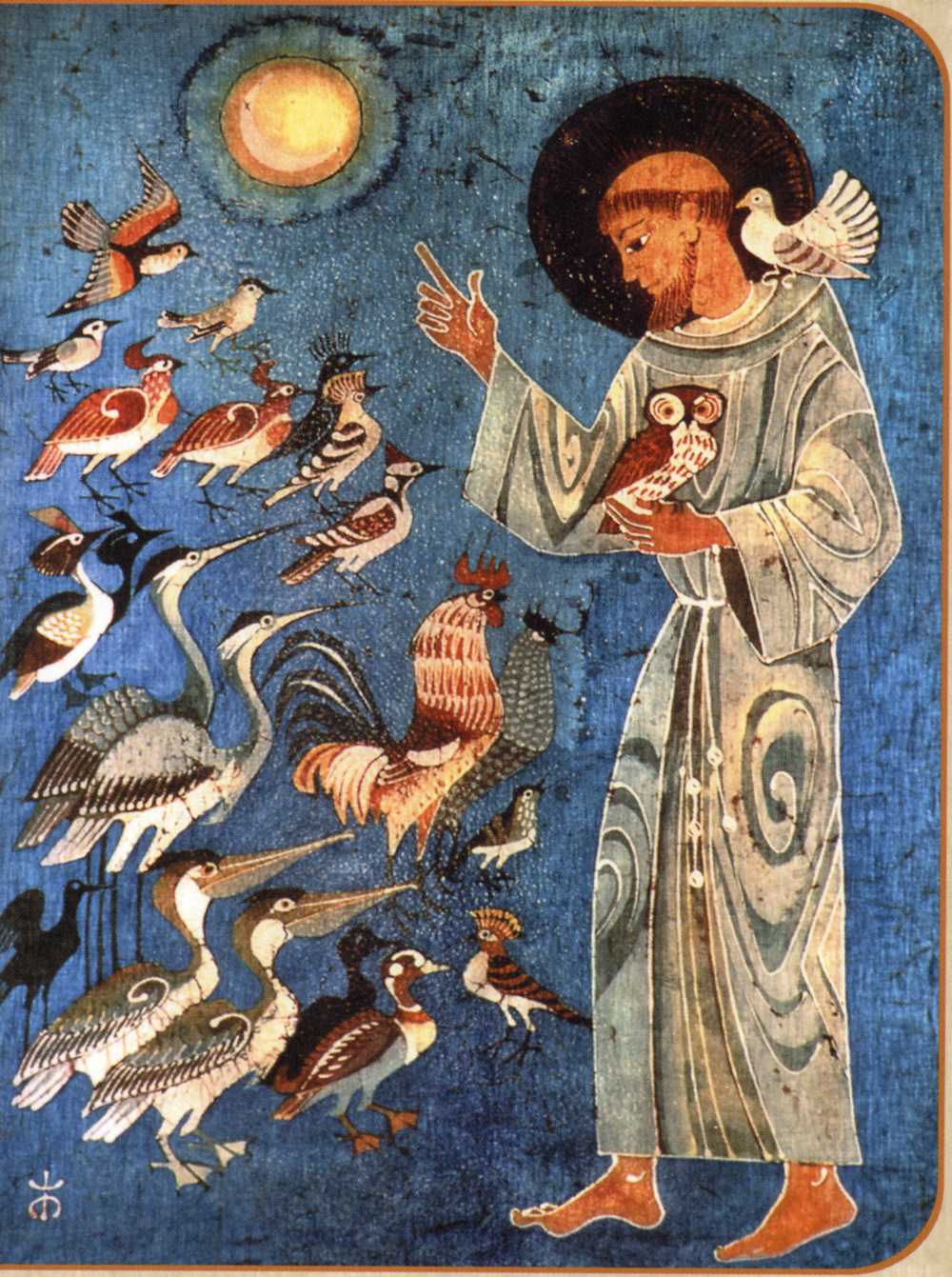
To offer classic examples, the itineraries of St Paul, St Augustine, and a St Francis delineate by different routes the way in which total Christian conversion is possible and how one can engage the world as a new creation in Christ. These are stories of our tradition worth telling. Their biographies and standing as models of holiness provide neophytes with a tangible vision of the way in which God promotes our flourishing in the particular circumstances of our life. It is not a stretch to assert that some of the spiritual stagnation in our pews may be attributable to the plain fact that many Catholics have no vision at all as to how the life of holiness could be pursued or ultimately take expression.

Take the story of St Francis of Assisi as an outstanding paradigm of our tradition. We recall here a young man of excess and indulgence, one who lives a dissolute life bankrolled by the wealth of the family business. Knowing no limits and characterised by exorbitant passions and intemperance, we learn that God’s work of grace in Francis does not cut out or obliterate this trait of excessiveness, does not excise his tendency to wild abandon but rather transforms it from within. Francis remains a man of excess but now becomes excessive in his poverty, radical in his self-sacrifice, zealous in his self-abandonment and self-donation to others.

The ascetic friar of Assisi brings forward for us the journey of holiness as inclusive and transfigurative rather than severe or caustic as the spiritual writer John O’Donohue adeptly explains:

The Christian life has always been a struggle towards perfection. Yet the recommended models of change have been very damaging, either metamorphosis, where the old self was expected to graft onto a supernatural level and become abruptly sanctified, or moral surgery, whereby the undesired dimensions of one’s life were cut out. Such externalist violence is always resisted by the psyche’s organic and inclusive spiritual instinct. Transfiguration is in harmony with the deepest rhythm of the soul because nothing is denied, excluded or forced. Attention is focused reverently on the whole complex of one’s presence. In light of this reverence to one’s self the places of entanglement, limitation, blindness and damage gradually reveal themselves in ways that suggest and invite changes in the configuration of one’s heart.[12]

candleWe learn that authentic growth in holiness is not about ‘metamorphosis’, the idea that we can simply shed the past, our very personality and history, and become someone entirely new. This is illusory. Nor is growth in holiness about moral surgery in which we simply excise or cut off whatever is found to be undesirable within us. As witnessed in St Francis’ life, the image of transfiguration is more apt, a gradual process in which we enter into and are attentive to every aspect of who we are, even those inevitable dimensions of darkness within ourselves, ‘lifting them up to the Lord’ whose Holy Spirit brings about transformation within, and not despite, the conditions of our life and character.

By such great narratives I believe neophytes as much as the already baptised can find encouragement to acknowledge the all-too-human reality which is inescapably ours – light and shadow, wheat and tare – and open this mixed reality to God’s love and grace which heals, redirects and transforms our very weakness into God’s strength (cf. 2 Corinthians 12:10).

I suggest that the dynamics of Christian conversion are well carried by the stories of those who have gone before us in faith, in the restless interiority of a St Augustine, the passionate poverty of a St Francis, the change of heart worked within the religiosity of a St Paul. These models need not stereotype holiness but give shape and substance to the possibilities that are there for all of us. These holy lives open us to more than what we may have yet imagined for ourselves, and so hold powerful relevance to our spiritual accompaniment of the enquirer, catechumen and the newly baptised by way of the RCIA.

Conclusion

In the midst of a changing ecclesial landscape and by its privileged access and accompaniment of unique and varied lives touched by Christ, the RCIA remains a gift and mirror to the Church, expressing its identity and vocation to be evermore an evangelising community of faith. Noting the particular challenges of Christian outreach at this time of history, Pope Francis remarks,

Pastoral ministry in a missionary style is not obsessed with the disjointed transmission of a multitude of doctrines to be insistently imposed. When we adopt a pastoral goal and a missionary style which would actually reach everyone without exception or exclusion, the message has to concentrate on the essentials, on what is most beautiful, most grand, most appealing and at the same time most necessary.[13]

In the work of the RCIA may we continue to offer that which is beautiful, most grand, appealing and most necessary, the Good News of the Gospel given to us in Jesus Christ, and the spiritual accompaniment of those who have walked the way of faith before us.

References:

[1] Rite of Christian Initiation 9.

[2] Vatican Secretariat of State, Annuarium Statisticum Ecclesiae 2012.

[3] Sherry Weddell, Forming Intentional Disciples (Our Sunday Visitor: Huntington, Indiana, 2012), 67-70.

[4] Vatican II, Sacrosanctum Concilium 59.

[5] Catechism of the Catholic Church #1079.

[6] Rite of Christian Initiation of Adults, no. 36-37, 39.

[7] NCLS Research, Denominational Church Life Profile: The Catholic Church in Australia. A Report from the 2011 National Church Life Survey (Strathfield: NCLS Research, 2013), 10.

[8] Ibid., 17.

[9] Fr James Mallon, Divine Renovation (Twenty-Third Publications: New London, CT, 2014), 94.

[10] This approach is also recommended by Fr James Mallon, Divine Renovation, 230.

[11] Pope Francis, Evangelii Gaudium 164.

[12] John O’Donohue, ‘The Priestliness of the Human Heart’, The Way 45.

[13] Pope Francis, Evangelii Gaudium 35.

laudato si

laudato siPope Francis’ encyclical on the environment has arrived, preceded by extraordinary anticipation and suspense on account of at least two factors – the extraordinary influence exercised by Francis as global leader as well as the highly politicised nature of the environmental debate, a politicisation of which Laudato Si is acutely aware and critical.

This new encyclical forms a part of Catholic Social Teaching, that body of doctrine stretching back to Pope Leo XXIII’s Rerum Novarum (1891) and more recently Pope Benedict XVI’S Caritas In Veritate (2009). This tradition affirms the scope of Catholic theology as embracing not only the God of Christ in the Holy Spirit but all things as they relate to God – the common good, human solidarity and dignity, the role of government, the work of peace, the preferential option for the poor and yes, ecological stewardship.

From its outset, Laudato Si reads as fresh and consequential, bringing together with deftness the two central concerns of Pope Francis’ papacy – care for the vulnerable and reverence for creation. Sure enough, this unity echoes the mysticism of Francis’ thirteenth century inspiration and forebear, the ascetic friar of Assisi.

After an initial reading I would propose the following: if Evangelii Gaudium implored Catholics to go out into the world in mission, it can be said that Laudato Si invites the whole world into a catholic view of things, to recover, quite literally, the organic unity of all that is under the love of one Father who is God (LS 238).

Hence, the encyclical relates without hesitation issues of environmental degradation to the destruction and marginalisation of the vulnerable, including the unborn; affirms the light of faith in dialogue with politics and philosophical reason; delineates lines of dialogue and action at both the international and domestic level; while it ultimately posits the need of deep ecological conversion expressed in the reform of structures (of food and energy production for instance) which will in turn be grounded in a deeper, radical conversion of understanding toward an appreciation of life, all life, not as self-constructed or an object to be used or controlled but in its fundamental character as gift (LS 11).

Other initial observations include the ecumenical spirit of the document, incorporating as it does the teachings of Ecumenical Patriarch Bartholomew, the “Green Patriarch” who is spiritual leader of the Eastern Orthodox Church. As well, the document cites with noticeable regularity the teaching of episcopal conferences from around the world (even the Australian bishops rate a mention in article 153) and this expresses the collegial way in which Francis views and exercises his Petrine ministry. The degree of specificity with which ecological issues are treated is remarkable, extending from the implications of genetically modified foods to the situation of international governance and institutions in face of growing transnational corporations which prevail over the political (LS 133; 175).

As for the manner of the encyclical, Laudato Si does not simply assert but explains the causes and consequences of ecological crisis at length and in so doing educates rather than pronounces to its audience which extends well beyond the Catholic fold. Like Evangelii Gaudium, this new encyclical is not brief and demands repeated readings, however its language and structure is noticeably more refined and disciplined than its charismatic predecessor and so well suited for a broad audience.

An Overview of Francis’ ‘Green’ Encyclical

ecologicalcrisisLaudato Si is divided into six chapters, beginning with 1) an appraisal of the environmental crisis which we have brought upon ourselves, 2) an affirmation of the ways in which faith brings light and responsibility to this situation, and 3) a firm identification of the human origins of this crisis dominated by an emphasis on what Francis describes as a “technocratic paradigm” (to which we will return later). The second half of the encyclical promotes 4) a deeper, integral ecology which treats the environment not in an extrinsic way, as merely the backdrop to human activity, but as integral to the future of humanity, 5) advocates a global, authentic and practical response to ecological degradation before concluding with 6) an emphasis on the type of education, moral and spiritual formation required to overcome our self-imposed paralysis on the environmental issues of our time.

Inevitably this vast material will fall victim to selective readings, to narrow interpretations of which the encyclical itself warns, the pontiff noting with cognisance of post-modern culture, “the fragmentation of knowledge proves helpful for concrete applications, and yet it often leads to a loss of appreciation for the whole, for the relationships between things, and for the broader horizon, which then becomes irrelevant” (LS 110).

The comprehensiveness of Pope Francis’ thinking in Laudato Si will certainly be lost to those who seek to bend his thought on the environment to serve political ends. His critique of the “deified market” (LS 56) and the “modern myth of unlimited material progress” will rile those who place their faith in unbridled capitalism. However, there is little sympathy for progressivist ideologies either, including the veneration of relativism, a disorder “which sees everything as irrelevant unless it serves one’s own immediate interests” (LS 122). For Francis, both the magical conception of the market as saviour and practical relativism lead to human irresponsibility, short-termism and a cult of unlimited power that has degraded the natural environment and human society with it. So, there is challenge here for everyone.

To summarise, the central thesis of Laudato Si is that natural conditions of constraint have been met by an insatiable human appetite for accumulation and reckless models of development, driven and underpinned by a technological mindset whose fundamental error is the idolisation of the self.

An “irrational confidence in progress and human abilities” (LS 19) has led to the destruction of the natural environment on a scale which is unprecedented (“things are now at breaking point” LS 61), and contemporary responses have ranged from denial or indifference, resignation or else naïve confidence in technical solutions to an ethical crisis which calls not for more technological application but a restoration of relationship with nature and one another as ecological citizens (LS 14).

Without apology, Pope Francis tackles the realities of climate change and its human causes which, as it carefully puts, “produce or aggravate it” (LS 23). In recognising anthropogenic causes of climate change and warning of worldwide vulnerability to locked in patterns of resource use, the plight of the poor are at the heart of the Pope’s concern. It is the most vulnerable on the planet, those who depend most of all on the earth for their life, culture and community, that are most immediately put at risk by ecological degradation. Hence, the pontiff concludes that a “true ecological approach always becomes a social approach; it must integrate questions of justice in debates on the environment, so as to hear both the cry of the earth and the cry of the poor” (LS 49).

It is in concert with the Pope’s emphasis on mercy, and his Latin American roots, that what is privileged in this outlook is the suffering subject who finds themself at the mercy of an instrumental view of nature and human history.

Proponents of ecological hermeneutics, a movement which has significant momentum in Oceania, will be glad to see the magisterium apply a hermeneutic of suspicion to a reading of Scripture that which would legitimise the exploitation of nature on the basis of man’s “dominion” over the earth (LS 67).  Instead, a relationship of mutuality between human beings and nature is affirmed as an integral dimension of the Judaeo-Christian tradition with reference to an array of biblical texts.

PX*7450626The third chapter of Laudato Si homes in on the human roots of the ecological crisis, and Francis here isolates the “globalisation of the technocratic paradigm” (LS 106) as the fundamental cause of the unsustainable predicament we face. This paradigm involves an ethic of possession, mastery and transformation that inevitably leads to a confrontational relationship between persons and between persons and nature with technology the means of our domination over each other and reality. This is seen no more clearly than in the destruction of the unborn, with the Pope asking the question, “How can we genuinely teach the importance of concern for other vulnerable beings, however troublesome or inconvenient they may be, if we fail to protect a human embryo, even when its presence is uncomfortable and creates difficulties?” Citing Benedict XVI, Francis concludes, “If personal and social sensitivity towards the acceptance of the new life is lost, then other forms of acceptance that are valuable for society also wither away” (LS 120). Objective truth and universally valid principles are today swept aside by the arbitrary use of technology as the blunt tool of human control and possession, as a means of rejecting that which is not convenient, profit-making or of utility to our private whims. It is no wonder then that the environment falls victim to that same myth of “progress” that erases the most vulnerable from view and even from life itself.

It is worth noting the broader implications of the “integral ecology” that Pope Francis is urging us towards in Laudato Si. The Pope includes ourselves, humanity, firmly within and not outside an integral ecology and so issues such as work, the dignity of the body, a common good that extends to future generations, this total “human ecology” is relevant to our care of creation. It is an authentic anthropology, one that holds faith and hope in the capacity of humankind to rise above itself (LS 205), to transcend isolation and find communion in truth and love that will lead us to the renewal of our relationship with the environment and other living beings.

To conclude this initial overview of Laudato Si, Pope Francis suggests that at the core of the ecological crisis is the crisis of the human heart. The remedy for this disordered desire that shapes so many, a desire that feels “unable to give up what the market sets before them” (LS 209) is the formation of a new heart and the retrieval of an “ecological equilibrium, establishing harmony within ourselves, with others, with nature and other living creatures, and with God” (LS 210). As the pope reminds us “we have only one heart” (LS 92) and its conversion from self-interested pragmatism will have salvific consequence for the environment as well as for each other.

starting afresh in the new evangelisation

Meeting the pastoral support staff of the Diocese of Broken Bay

Meeting the pastoral support staff of the Diocese of Broken Bay earlier this week.

It has been a joy to take up my appointment as Director of Evangelisation for the Catholic Diocese of Broken Bay, working under the leadership of Bishop Peter A. Comensoli and together with the clergy, religious and laity of this region of NSW, Australia.

Encompassing some 3,000 square kilometres, the Diocese of Broken Bay stretches from the northwest of Sydney, in the suburbs of Arcadia and Pennant Hills, through the North Shore, east to Manly Freshwater, North Harbour and Pittwater, and as north as Toukley and Warnervale, taking in some forty plus communities gathered in twenty-six parishes.

Some 223,000 Catholics live in the diocese, including 85,000 Catholic families while almost one third of Catholics in the diocese are aged 19 years or under. There are some 17,000 students in its systemic schools with a high percentage of students Catholic. With all this in view, there are great possibilities to build upon the achievements of the past and carry forward the work of evangelisation in this new environment.

In speaking at a farewell in the Diocese of Parramatta, I chose to quote Thomas Merton having read him for some years and recently returned from a retreat at the Abbey of Gethsemane where he lived, wrote and is buried. Merton reflected on the unique character of Christian mission which I think is relevant to the project of evangelisation. He averred,

Do not depend on the hope of results. You may have to face the fact that your work will be apparently worthless and even achieve no result at all, if not perhaps results opposite to what you expect. As you get used to this idea, you start more and more to concentrate not on the results, but on the value, the rightness, the truth of the work itself. You gradually struggle less and less for an idea and more and more for specific people. In the end, it is the reality of personal relationship that saves everything.

While at first glance this may suggest a casual disinterest in pastoral outcomes, Merton in fact turns our attention towards the very centre of our mission as Catholic leaders, the ultimate end, and that is the heralding of a culture of deep personal faith and evangelisation born of relationships of faith and evangelical zeal.

The privilege of Christian leadership is affirming that all the baptised are agents of God’s evangelising mission because we are first personal subjects of that mission, because He has first sought us out, reached out to us with love and so we are called to reach out to others in His name with the intimacy and familial love that Pope Francis has so well embodied in his Petrine ministry.

Much of the contemporary literature on evangelisation suggests that since the Second Vatican Council we have taken a largely ‘programmatic’ or institutional approach to evangelisation without necessarily addressing personal faith as well as we ought, or taking into full account the reality that the ‘conveyer belt’ that was assumed to take people from childhood faith into adult discipleship has broken down, if it was ever as reliable as it was once thought to be. As mentioned in a previous blog, we have been tempted to ‘evangelise’ by providing external stimulus for people’s contact with our faith and parish communities (e.g. giving people ministries to keep them engaged) rather than addressing the interior conversion in Christ that is the source of all other commitment and ongoing practice.

Rebuilt and Other Observations

My time in the U.S. provided insights into how many dioceses, parishes and groups are seeking to reclaim this focus on personal faith and discipleship in challenging contexts which are not dissimilar to our Australian experience.

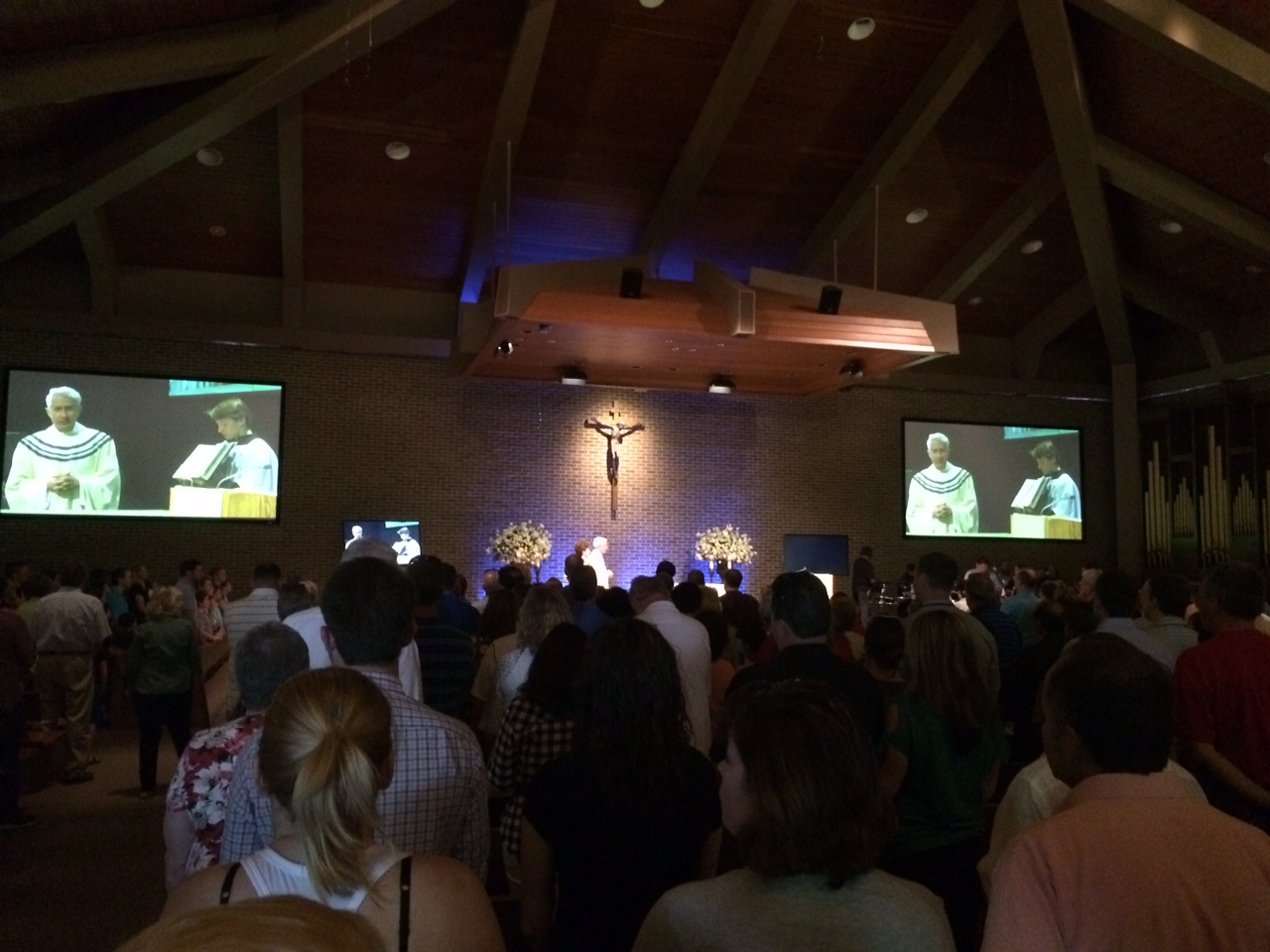
A scene from the Church of the Nativity, Maryland, last month.

A scene from the Church of the Nativity, Maryland, last month.

I can confirm that the Church of the Nativity in Timonium, Maryland, is certainly as interesting as the book Rebuilt would suggest but not a template that could easily be transferred elsewhere. The church itself is a simple, unadorned one storey building with a large car park (perhaps their first achievement!). On the weekend I visited, a small marquee was planted out the front of the building with staff and volunteers sharing information about plans for a large new worship space, including renderings of a new church interior and exterior.

As for the liturgy, the music was contemporary as expected, with the nave of the church darkened to generate atmosphere and the technology savvy. Fr Michael White shared in his homily that the new exterior of the church would be plain, not much different from the glassed, contemporary style of modern airports or public buildings. That is, it will not be an unusual or alienating environment for first time visitor, ‘Timonium Tim’. Passing through a spacious foyer into the newly constructed sanctuary, Timonium Tim will discover he is in an intimate, semi-circular worship space. Tim will discover that he is, in fact, in church.

Such plans for the future manifest the fact that the Church of the Nativity is primarily dedicated to the newcomer while the parish’s commendable focus on small groups is the strategy that is engaged for a consequent deepening of faith in line with Fr Michael’s ‘message’ (i.e. homily) for that particular weekend.

There are many positives to be taken from the parish and the book Rebuilt. While it is too particular a community to serve as a blueprint – which it was never intended to be – it affirms the need of parish vision, creative leadership and commitment over the long term to think and rethink of Church in terms other than mere survival. It is the commitment to evangelise in the wider community that opens up possibilities within the life of the Church. Each community will have to wrestle with its own approach to evangelisation appropriate to context but the vision of growth, welcome and outreach found at Nativity is something that could be embraced by all.

The Archdiocese of Boston

Staff of the Pastoral Planning Office in the Archdiocese of Boston

Staff of the Pastoral Planning Office in the Archdiocese of Boston

For those planning on a diocesan or parish ministry level, you could do no better than sit at the feet of the Archdiocese of Boston which has transformed its life over recent years. The initial focus of the planning commission formed by Cardinal Sean O’Malley was the new evangelisation, understood as “the particular work of reaching out to Catholics who are not currently active in the Church”.

It was recognised that structural change alone would not sustain the life of the archdiocese, let alone grow it. The eventual pastoral plan, Disciples in Mission was decreed by Cardinal Sean after more than one year of development and consultation and is available here. At only eleven pages, it is a thorough and comprehensive guide for an archdiocese with momentum.

Part One of the plan is focused on the organisation of the archdiocese’s 289 parishes, fortifying their resources so they can more effectively evangelise. 289 parishes are to be organised into 135 “collaboratives” over the coming years. In this situation, each parish retains its name, assets, financial responsibilities and canonical independence (so these are not ‘amalgamations’ or extinctive unions), however, a single priest is assigned as parish priest of Parish X, as parish priest of Parish Y, and as parish priest of Parish Z with collaboration of the ministries and staff of the parishes a key priority for this priest. It’s worth noting that even after the completion of Part One of this plan, Boston will still be not as lean as the Archdiocese of Los Angeles which has five times the number of Catholics but the equivalent number of parishes (about 260 in total).

No parishes will be closed as a result of Disciples in Mission and so communities remain available to people as they are now. This enables members of the diocese to focus on what the pastoral plan and evangelisation means and invites for their personal living of the faith, not the structural question which so often dominates contemporary church agendas.

The collaboratives are to be created slowly across the archdiocese, over a period of four years. Boston is currently in Phase 2 of creating collaboratives right across the archdiocese with two more phases to go. Parishes involved are typically given a year’s notice of their collaboration, an announcement which is made following consultation with priests and people, nomination of suitable collaborations that are given to the Cardinal who makes the final decision. Remote preparation, through the reading and reflection of communities of such texts as Rebuilt, Forming Intentional Disciples, and Divine Renovation, has been key in introducing communities to common language, ideas and insights throughout the year prior to the formation of the collaboratives.

Priests are allocated to collaboratives based on their discerned ability to lead such a cluster of parishes and are also expected to form one pastoral team for the communities, a team which is expected to undertake diocesan training in collaboration and evangelisation.

Part Two focuses on strengthening the embrace of this new evangelisation in parishes, by “reenergising pastoral leadership” in parishes, the archdiocese, youth ministry and adult formation. This runs concurrently with the activity of Part One. To achieve a depth of missionary zeal and commitment in the collaboratives, training is made available by three bodies which provide expertise in distinct areas – the Episcopal Vicar for the New Evangelisation who leads the area of evangelisation, the Catholic Leadership Institute (CLI) that provides training in leadership and management skills, and the Pastoral Planning Office which, under Fr Paul Soper, provides unity in the midst of change and coordinates ongoing practical support to help make the collaboratives function and grow.

The archdiocese envisages that the pastoral plans of parishes unfold over a nine year period – one year to write a parish plan centred on the collaboration of disciples, with three years to implement it, a year of prayer and discernment, a further year to write a new or revised plan centred on disciple-making, and another three years to implement this second pastoral plan. This is long term parish planning to accompany the long range approach of the archdiocese.

The parish training provided by the Pastoral Planning Office is being implemented in six stages starting with archdiocesan staff, clergy, then parish pastoral councils, going on to focus on the training of parishes in the art of writing parish plans.

Dedicated to discipleship in the Archdiocese of New York. Dianne Davis and Daniel Fraschella.

Dedicated to discipleship in the Archdiocese of New York. Dianne Davis and Daniel Fraschella.

Gateway moments of conversion (e.g. Masses, baptisms, seasonal peaks, etc.) are discussed in the training sessions, prayer is discussed at length (only praying disciples make disciples) and all parish activities are understood not as programs but processes that develop discipleship over time. It was noted that if a parish gets hung up on just one approach (e.g. small groups), it is likely to lose all sorts of people who will not be attracted to those ways of community or evangelisation. There must be a variety of responses to people in a variety of situations of faith.

Apart from the trainers in parish evangelisation, the archdiocese engages a “consultant model” in its parish support, with each collaborative having a key contact in archdiocesan finance and accounting, human resources, and other services of the archdiocese. It is a strength of the process that all staff, including finance staff, are encouraged to be mission-oriented and speak the same language as staff dedicated to evangelisation in a more formal capacity. This “all in” approach is key to the priests, pastoral councils and parish teams feeling supported in the change agenda of the archdiocese. The CLI also provides mentors for priests in managing change, often consisting of lay persons of expertise.

New friends in the U.S. also include Dave Nodar of Baltimore, the founder of ChristLife, and Dianne Davis, a regional coordinator of this Alpha-type process in New York, both of whom point to the Catechism of the Catholic Church which notes, “The sacred liturgy does not exhaust the entire activity of the Church; it must be preceded by evangelization, faith and conversion” (#1072). Evangelisation must lead us into the future as the foundation on which all else depends.

Conclusion

To learn from others in the field of pastoral planning and evangelisation is a delight. Back here at home, it is an enormously exciting time for the Church also with Archbishop Anthony Fisher OP the ninth archbishop of Sydney, Bishop Peter Comensoli the third bishop of Broken Bay, and the fourth bishop of the Diocese of Parramatta anticipated in coming months.

Together there are great things that the Church can do in partnership with and for Greater Sydney. I believe significant renewal is taking place in metropolitan Sydney with a focus not merely on institutions and structures but on the life and mission of local communities of faith – parishes, youth, and movements – that will form the basis of mission in the twenty-first century.

learning from the Church abroad

image

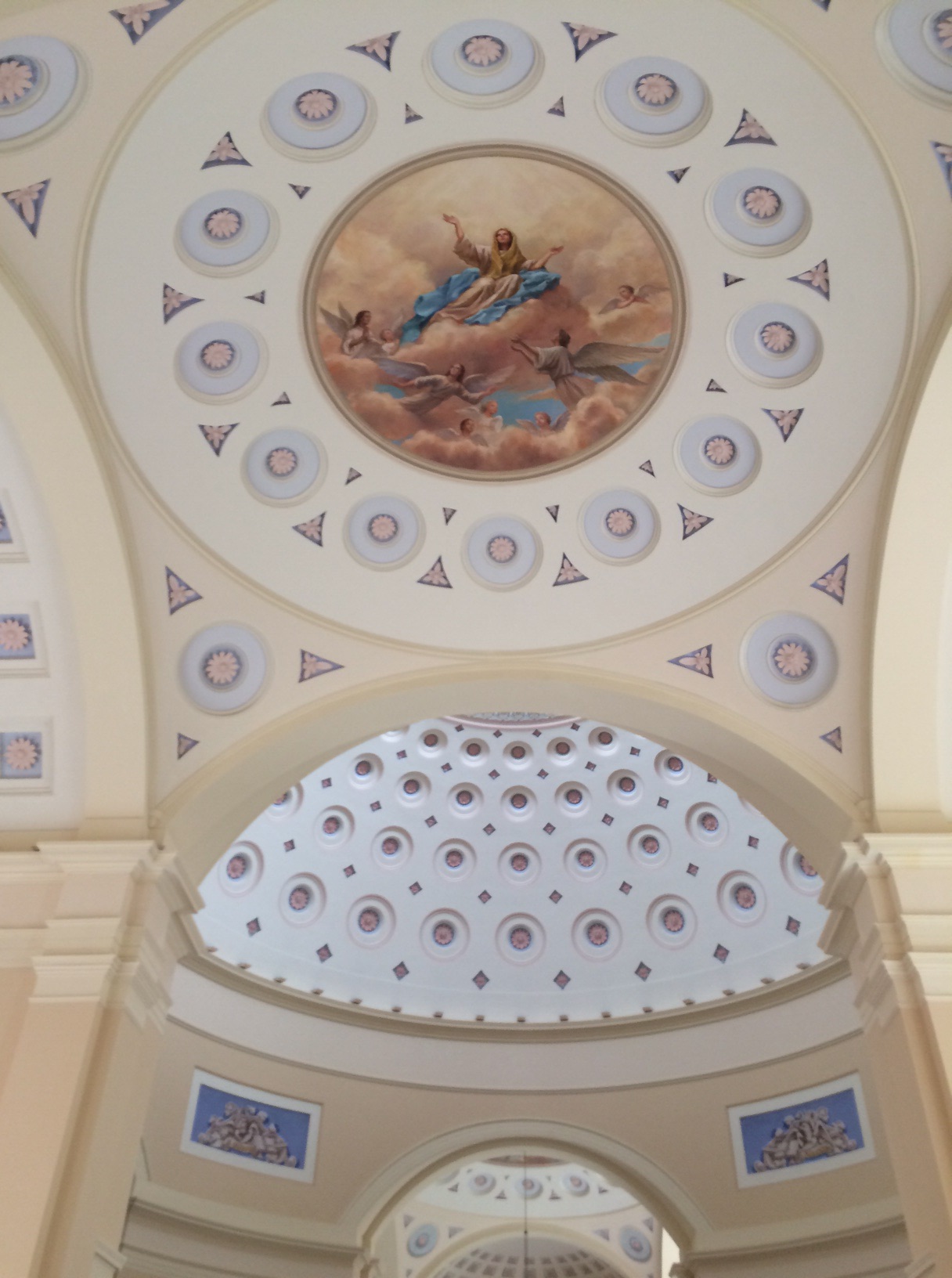
A secondary dome in the Basilica of the National Shrine of the Assumption of the Blessed Virgin Mary, Baltimore, the first Catholic cathedral built in the United States

The past fortnight of a research tour here in the U.S. has provided valuable insight into the life of local churches and the social fabric of America as a nation, a fabric that is complex and strained as I write this blog. Here in Baltimore the sounds of sirens, demonstrations, the cries for justice and social equity can be heard on CNN or directly out my hotel window, as rallies continue two blocks west of my stay.

As I have spoken to local residents, taxi drivers, and even members of the National Guard over these days, the tensions seem symptomatic of a self-destructive alienation of human society from itself, of the insufficiency of social contract which only mediates conflict without addressing its causes, and of forces of dehumanisation (poverty and militarisation among them) that render genuine communion near impossible.

These tensions, saddled between ignorance and fear, cannot be overcome by force, by technological advancement, by politics, not even the economy, least of all what Merton describes as a “bright official confidence” that all will be well. Surely the profound wisdom of the Christian tradition has not simply something to say to this mess we are in (and we are all in it) but also brings a responsibility to act through solidarity with the poor in spirit and circumstance. And yet this wisdom and action seems largely absent or lost among the roar of the crowds and the rattle of tanks.

In conversation with pastoral leaders in the U.S. over this time, and with the expertise of Sherry Weddell and Mary Gautier, I’ve come to better appreciate the similarities and distinctions between the American and Australian contexts that influence approaches to mission, which includes the peace-making and spirit of reconciliation being called upon in this hour.

I have learnt of the urban, rural and regional variations thread throughout the American Church, many sharing constraints in resources and local priestly vocations as at home, and the distinctive and deep religious identity that builds upon the story of America’s foundation but that threatens to remain a legacy of the past without a renewed mission of evangelisation.

As settlements of religious asylum and religious freedom, states such as Maryland, Philadelphia and New England are indelibly marked by their spiritual origins and aspiration, whether they be Catholic, Puritan or otherwise. These origins have seen religion intertwined with American culture, government, and daily life and religious belonging maintain a civic respectability in the wider community to a degree not at all experienced in the Australian context. The waves of religious revival in the U.S., the five Great Awakenings for instance or the upsurge of evangelicalism and Pentecostalism, are not our own story. As Chris McGillion reminds us,

Australia was always more a country of Christians than a Christian country. European settlement was not motivated by some noble cause, far less by any notion that it was part of God’s grand design. There is no foundational myth for Australia, let alone a religious one, no equivalent of America’s Pilgrim Fathers (McGillion, “O Ye of Little Faith”, Sydney Morning Herald, 11 April, 1998).

However, like Australia, the Church in the U.S. confronts the necessity of not merely renewal but reform and this places varied demands on leadership. In listening to conversations I sense that when a diocese is in strife (e.g. the Archdiocese of Boston following the sexual abuse crisis), church leadership is able to impose or set out with a firm vision and priorities as this provides direction and confidence in a time when both are lacking. The community is then left with enough wiggle room to live out the set vision and apply it to local circumstances.

When a diocese is in good or better shape, however, I sense that church leadership can more easily invite the community to join in the discernment of the future vision and priorities, a process which is more time-consuming but better at fostering genuine ecclesial integration around missionary goals. Take Bishop Caggiano’s lead in the Diocese of Bridgeport, Connecticut, for instance, a bishop who clearly has his eyes on the detail, is patiently engaging in an 18-month discernment process with his new flock, and deeply appreciative of the value of pastoral planning to build ownership and invite lay involvement following his tenure as bishop of Brooklyn. The situation in which the local church finds itself – the urgency of issues, history of the church, and culture of its people – ideally will impact upon the style and processes of change that are engaged.

For a variety of reasons, but almost always including financial limitations, I have learned that many pastoral planning roles in U.S. dioceses have been shed in the past decade, planning offices have been closed or otherwise devolved into part-time planning responsibilities among existing staff.

image

Planning staff from the dioceses of Bridgeport and Brooklyn at the Conference for Pastoral Planning and Council Development in April 2015

Notably though, and this is critical to recognise, the demise of local, diocesan planning resources and wisdom has not at all lessened the demand for what good planning offers but in many cases shifted the work and expertise from internal staff to external consultants who are engaged at significant cost and, I contend, can struggle to embed their plans within a proper theological framework and the local context in which they are working. From experience I would suggest that some in authority in the Australian scene would hesitate to engage outside consultants in this way for fear of what Pope Benedict XVI described as the ‘bureaucratisation of pastoral care’, particularly if planning is engaged merely as a way of managing scarcity rather than advancing mission and cultivating conversations about discipleship.

These trends in the U.S. pose questions to the Australian Church in regards to its commitment to building up its local planning expertise and resources as the challenge of change is ongoing and the need of unified pastoral outreach more urgent. The alternative to consultative, locally developed and communally owned processes of change and evangelisation, we know, is unilateral decision-making, a tinkering with structures with little impact on personal, spiritual growth, and a reliance on personalities rather than principles in decisions that effect entire communities of faith.

Very briefly, the pressing issues that I have gleaned from local dioceses here so far remain the shortage of priestly vocations (with responses varying from reliance on international priests, the practice of communion services, or exploring canonical options for pastoral leadership i.e. CCC #517.2), the growing migrant profile and strength of the Church (take the Diocese of Galveston-Houston which is becoming increasingly Hispanic in demographic and whose clergy includes more than half who were born outside of the U.S.), and the challenging necessity of greater shared responsibility and the implications of this for the ordained and laity.

Most change in the number and size of parishes is taking place in the north east of the country, where I am heading in the next two weeks, and the size of these communities certainly impacts on organisational complexity as more mega- or multi-parishes arise (these parishes are taken to consist generally of more than 10,000 registered parishioners).

Larger parishes demand well-honed administration or relational skills, operating budgets between $USD850,000 to $1.6 million and above, often include multiple, full-time paid staff, the priest having to act increasingly as an employer with related responsibilities, the hosting of multiple programs, consultation processes that are generally more formal, with complex decision-making and even formal, written policies of their own. Of course, it can be harder to build a sense of community in larger parishes, especially when small groups outside of liturgy are not nurtured or encouraged.

In contrast, smaller parishes can conduct informal consultation of key parishioners and families, engage fewer and part-time paid staff with a greater reliance on volunteers, and there are usually informal, unwritten operating norms. Without understanding these different variables of parish life, pastoral planners and diocesan leaders in evangelisation can seek to engage very different communities with rather generic activities or proposals that will not generate fruit without respect of their actual life.

I look forward to sharing the insights gathered here more systematically and moving from general observations to specific practices in future blogs as I prepare a report for sharing with dioceses in the Sydney region. This will include reflections on the Church of the Nativity at Timonium, in north Baltimore, the subject of the book Rebuilt, where I attended Mass this weekend.

On a more personal note, I also spent some days at Gethsemane Abbey in Louisville, Kentucky, a part of the U.S. where the Catholic Church established itself soon after Baltimore (which is the premier episcopal see of the American Church). After visiting the repository of Merton’s manuscripts, letters, journals, tapes, drawings, photographs, and memorabilia at Bellarmine University (and shaping a potential PhD question), the grounds and life of the Cistercian monastery brought the focus back to the heart of our faith which is Christ living within us.

I’ll simply conclude with this thought. When you get what you want – a diverse Church sharing responsibility for ministry and mission, engaging with the issues of the day with evangelical zeal, moving from what Pope Francis called this past night ‘a superficial and dry religiosity’ to a living house of prayer and deep discipleship – the Church becomes infinitely more complex. We should not be afraid or wearied by this prospective complexity but receive it as the gift of a stronger and more faithful future, calmly accepting the fact that renewal is always bought at the price of risk.

the parish leadership challenge

Ministry 1Last week I participated in a conversation on ‘tomorrow’s Church’ alongside a biblical scholar, with some 150 people gathered.

I shared that I expect the parish to remain the primary experience of Church for Australian Catholics but that this basic community will require conversion and ongoing development if it is to be something other than a testament to times past.

The parish is a privileged place where the living mystery and mission of Christ is encountered in Word and sacrament. It is the very ‘face’ of our Church and is called to manifest the grace and vocation proper to the Church – the mission of evangelisation (Evangelii Nuntiandi 14).

However, drawing on French Dominican Étienne Hugueny (1868-1942), I suggested that the possibility of personal transformation in our parishes is not the same thing as the frequency of its happening. We are called to constantly grow as persons and communities, in holiness and charity, in number and involvement, in personal commitment and public presence as disciples ‘in the midst of the Church for the sake of the world’ (Weddell, Forming Intentional Disciples).

Our parishes are filled with good people, dedicated people to God and one another. This includes our ordained priests who form and govern the priestly people, building up the baptismal and Eucharistic unity of the Church through a ministry of grace, teaching and pastoral government. Our parishes depend also on our lay men and women, who are called to be spiritually-well formed, steeped in prayer, witnesses to the self-emptying of Lent and the generous joy of Easter.

The future of our communities depends on an ongoing deepening of this common life, on an ability to preference growth over stability, an ability to recognise that ‘evangelising parishes’ is not one and the same thing as ‘parishes without problems’, and the recognition that there is no universal call to complacency or settlement but a universal call to holiness, a holiness and striving that is always going to take us further than we are accustomed to or comfortable to go.

All of this was a way of saying that our mission in the world as Church, as fishers of men and women, is dependent on the mending of our own nets and this mending must start with the local parish as a community of disciples on pilgrimage to God.

The Task of Parish Leadership

Liturgy 6The Church of tomorrow, I insisted, also calls for parish leadership that on the level of mercy encompasses, invites and consoles each and all, sharing that same mercy given to us as gift in the covenantal relationship between Christ and the Church (the Church is merciful because the Church itself is the object of God’s mercy, redeemed by Jesus Christ).

However, in forging new paths we also require leadership that does not capitulate to the timidity of a ‘convoy routine’ where all travel at the speed of the slowest ship. As leaders we must actively seek out, desire and co-create opportunities for grace which acts not above or behind human history but through flesh-and-blood disciples, through human agency, decision and commitment, even planning.

As I’ve further reflected on last week’s conversation about ‘tomorrow’s Church’, another key to the reform of our parishes has come to mind – the need for us to develop an attentiveness to the dynamics that may be surreptitiously undoing, or at least frustrating, the mission we have been given.

As an example, I’ll focus on our parish engagement of those Catholics who are at the margins of faith or ecclesial life. This refers to the large majority of occasional or non-attenders who are the subject of many a water cooler conversation in our local parishes (at least I hope they are!).

It is important to acknowledge that at times the motivation for less committed Catholics to engage with our Church or parishes is extrinsic; that is, their contact with us is not yet motivated necessarily by an inner drive, an interior desire to explore, learn or find personal or social fulfilment for instance. Often the stimulus for people’s contact with our parish communities is external, focused on an outcome which is separate from the religious act itself. For example, it could include participation in sacramental preparation for the purpose of meeting admission criteria for Catholic schools or to maintain family custom rather than to live faith, attendance at youth groups motivated by parental encouragement alone, or involvement in ministry as a means of offsetting the more ‘boring’ bits of Mass (it can happen!).

What makes this hollow dynamic more entrenched in some parish cultures is that in seeking to respond to those on the margins we can actively feed this extrinsicism by attempting to engage people in the life of faith and the life of our communities by giving them jobs.

Have a young person you want to hold on to? Invite them to a ministry because we tell ourselves that what young people really want, above all, is to ‘do things’. Have a newcomer or neophyte you want to retain? Involve them in ministry as well. Have someone who is restless in the pews, weighing up their commitment or even on the way out? Give them a ministry too, an upcoming event, something to do or an activity in which to get involved.

Jesus Christ 2It doesn’t even matter if those ‘involvements’ involve a formative dimension or not, nor whether they encourage a ‘dropping of their nets’ as Sherry Weddell has emphasised as a necessary step toward discipleship. At least these people might still be with us next weekend. Well, sort of.

Rarely do we attempt to address the issue of discipleship, of that deep interior conversion of individuals that happens to call forth a community that forms and apprentices people in that Christ-embracing life. Just like those on the margins of faith, we as ‘insiders’ can get caught on the extrinsic, frenetic borders of what Merton describes as a ‘mass-movement’, a religious collectivity that is but a parody of the Catholic communion of discipled persons we ought to desire:

A mass-movement always places the ‘cause’ above the individual person, and sacrifices the person to the interests of the movement. Thus it empties the person of all that is his own, takes him out of himself, casts him in a mould which endows him with the ideas and aspirations of the group rather than his own . . . The individual ceases to be a person and becomes simply a ‘member,’ a ‘thing’ which serves a cause, not by thinking and willing, but by being pushed around like a billiard ball, in accordance with the interests of the cause (Merton, Disputed Questions, 132-133).

What separates a ‘mass movement’ from a spiritual communion is a concern and a challenge for persons, each of whom is called to be a disciple and find their vocation by walking a unique path of holiness.

However, we do not address this interior life of persons so well, that intrinsic fire of discipleship that sees people do such things as attend Mass, to give, to live and to desire to live a life of faith in the midst of the Church and world. We are not always focused on cultivating and supporting this personal relationship with Jesus Christ and can distracted by what we think will ‘work’ to strengthen extrinsic or nominal membership, despite all the evidence to suggest that we do not do that either!

We can be especially lackadaisical in responding to the discipleship of adults which is the great challenge for our Catholic Church as we in Australia watch 13,000 people walk out the parish door each year (Dixon, Reid and Chee, Mass Attendance in Australia: A Critical Moment, 4).

Renewing Our Pastoral Vision

In a recent article posted online, an American commentator, Jennifer Fitz, throws light on the need for renewed vision among parish leaders by pointing to our catechesis of children as an instance that betrays a narrow but customary view of discipleship-making in our parishes. Fitz draws on the ‘orphanage’ as an analogy to critique our parishes, which, she suggests, tend to treat symptoms rather than address causal factors:

In the helping professions, there’s a tendency to want to sweep in and “rescue” children by making them wards of an institution.  We look at the saintly orphanage workers in certain impoverished countries, and forget that the ‘orphans’ aren’t orphans — they have living family members who would take care of them if only they could.  The solution to the ‘orphan crisis’ in such situations isn’t to build bigger, better orphanages, but to work towards economic, political, and social reforms that will make it possible for families to raise their own children.

Proclaim 3Fitz then comes to her point, ‘In our parishes, we have just such an orphan crisis’. Unlike good institutions, we fail to address or else avoid the larger and critical issue which is the faith formation of parents, parents who are, as the refrain goes, the primary educators of children in the ways of faith (Lumen Gentium 11).

Instead, we just work harder on the existing ‘program’ with a cadre of ‘spiritual orphan workers’. We grow and fill our catechetical and sacramental processes with add-ons and trimmings in order to ‘engage’ – tasks for the parents, family-focused events, gratifying and non-confrontational activities – but without address of the elephant in the room, the ability or otherwise of parents to form these children themselves.

Indeed, Fitz notes our actual parish practice gives light to the fact that for many, ‘it becomes inconceivable to imagine the existence of parents who are capable of instructing their children in the faith . . . The norm is to assume that Catholic parents simply cannot be trusted to teach their children the Catholic faith. If you spend much time around Catholics, you know this fear has its basis in sordid reality . . . Since the parents are unable to teach, we’ll teach for them’ (my emphasis).

We widely accept this norm as parishes, and therefore substitute a domestic responsibility with an institutional ‘solution’ which has revealed itself to not really be a solution at all. Fitz concludes, “When you monkey around with Church teaching, bad things happen. We’ve identified a problem — kids whose parents aren’t disciples — and we’re so busy ‘solving’ the crisis by heroically stepping in to replace the parents, that we’ve overlooked a small detail: Doing so is contrary to the Catholic faith’. This is strong tonic for our parishes today and certainly challenged me to widen or deepen my view of the heart of our pastoral ministry.

From ‘Orphanage’ to Ownership

In setting out the scene above, I am very conscious that many sacramental processes in Australian parishes do in fact work very hard and seek to address the faith of parents in the preparation process of their children, including parent-only sessions which are an opportunity for catechesis or, more commonly, for rudimentary evangelisation. This takes place not only in the Parramatta Diocese but also in the Archdiocese of Sydney and in the Broken Bay Diocese.

However, I think our approach is always called to deepen and widen, and ideally we would work towards a whole-of-parish commitment to address adult formation for adult discipleship. As Jane Regan, an impressive writer on the adult Church in Boston, shares, ‘Jesus welcomed the children but taught the adults, and the church has been doing just the opposite for years’ (Regan, Forming a Community of Faith, 2).

prayerA good parish, sacramental process, or parish ministry will seek to lift and support people, not only children but adults as well, to grow in faith and discipleship above and beyond what their religious background might have equipped them for. It will enable parents to claim what is their unique calling and not substitute for it as yet another ‘outsource’ for domestic responsibilities.

As noted in a previous blog, consider what a good school enables when focused on the growth of student performance (we won’t get into the meaning of a holistic Catholic education right now…). We know that a lack of academic opportunity is transmitted from generation to generation and, as such, students from lower socio-economic backgrounds often do not perform as well as they could. However, some education systems (e.g. Shanghai and Korea but sadly not Australia) are able to lift students well beyond their statistical likelihood of poor academic performance, enabling these students to perform and excel at their full potential. In this context, good teachers make a tremendous difference.

In a similar way, we know that ignorance of the faith is transmitted from generation to generation, and that many of our people start their journey in the Church ‘disadvantaged’ by low religious literacy and low or no commitment to practice, including little enthusiasm for evangelisation. We know that the aim of good parishes is to make a difference, not simply provide a sort of spiritual welfare service, but to be a ‘circuit breaker’ in the story of low religious literacy, practice and understanding of faith that marks many of our disconnected and loosely-affiliated families and individuals.

We are not talking about revolution in our parishes, sacramental processes and catechesis but we do need to look again at our focus from time-to-time as parishes, leaders and communities, to ensure we are set on the mission of evangelisation not a routine of maintenance and that we provide for the formation and empowerment of parents. We cannot afford to discharge parents of their primary responsibilities by maintaining a religious system devoted to expanding the ‘orphanage’.

Rather, we must attend to reforming our parish vision and practice of ministry and mission so that our communities of faith empower and support parents to raise their own children, to nourish inner belonging not extrinsic membership, and so translate compulsive compliance into a genuine desire to share in the life and mission of our evangelising Church.

on holiness and growth

DSC_0137

(c) Catholic Diocese of Parramatta

Over the summer I was able to skim across a number of themes, from Church governance, to the theology and sociology of discipleship, and a powerful book on the concepts of mission (by Francis Anekwe Oborji). There was also a Lenten campaign to coordinate, all of which returned focus to the parish as a central yardstick of our spiritual life as a communion.

As absorbing as ecclesiology is as a theme of Catholic theology, offering us the ability to look at the Church from this point of view or that, it is the flesh-and-blood reality of the parish that grounds us in the essence of what the Church is in fact, a pilgrim community seeking to develop its baptismal and eucharistic unity not simply for its own sake but for the good of the world. To the extent that the local parish gives witness to and really lives as a tangible sign and the reality of God’s grace alive in the world, the more compelling and missionary it will be in and for that world.

Certainly, some of the signs don’t look as good as we would like – participation wavers, local issues can encourage inwardness, spiritual development can stall, amateurism can prevail, and energy can wane.

Rigorous self-assessment by local communities is a healthy exercise for we are not seeking to build a sort of ‘Potemkin village’, an ecclesial superstructure of show and spiritual pretence, but asking quite seriously how we might deepen our conversion and deepen it together for the sake of a mission we have been given. This is our task. We are forbidden by the Gospel to take a ‘steady as she sinks’ approach to parish life. We want to see what Christ calls us to see and to actively move in that direction.

Liturgy 2To see properly, however, means purifying our vision as Catholic communities. For those in positions of ecclesial leadership, a basic thing to say is that a missionary viewpoint does not consist of imagining ‘parishes without problems’. This can, I sense, be a temptation on account of the tyranny of the urgent, competing concerns and the subtle routinisation and flattening of communal life that results in what Francis calls ‘pastoral acedia’ (Evangelii Gaudium 82). We can settle for tranquillity and cosiness in our communities, a dull serenity that contrasts with the dictum of Blessed John Henry Newman, ‘holiness rather than peace’.

If our vision as leaders is limited to parishes or faith communities without problems, then it is not surprising that our groups and members slip into a managerial or administrative mindset. As Pope Francis has repeatedly conveyed, the mission of Christ into which we have been grafted is not at all synonymous with tidiness, let alone comfort:

I prefer a church which is bruised, hurting and dirty because it has been out on the streets, rather than a church which is unhealthy from being confined and from clinging to its own security.  I do not want a church concerned with being at the centre and then ends up by being caught up in a web of obsessions and procedures.

We need good structures and procedures as it is naïve and even dangerous to think we could live without them in some sort of casual huddle of believers, sharing life as if by chance. However, we do need to think creatively about how these structures of our communities intersect and support real, personal and ecclesial discipleship and the mission into which that identity eventually unfolds.

In the case of parishes, there are some noticeable structural reasons that we do not often ‘go out’ with genuine missionary zeal, and one reason is well articulated by Sherry Weddell of Forming Intentional Disciples, with relevance to the Australia milieu.

Sherry points out that a key factor in the growth or otherwise of Christian community is scale, with ‘smaller’ groups providing a fertile environment in which personal discipleship can develop, flourish and be sustained. However, the reality for our Catholic parishes can work against this potential:

This strategy of founding hundreds of thousands of small evangelising communities is key to evangelical/Pentecostal growth in Latin America and throughout the global south . . . While in the U.S., Catholics are doing the opposite – largely because of the relative shortage of priest compared to our gigantic Catholic population. Our parishes are getting ever bigger as one priest become responsible for thousands of people in multiple linked or clustered parishes who are already “parish-connected”. Which means our parishes become more and more centripetal, and focused upon the people who are or will be willing and able to make the journey to us. You literally can’t go out as long as you are besieged at HQ.

Proclaim 3So as previous blogs have noted, the recovery of small groups – which I propose is entirely possible even within our now larger parishes and communities – is critical to mission. To be disciples of ‘encounter’, ‘accompaniment’ and ‘mercy’ on the streets, as Pope Francis suggests, requires disciples who have had some opportunity, at some time, to discern the divine initiative and action in their individual human lives. It insists on some forum in which Catholics can share their inner life and wonder, like the Spirit-filled individuals of the Upper Room, at the work of God in their midst.

This need of structures of intimate support amidst the ecclesial calls for the recognition that the weekend liturgy cannot suffice alone in promoting spiritual growth and missionary outreach, and that parishes can do something about this – whether it be creating opportunities for spiritual direction, faith-sharing, catechesis, for the discernment of individual gifts, and openness to the influence of other witnesses to faith and mission including ecclesial movements, religious communities, associations and other groups that offer diverse charisms and often overlooked dimensions of Christian living to the memory of the local Eucharistic community.

To be sure, this may all cause some ‘problems’ and messiness in parishes if ‘problems’ and ‘mess’ are understood as something other than the status quo. However, without such catholicity and creativity of vision and structure, communities may never realise their full potential as centres of grace and formation where we can learn to enter ever more deeply into the life of charity and to engage the world as it really is in Him.

The fostering of such missionary discipleship is not an abstraction but a concrete task and call for communities to pursue a way that life that enables ‘holiness rather than peace’ and growth which Newman will claim is ‘the only evidence of life’. But we must pursue it and actively seek out a new way of life, for without that desire in us not much is possible such is God’s generous reliance on us.

making all things new

photoWe have arrived at the final days of the working year and there is much to give thanks for. Back in February, Faith in Our Future: Pastoral Plan for the Catholic Diocese of Parramatta was launched after two years of preparation and consultation. The months that followed have been dedicated to seeing through the implementation of initiatives in the diocese as well as offering support to parishes and a variety of groups to engage the plan as a vehicle to grow in identity and mission.

For me, planning for mission has never been a desperate attempt of the Church to pull itself out of an abyss; it is an expression of faith in God that there is more offered to us, more possibilities for growth in grace than we have yet to receive, discern and bring to life in our time. It is a way of listening and responding to the future that God really wants to bring about in our contemporary culture and actively walking towards that horizon, rather than remaining content to bemoan the setting of the sun.

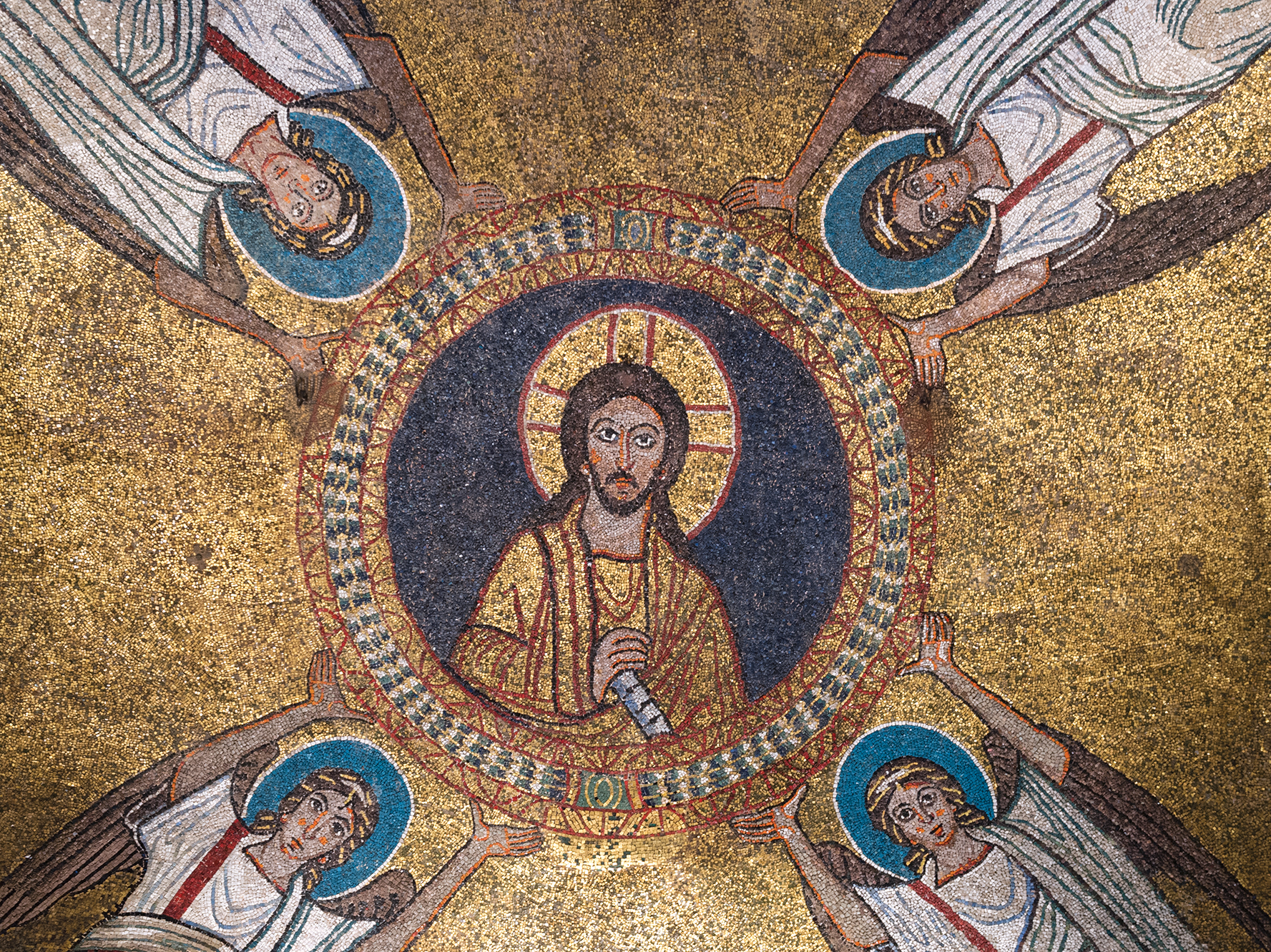
st-praxedes-ceiling-of-st-zeno-chapelThis year has exceeded my expectations because there has been a sincere and common commitment to undertake the journey of renewal in the diocese. This commitment has been genuine and determined at all levels. All of us are asking the hard questions about parish life in the light of their challenges and to consider new ways of living this perennial mission we have received. If nothing else, the vision and direction of the plan has given people permission and the courage to reform their pastoral life, to make change in order to remain faithful.

Of course, in bringing forth the new or unfamiliar in the Church, there will always be elements of inertia, sometimes fuelled by pride or inflexibility. Sometimes change is resisted due to weariness, other times by a pessimism or low morale that obscures hope. However, even where such reticence exists, the experience of decline as Church or the lull in vocation among some eventually discloses the hidden, divine situation that lies in wait. The experience of diminishment can reveal what as individuals and communities we have taken for granted – whether that is the presumed sufficiency of our current pastoral practice or the depth of our vision – and also what we have overlooked, the capacity of our people for discipleship, for going beyond mere religious conformism and entering into a real, genuine and evangelical faith.

As Antonin-Gilbert Sertillanges OP shares, in the spirit of the ressourcement, there is nothing contradictory about the interruption of the new and continuity in the life of the Church,

It is a rather widespread error, but an error all the same, to believe that continuity and transcendence are opposed to each other, as if in the analysis of a single phenomenon the one were exclusive of the other. The truth is that continuity and transcendence . . . do not impede each other in any way. A ray of sun that strikes water does not prevent it from running, and the current does not prevent the shining of the sun.

Most times the waters of the Church do carry the light of the sun. Other times, the waters can become sullied and the plenitude of the Gospel light is obscured or hidden from sight. The Church is never beyond reform or conversion and ‘the new evangelisation’, first of all and ultimately, is a call to enter more deeply into the life of God, and to bring all of creation, culture and the pilgrim Church with us.

© Diocese of Parramatta 2012

© Diocese of Parramatta 2012

When looking for signs of change and conversion, a shift in language can be a sign of a shifting ecclesial culture. When people and parishes talk about things they have not traditionally spoken about, ask questions when groups or ministries no longer grow and also when they bear unexpected fruit, when communities not only talk about mission, lay formation or evangelisation but actually do something about it or make room for the new, when parishes know with conviction that they do not have to fall into a sense of resignation, low morale or nostalgia for a time past, when parishes give up obsessing about the many red herrings in Catholic discourse and focus on worship, mission and disciple-making, you know that a Church is not merely moving but is being moved. He is making all things new (Rev. 21:5).

Looking beyond the border, this year also saw the privilege of offering formation at the Good Shepherd Seminary in Sydney (February), in the Archdiocese of Melbourne and in Townsville (March), at a Catholic Mission colloquium on Pope Francis (April), a clergy conference at Bathurst (April), at Australian Catholic University with chaplains, and with the priests and deacons of the Melkite Catholic Church (June). Then there were addresses to the ACBC Commission on Church Ministry, at an Augustinian chapter at Dee Why (July), at the Catholic Digital Media Conference in North Sydney and at the Proclaim Conference (August).

Next year brings a research trip to the U.S. where I’ll be attending the Conference for Pastoral Planning and Council Development in San Antonio, Texas, followed by meetings with the archdioceses of Louisville, Kentucky (with a few days retreat at the Abbey of Gethsemane, the spiritual home of Thomas Merton, in the 100th anniversary year of his birth), the archdiocese of Baltimore, time at CARA in Washington, a premiere Catholic research body, then meetings with the directors and staff behind the significant planning projects currently unfolding in the archdioceses of Boston and New York.

© Diocese of Parramatta 2014

© Diocese of Parramatta 2014

Closer to home 2015 will see our team offer diocesan formation events for parish pastoral councils, an initiative that recognises that parish pastoral councils best plan for the future with a shared sense of Church and mission, additional parish-based resources similar to Welcome and Evangelise (3MB) released this year, pilot programs of Catholic Alpha at both ends of the diocese, and Lenten resources which have just been prepared to aid the ongoing spiritual renewal of the Diocese. So, much to look forward to even as we look back on the year that was.

Thank you for being a reader and every blessing on you and your loved ones this Advent and Christmas. I’ll be back online in February 2015 and look forward to sharing some learnings and travels with you in the New Year. With every good wish, Daniel.

synod on the family 2014

synod2The Extraordinary Synod on the Family concluded over the weekend in Rome (5-19 October, 2014), bookended by the beatification of Pope Paul VI. It proved to be an eventful, even enthralling journey for the Church, two weeks of discussion, passionate debate and prayerful discernment about the way in which the Church can best bring the Gospel to bear on the lives of millions of families as diverse as they are complex.

Given the multidimensions of family life, the issues canvassed by the bishops and participants were also broad. They included the plight of refugees, the care of children with special needs, the situation of migrant workers and the unemployed, the impact of the internet on family bonds, and then there were the distinctive concerns of African bishops whose concerns differ in striking ways from those in the affluent West (e.g. the practice of polygamy and conditions of extreme poverty).

However, and perhaps inevitably, the focus of media and popular attention ultimately fell on two specific matters: the question of Eucharist for the divorced and remarried, and the Church’s pastoral response to homosexual persons.

Controversies of the Synod

synod3As the first synod of bishops to meet under the leadership of Pope Francis, and affirming as it did many diverse views on the way in which Catholic faith speaks to human lives, the synod attracted not only generous media coverage for a Catholic get-together but wide-ranging interpretations of what was said, by whom and for what intent.

Of course, the synod discussions were pre-empted and almost overshadowed by Cardinal Kasper of Germany who in February 2014 advocated for access to communion for Catholics who have divorced and remarried. This was followed by a strong critique of his position by several other cardinals, including in the book-length reply, The Gospel of the Family, which contained a foreword by our own Australian prelate Cardinal Pell (the text of the Cardinal’s introduction is available here).

(For those interested in the pre-history of the synod, preparations began in earnest in November 2013, with a survey distributed by national bishops’ conferences to glean the opinions of Catholics on a number of Church teachings. The survey was a commendable initiative and expressed a sincere desire to be consultative though it clearly suffered from limitations, including the formulation of the questions which could be difficult for the Catholic in the street to say the least e.g. ‘How is the theory and practice of natural law in the union between man and woman challenged in light of the formation of a family?’ This survey was followed in June 2014 by the lineamenta or preparatory document for the Synod which presented the results of the November consultation and set a platform for the synod discussions to begin in earnest).

midtermreportAs the synod officially got underway this month, one of the major causes of controversy was the mid-term or post-discussion report known as the relatio post disceptationem. This was intended as a provisional snapshot of the views of the bishops thus far. However, many bishops objected to the content of this summary, noting that it was not only insufficiently grounded in Scripture and Catholic tradition but that it seemed to present the views of one or two particular bishops as the consensus of the whole assembly, which they were not.

The most strident and vocal objector to this interim report was the American cardinal Raymond Burke who argued, ‘[this document], in fact, advances positions which many Synod Fathers do not accept and, I would say, as faithful shepherds of the flock cannot accept’. Controversially, the interim report had included praise for the ‘positive aspects’ of what the Church has long considered ‘irregular’ situations, including civil unions and cohabitation, and even spoke of ‘accepting and valuing’ people of homosexual orientation  (though with the notable disclaimer ‘without compromising Catholic doctrine on the family and matrimony’).

Criticism was particularly focused on the General Secretariat of the Synod which handled the information flowing out of the bishops’ discussion, with accusations that its members, including Cardinal Baldisseri, had manipulated, or at the very least swayed considerably, the content of the relatio to reflect a personal and permissive agenda.

Interpretations of the Synod

synod4As is customary, and was the case following the Second Vatican Council (1962-1965), the major media outlets interpreted the discussions and debates of the bishops through a political lens, with reports of ‘conservative’ and ‘liberal’ camps pitted one against the other (of course, Pope Francis was read as ensconced within the latter and undermined by the former, taken to be the majority).

Without denying the political nature of all human discourse, including the ordinary desire to influence outcomes and press one’s case, the heart of a synod is not the political motivations that underlie the bishops’ views but the theological arguments that are raised in accounting for those positions. Of course, the media is generally not interested in actual arguments, only assertions, and for the most part lack a theological background or concern.

In cherry-picking lines from the disputed interim report we have mentioned, as well as Pope Francis’ powerful concluding address to the Synod Fathers, the Daily Mail and even the BBC were able to run histrionic headlines such as “Massive Vatican shift on gay sex” and “Pope Francis set back on gay policy”.

The BBC coverage focused on Francis’ critique of ‘hostile inflexibility’ among so-called traditionalists and intellectuals, and implied that these adversarial forces had undermined or ‘setback’ the Pope’s more ‘progressive’ agenda on homosexuals and the remarried. Conspicuously, the report made no mention whatsoever of the pontiff’s critique in the self-same address of those who have ‘come down from the cross’ to ‘bow down to a worldly spirit instead of purifying it and bending it to the Spirit of God’ (you can read the complete address here).

More locally, broadcasters tapped into the local response to the synod, including SBS which while perpetuating the BBC caricature of a Pope Francis opposed by backward bishops, at least tried to seek out a Catholic view of things.

sbsIn my fifteen seconds in the spotlight, I shared the view that the synod represents a healthy and vital discussion for the global Catholic Church and that the Catholic bishops are mindful of the lived situations of people from across the world and mindful also of what the Gospel can bring to those contexts. I tried to underscore that the range of issues being discussed by the synod as they relate to the family were broad and that the synod represents the Church’s ongoing and sincere discernment of how best to accompany people in their life journeys, including divorcees, the civilly remarried, single parents, and gays and lesbians to whom the Gospel also speaks. (Other voices in the report included Paul Collins who can always be relied upon to express more than a healthy scepticism about Church matters).

Discernment is Not Division

The key to an interpretation of the synod and its events is given to us, I think, in Pope Francis’ closing address to the Synod Fathers which is a profound and striking statement (you can read it here). He provides us with ‘the eyes of faith’ to continue talking about these issues with confidence.

Firstly, Pope Francis is not at all unnerved by the differing views expressed in the preceding fortnight and accepts the rigorous debates in faith as an expression of the Church discerning how to enter ever more deeply into the heart of the Gospel by the sensus fidei, the sense of faith of the faithful. As he shared,

Many commentators . . . have imagined they see a disputatious Church where one part is against the other, doubting even the Holy Spirit, the true promoter and guarantor of the unity and harmony of the Church – the Holy Spirit who throughout history has always guided the barque, through her ministers, even when the sea was rough and choppy, and the ministers unfaithful and sinners.

9954008What Francis is affirming by valuing debate over the silence of ‘a false and quietist peace’ is the capacity of the Church to receive God’s revelation faithfully and meaningfully by attending, together as people of faith in the Spirit, to tradition, including the teachings of the Magisterium, and the experience of Christian families in the world (I have written about the Church’s discernment of the Spirit here, in relation to the 2013 papal conclave).

To teach and evangelise the Church must first listen, receive time and again the deposit of faith which constitutes our living tradition and attend to the complex realities of contemporary family life which too can be a source of theological knowing.

The guarantor of the Church’s ongoing faithfulness to Christ in this multidimensional process is the Holy Spirit, as Vatican II’s Lumen Gentium affirms and which Pope Francis cited in as many words,

The universal body of the faithful who have received the anointing of the holy one cannot err in matters of belief. It displays this particular quality through a supernatural sense of the faith in the whole people when ‘from the bishops to the last of the faithful laity’, it expresses the consent of all in matters of faith and morals (Lumen Gentium 12).

This discernment of the sensus fidei, a sense of the faith and the Church’s sense for the faith, should not be a ‘source of confusion and discord’, as Francis remarked in his address, but should be entered into with confidence, trust and utmost faith in the Holy Spirit’s capacity, through diverse and even imperfect people (like you and me) to lead God’s people to the truth and mercy of God (you can read more about this connection between the deepening of tradition and the divine assistance of the Holy Spirit in Dei Verbum 8 as well as the Catechism of the Catholic Church n.892).

As well, in the process of spiritual discernment that will continue until the General Synod on the family in 2015, Francis warns of temptations or polarities. The first temptation is to be fossilised in our faith, exhibiting a ‘hostile inflexibility’ which would in fact impede the ability of the Church to bring the Gospel to new and developing circumstances. This kind of fundamentalism or rigorism can manifest a lack of faith and trust in the Spirit that guides the Church (the Marian dogmas of the 19th and 20th centuries standout as instances in which the Church has developed a deeper appreciation of her own faith). ‘Traditionalism’ is in fact not traditional at all for the pilgrim Catholic Church understands development as a perennial and necessary deepening of her self-understanding in light of the Gospel, and never a departure from it (“Lord, to whom can we go? You have the words of eternal life”; John 6:68)

Christ Mosaic Cefalu Sicily 12th CenturyThe other risk named by Francis, the one that media outlets were less enthusiastic to report, was the capitulation or accommodation of the Church, and the Gospel it bears, to ‘a worldly spirit instead of purifying [the world] and bending it to the spirit of God’.

The Church must engage the world, as Francis has so often stressed, but it engages the world and contemporary culture with a view of what the world really is in Christ, a world of men and women made in the image of God and called to conversion or ‘likeness’ in Christ in whom we find our origin and destiny. Thus, Pope Francis critiques outright in his concluding address,

a destructive tendency to do-gooding, which in the name of a false mercy binds the wounds without first curing them and treating them, that treats the symptoms and not the causes and the roots

with the phrase ‘false mercy’ a nod to no less than St John Paul II. What does Francis mean by this? He means that we cannot truly serve people in their wounds and in their growth through crisis if we disregard the truth, if we cover over the truth with superficial or cheap dressings. As American Archbishop Kurtz put it, ‘Mercy without truth is not mercy’.

While the concrete solutions to the contemporary challenges that confront the family will be the subject of discussion over the next twelve months, the synodal process has already recalled two principles for our view of Church and mission. The first, that all people are called to Christ and the Church – as all are called to the King’s banquet in the parable of Matthew 22 – and second, that all people are called to conversion in Christ who is the source of true life  – as was the guest at the banquet called to change before approaching the table. The Church must both open wide its arms to the sinner and invite a new creation in each one of us, no matter what our state of life or circumstances may be. This is the universal hope and universal challenge of the Gospel.

Much more will be said on family and life issues in the coming year, by each of the local churches (dioceses), episcopal conferences and the observing media. As Catholics, we are being invited by Pope Francis explicitly and the debates of the synod implicitly to trust in the Spirit-filled capacity of the whole Church, all of us together, to know what the faith is and to better accompany all people in their journeys with the promise and joy of the Gospel.


forming the adult Church

Candle 4Next week I begin teaching a ten week course, an introduction to Catholic ministry, which forms part of a year-long course offered by the Institute for Mission, an adult education centre in the Diocese of Parramatta. Remarkably, the course has seen over 400 participants undertake studies in spirituality, Scripture, theology and ministry since its inception and includes spiritual direction, companioning groups as well as plenary days.

My particular component of the course attempts to situate ministry within the broader context of baptismal mission and the legacy of the Second Vatican Council, explores the ministry of Jesus as given witness in the New Testament, overviews the development of ministry from the Constantinian area until the present day, surveys the theologies of the ordained priesthood, the diaconate and lay ministry, relates ministry to Eucharist, before concluding with issues in pastoral practice and spiritual discernment.

Over the years I have tried to ground the course as much as possible in the touchstones of the ressourcement movement, and so the participants are exposed to the writings of the Church Fathers, the Scriptural testimony of early Christian life, and are invited to delve into the meaning of the Eucharistic prayers, including a nod to Eastern anaphora recognised by the Catholic Church (the most obscure of which is that of Addai and Mari, an Assyrian prayer distinguished for the absence of an institution narrative. See here for extended analysis of its use and context).

The growth in opportunities for such theological formation of lay men and women since the Second Vatican Council has been tremendous, meeting as these opportunities do the greater baptismal consciousness that flowed from the Council’s reception, and extending the possibility of theological learning and reflection beyond the seminary and religious houses of formation.

Foundational documents in the area of adult faith education include conciliar documents such as Lumen Gentium (1962), Apostolicam Actuositatem (1965), Gravissimum Educationis (1965), and post-conciliar monuments including Catechesi Tradendae (1979), the General Catechetical Directory (1997), and the pastoral plan for adult formation authored by the US Conference of Catholic Bishops, Our Hearts Were Burning Within Us (1999; available here). This last document offers as its model the Emmaus story as a paradigm of encounter and accompaniment on the road to faith in Jesus, in a way which aligns well with the pedagogy outlined by Pope Francis in Evangelii Gaudium.

5382043It is worthwhile noting that the greater opportunities for theological formation of the laity in the contemporary Church reflects, in part, a shift in ecclesiastical culture over the last half century, away from a climate in which ‘religiosity’ was often identified with obeying the will of a superior as opposed to religious practice being the way to obtain our happiness and fulfilment. As the Canadian theologian John Lamont points out of that authoritarian atmosphere, one which extended well in the 1950s, ‘If faith is a matter of obeying orders, then asking questions about Catholic belief is insubordinate’.[1]

This climate also affected theological learning in general, producing an anti-intellectualism because asking questions about the faith was seen as smacking of disobedience rather than looking for new knowledge and a way of approaching God. The second opposite effect was that among the people who did ask questions, which were first the priest-scholars before the laity, there was a certain attitude of rebelliousness (e.g. Hans Kung, Herbert McCabe OP) which has been unhelpful at times to genuine theological development and for freedom of inquiry in other corners of the Church.

Today the possibilities for the faith education of lay men and women are much wider than available to previous generations and a commitment to critical research, historical studies and an awareness of how culture and a globalised context can illumine the mysteries of faith has provided Catholics ordained and lay with a richer theological horizon against which they can make sense of faith, if we are disposed to making use of the resources available to us.

In today’s Church, our Catholic universities continue to serve as the primary venue for formal theological education of lay men and women. However, it is also the case that many laity do not enrol in such accredited courses and degrees for at least two reasons. One is the expense of such courses which can be prohibitive, especially for those without recourse to student loan schemes; the other is that the spectre of rigorous assessments can also discourage participation at this tertiary level, especially for adults who have not studied for some time, even decades, and yet still seek some form of theological input and learning.

Participants at a recent Alpha Leaders Training Day held in our Diocese

Participants at a recent Alpha Leaders Training Day (c) Diocese of Parramatta 2014

Hence, diocesan centres of adult formation, and the occasional talks, retreats, lecture series and programs facilitated by them (Catholic Alpha, Life in the Spirit seminars, the Siena Institute’s Called and Gifted workshops come to mind) as well as opportunities provided by religious congregations, remain critical to the education and formation of Catholics for mission. Online courses and other new media also offer sources of spiritual nourishment and theological reflection for those stretched for time in a work-a-day world.

Sadly, even in these less formal and more accessible settings for adult faith education there has been a conspicuous decline in the number of people taking up such opportunities. The low participation numbers in many diocesan adult formation initiatives brings into question the ability of the Church (at least the Australian Church) to communicate and deepen its faith and prepare its people for discipleship and outreach now and into the future.

As noted in previous blogs, while homilies, parish bulletins and the liturgy itself are the primary forms of formation experienced in the parish, these are rarely sufficient in themselves for working out that relationship between the faith we have received and the contemporary culture in which we are called to live it. As Thomas Merton remarks, as Christians we do not choose between Christ and the world as if they were utterly opposed. We choose Christ by choosing the world as it really is in Him.[2] However, this ‘catholic’ choice requires formation and discernment lest we choose one to the neglect of the other – either a self-enclosed identity incapable of speaking to the world in the light of the Gospel, or a generalised humanism without Christian substance.

When Christian faith is not deepened through reflection on faith, it becomes difficult to live out that life commitment in both an integral and world-engaging manner. It is true, as Pope Francis has pointed out, that we do not need theological degrees to be Christian but it also the case that ignorance of our faith is not a virtue. As Clement of Alexandria wrote in the second century, of those who do not bother to pursue an understanding of the riches of their own calling as Christians, ‘They demand bare faith alone – as if they wanted to harvest grapes right away without putting any work into the vine’ (Chapter IX, Stromata).

In a more contemporary key, the English theologian, Nicholas Lash, describes well the stagnancy in our midst in his 2002 Prideaux Lectures at the University of Exeter,

I never cease to be astonished by the number of devout and highly educated Christians, experts on their own ‘turf’ as teachers, doctors, engineers, accountants, or whatever; regular readers of the broadsheet press . . .  occasional visitors to the theatre who usually read at least one of the novels on the Booker short-list; and who nevertheless, from one year to the next, never take up a serious work of Christian theology and probably suppose The Tablet to be something that you get from Boots the chemist (Lash, Holiness, Speech & Silence: Reflections on the Question of God, 4-5).

SB048On his part, Lash attributes the decline in adult formation to the ‘systematic failure of the Christian churches to understand themselves as schools of Christian wisdom: as richly endowed projects of lifelong education’ (Lash, Holiness, Speech & Silence, 5).

There is much truth to this. As we have noted, our parishes do not largely understand themselves in this way, as ‘schools’, and therefore depend too heavily on the ability of our people to make sense of their faith and give an account of their hope unaided, without the support of a community of kindred learners who sit at the feet of the kerygma and tease out together the implications for life in this world.

As Richard Lennan of Boston College has written, ‘A secure faith . . . does not merely tolerate questions and thought, but affirms their capacity to act as vehicles for an ever-deeper engagement with the God revealed in history’.[3] Without doubt, we need to grow the opportunities for adult faith education but we must first grow the appetite and desire of our people for such formation, so that they can fully realise their own vocation and make use of the gifts and capacities called forth in them.

To conclude, the tradition of the Church upholds that the ‘catechesis of adults must be regarded as a preferential option’, and that this ‘can bear fruit only within the overall pastoral plan of the local Church communities’. [4]  To form our adults to be constructive participants in the life and mission of these communities, we need to place adult faith education once again at the heart of our intent and pastoral practice. Without such a focus, lay Catholics will lack the confidence to bear witness to the Gospel in a complex world and so the mission of the Church will be impaired on account of the undeveloped faith of the majority.


References:

[1] John Lamont, ‘Why the Second Vatican Council was a Good Thing and is More Important than Ever’, New Oxford Review (July/August 2005), 35. You can read the text on this blog.

[2] Cunningham, Lawrence, ed., Thomas Merton: Spiritual Master: The Essential Writings (New York: Paulist Press, 1992), 387.

[3] Richard Lennan, ‘”Looking into the Sun”: Faith, Culture, and the Task of Theology in the Contemporary Church’, Australasian Catholic Record 84/4 (2007): 467.

[4] COINCAT, Adult Catechesis in the Christian Community: Some Principles and Guidelines, 29; available here. Accessed 30 September, 2014.


recent news in the Australian Church

Bishop Anthony Fisher OP 2 - CopyOvernight Pope Francis appointed Bishop Anthony Fisher OP the ninth Archbishop of Sydney. Bishop Anthony will continue to administer the Diocese of Parramatta until he is installed as Archbishop later in the year, most likely in mid-November as there is a maximum two month window by canon law (so no change in the Eucharistic prayer for now!).

While it is sad to see him leave the Church of Western Sydney for the east, the connections will continue and his appointment will bring renewal and vitality not only to Sydney but, I suspect, to the national church (for those interested in the nitty gritty of church administration, once the new Archbishop is installed the College of Consultors of Parramatta will appoint a diocesan administrator and onwards we go!).

At this morning’s press conference, +Anthony underscored the Catholic Church as the largest multinational organisation in the world and therefore well equipped to play its role in fostering and building up the harmony and social capital of our society at a time when tensions and fears are at a peak. Catholic education is an ongoing priority as are the connection of young people to the Church which needs their faith and leadership, both now and into the future. +Anthony also underscored the seriousness with which he and the Church takes the scandal of abuse and remarked, ‘I think the Catholic Church is going through a period of well-deserved public scrutiny and humiliation and certainly self examination, but I hope we’ll emerge from that purified, more humble, more compassionate and be spiritually regenerated’. A good summary of his comments this morning can be found here.

For the past four years I have been privileged to work for and with Bishop Anthony in the area of adult formation and then in the development of a pastoral plan for the Diocese of Parramatta, a project which had not been undertaken in the past with significant vigour. When the potential of diocesan-wide strategic planning was first aired over a cup of coffee in late 2011, I did not anticipate the theological and pastoral learning that would follow, not merely from the process of bringing about a common vision and intent among the parishes, clergy, agencies and ministries of the diocese, but from +Anthony’s own style of leadership and governance. In exchanging ideas about organisation of ministries, parish life and structure, pastoral outreach, the mission of the Church’s social services, financial considerations and canon law, all in the effort to foster new norms for the diocese and its communities, there was always a good sense of humour and genuine companionship.

There is also leadership which includes an ability to articulate what a better future looks like, and a commitment and strategic mind to bring it to life. His involvement with the pastoral plan has been anything but a ‘tick-a-box’ exercise and the ongoing commitment to deliver what we promise has been the standout feature of his episcopacy since his installation at the beginning of 2010. On a personal note, he has been a wonderful shepherd and been present in the high and lows of some of our lives in ways which should remain private. Suffice to say, it is rare that one works with a leader over years, in a project of great change and overwhelming detail, only to grow in fraternal affection and respect of their person as a Bishop, colleague but most of all as a Christian disciple committed to the harvest, all the while imploring the graces of God.

Bishop Anthony recording the Faith in Our Future pastoral message in late 2013 for the 2014 launch

Present within +Anthony’s ecclesiology is a keen recognition that the Church is both a gift and task, and that church planning does not represent a lack of faith in God to bring us to greener pastures but rather is a response of faith to the gifts, people and resources with which we had been bestowed for His mission. There is a recognition that parishes need to be re-imagined not merely as congregations but entire pastoral areas in which there are many Catholics who were distant from the Church and still others who did not yet know their home was with us. Parishes bear a responsibility to all those in their midst, for their spiritual care, vocation and yes destiny, and therefore must be missionary in intent and missionary in practice.

There is an appreciation of the gift and potential of migrant communities, in Sydney’s west in particular, some groups being as large as parishes and therefore calling on appropriate resources to support their life and receive their gifts and difference into the body of the Church catholic. While the pastoral plan continues to unfold, with parishes aboard and commitments to unfold in the months and in some instances years ahead, here are the highlights of the first year with no small credit to the confidence and support of Bishop Anthony to make things anew:

  • DABAF

    Celebrating Archbishop-elect Anthony Fisher’s appointment to Sydney after the press conference this morning at Parramatta (19.09.14)

    Overseen the consultations, publication and first stage of implementation of our Diocesan Pastoral Plan, Faith in Our Future (a commitment that bodes well for the future of the Church in Australia);

  • Overhauled the Parramatta Chancery with a new structure and an emphasis on service delivery and collaboration;
  • Established a renewed Office for Child Protection and Safeguarding, a comprehensive diocesan youth manual in this area, and strengthened related processes;
  • Launched a comprehensive review of the Religious Education curriculum in our schools, conducted by the University of Notre Dame;
  • Increased the capacity of our social service and welfare agencies to meet increasing needs in Sydney’s West;
  • Opened the Aboriginal Catholic Services centre at Emerton and renewed the structure, identity and mission of migrant chaplaincies;
  • Strengthened and raised the standard of youth ministry in the Diocese through new leadership, and focus on both international and local events;
  • Directed the building of the new Holy Spirit Seminary at Harris Park which is now fully occupied.

There are a number of other ‘big picture’ plans that will proceed and be realised in the Parramatta Diocese over the time to come, thanks to his contribution to the Church of Western Sydney. The Church can be an overwhelmingly complex organisation, with various concerns on the table at any one time but the overriding mission to proclaim the Gospel and build up the Church for the sake of the Kingdom remains a clear point of purpose and mission. +Anthony has exercised this mission in the local church of Parramatta with vigour, calmness and great competency and he will no doubt continue to share those tremendous gifts with the Australian Church in the years ahead.