the empty places matter

Over the past two and a half years, I have had the privilege of working with Dr Trudy Dantis, Dr Stephen Reid and Leith Dudfield at the National Centre for Pastoral Research (NCPR) towards the publication of Absent from the Table, a national study commissioned by the Australian Catholic Bishops Conference, exploring why Catholics in Australia who once attended Mass regularly no longer do so.

This morning, at the report’s launch at Mary MacKillop Place in North Sydney, I was invited to offer some reflections on its pastoral implications for the Church in Australia, particularly what its findings might mean for our approach to evangelisation, parish life and the renewal of our missionary culture.

While the report presents some sobering challenges, I believe it also offers real grounds for hope. Many Catholics who are absent from Sunday Mass have not lost their faith or their connection with the Church entirely. The question is how we respond to these connections, accompany people in their lives and invite them towards a deeper encounter with Christ. The full Absent from the Table report is available here.

Thank you and congratulations once again to the National Centre for Pastoral Research and all who contributed to this important work for the Church in Australia.
What strikes me about Absent from the Table is that, while it presents a serious pastoral challenge, it is not a report without hope. It reveals something perhaps surprising: absence from the Eucharistic table does not necessarily mean absence of faith.

Two-thirds of respondents say their faith remains important to them. Almost two-thirds pray regularly. And more than three in five retain another connection with Catholic life – through schools, hospitals, prayer groups, religious communities and elsewhere.

So what does this mean for evangelisation?

First, we should resist writing people off.

We can too easily divide Catholics into those who practise and those who have “left”. The reality is more complex.

Disengagement is often gradual. Leaving school, moving house, having children, work, caring responsibilities, COVID, disappointment with a parish, or simply the pressures of life can loosen one connection after another.

People don’t generally wake up one Sunday and decide, “Today I will become a lapsed Catholic”. They simply come less often. Relationships weaken, other priorities take over, and eventually absence becomes normal.

So, we cannot simply ask, “Why aren’t they coming to us?” We must also ask, “How are we going to them?” We “go” through relationships already present in their lives. We equip parishioners to invite friends and family. We create accessible places to explore faith before expecting someone to walk straight back into Sunday Mass. We accompany families beyond baptism, First Communion and Confirmation rather than allowing these to become points of departure.

The path back to the table will often begin with a person rather than a program.

Second, hospitality matters because small experiences accumulate.

Young parents in the report speak about the exhaustion of bringing children to Mass, anxiety about noise, or feeling judged when a child cries. Anyone who has sat near a two-year-old at Mass knows they do not always display an instinctive appreciation for liturgical solemnity.

But these experiences matter. For someone whose connection with the Church is already fragile, a cold welcome or sense that their family is an inconvenience can determine whether there is a next Sunday.

Hospitality is therefore more than someone at the door with a name badge. Who notices the new family? Who learns their name? Who introduces them to others? What invitation comes next?

This is not about choosing hospitality over reverence. We need both. The stranger, the restless child and the person who doesn’t know when to sit or stand are not interruptions to our mission. They are a part of our mission.

Third, evangelisation cannot be confined to the parish.

One striking finding is that 74 per cent of respondents value Catholic school communities, compared with 50 per cent who value parish communities.

Many Catholics absent from Mass are therefore not entirely absent from the Church. We encounter them in schools, hospitals, social services, youth ministries, cultural communities and increasingly online.

We sometimes consider these places “the peripheries”. But for many Catholics, they are actually the front door through which they encounter the Church. So, what happens at those front doors matters. A school enrolment, hospital encounter, sacramental program or digital interaction can remain a transaction – or they become the beginning of relationship, invitation and encounter with Christ. If people are there, our missionary imagination needs to be there too.

Fourth, we need renewed Eucharistic catechesis rooted in encounter.

Only 55 per cent of respondents affirmed the Real Presence, a quarter understood the Eucharistic elements symbolically, and a further fifth were unsure.

We could conclude, “Clearly we need another catechetical resource”. And, as someone who works in an evangelisation centre, I am professionally obliged to say resources can be wonderful. But I suspect another PDF alone will not save us.

The Eucharist still carries spiritual and emotional resonance for many respondents. Perhaps some have not rejected the mystery so much as never been accompanied deeply enough into it.

So yes, we need good catechesis. But we also need beautiful and reverent liturgy, preaching that connects the Gospel with life, personal testimonies that demonstrate conversion is indeed possible and life-giving, Eucharistic prayer and communities whose life makes credible what we proclaim at the altar.

People need not only to be told what the Eucharist is – they need to encounter the One who gives himself to us in it. And this leads to a central pastoral implication of the report.

We need to move from maintenance to mission, from a Church organised primarily around those already present to a Church that actively seeks out, welcomes and forms new disciples.

Maintenance asks how we can care well for those already in our pews, sustain our activities and meet the needs of our existing communities. All of this matters. But if these become our only concerns, we risk becoming a Church preoccupied with serving ourselves rather than reaching those who have yet to encounter Christ.

Mission asks a different set of questions. Not simply how we keep people coming, but how we reach those who are not. Not only what our existing parishioners prefer, but what might help someone encountering the Church for the first time to feel welcomed, hear the Gospel and take a step towards faith.

Mission looks at the empty places and asks: Who is missing? Where are they now? What might be keeping them away? And what must change in us so that we can draw near to them?

This is not simply about filling empty pews, but sharing in the mission of Jesus, who came “to seek out and to save the lost” (Luke 19:10).

The encouragement of this research is that there is often something there in those absent from the pews: a prayer that never quite disappeared; a Catholic identity still claimed; a childhood memory of faith; a connection through a school; a desire for belonging; a question about God. Even disappointment with the Church tells us something: the Church still matters enough to disappoint!

These are not simply remnants of a disappearing Catholicism but starting points for a renewed evangelisation.

Our task is to build pathways from contact to relationship, from relationship to invitation, from invitation to encounter, and from encounter to discipleship and the sacramental life of the Church.

So, the challenge of Absent from the Table is not simply to devise better strategies to get people back into our pews. It is to become a Church that goes out to meet people where they are, listens to their experience, accompanies them patiently, invites them personally, and offers them a clear next step towards Christ.

Ultimately, we hope to accompany people back to the table – not because Mass attendance is an institutional KPI but because at that table Christ gives us himself.

The empty places matter, and perhaps this report’s invitation is simple: don’t merely count the empty places, but ask who used to sit there. Go looking for them. And trust that, long before we arrive, the Holy Spirit is already at work in their lives and that, as we pray in the Eucharistic Prayer, “God never ceases to gather a people to Himself”.
learning from the Church abroad

image

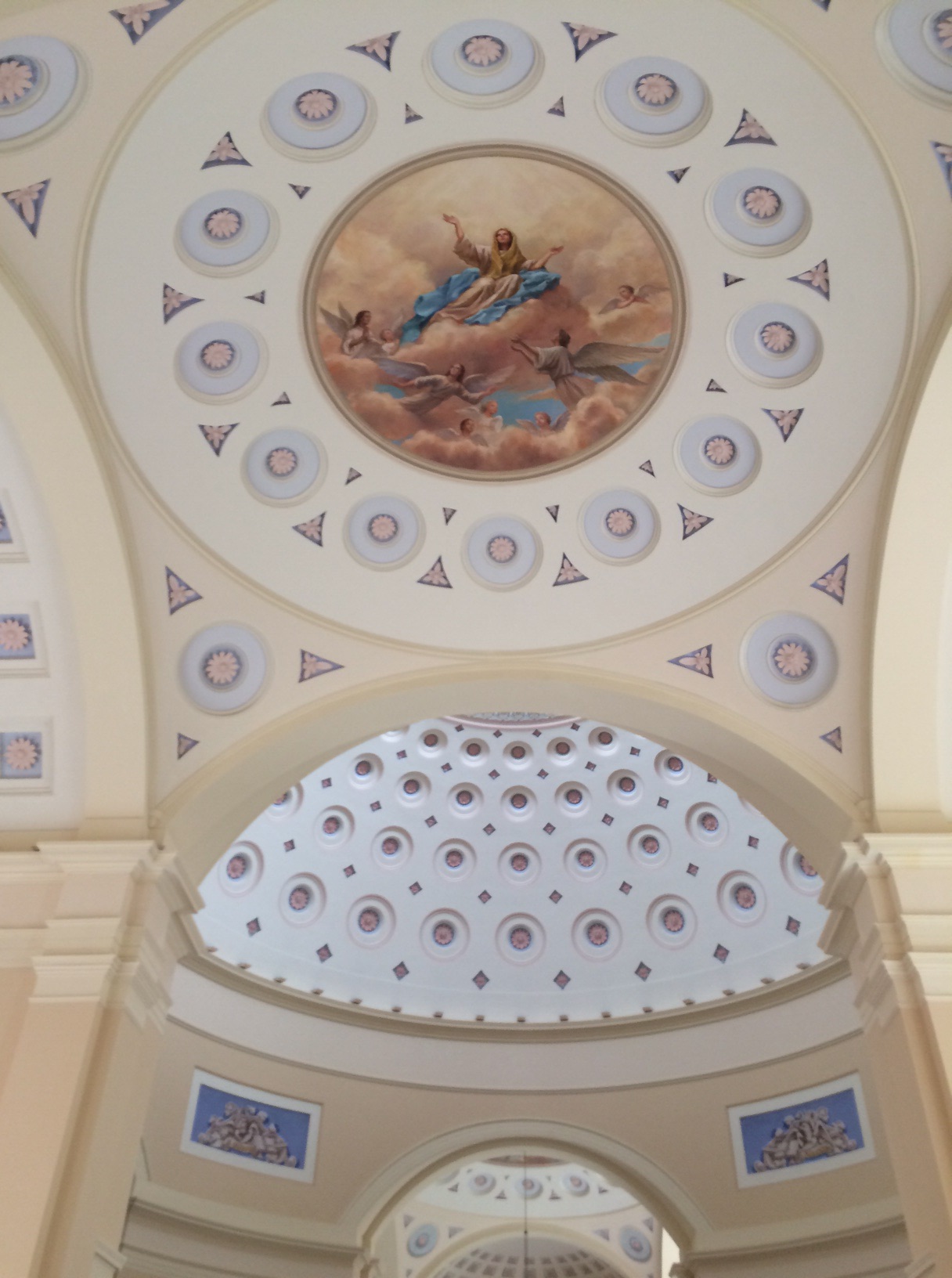
A secondary dome in the Basilica of the National Shrine of the Assumption of the Blessed Virgin Mary, Baltimore, the first Catholic cathedral built in the United States

The past fortnight of a research tour here in the U.S. has provided valuable insight into the life of local churches and the social fabric of America as a nation, a fabric that is complex and strained as I write this blog. Here in Baltimore the sounds of sirens, demonstrations, the cries for justice and social equity can be heard on CNN or directly out my hotel window, as rallies continue two blocks west of my stay.

As I have spoken to local residents, taxi drivers, and even members of the National Guard over these days, the tensions seem symptomatic of a self-destructive alienation of human society from itself, of the insufficiency of social contract which only mediates conflict without addressing its causes, and of forces of dehumanisation (poverty and militarisation among them) that render genuine communion near impossible.

These tensions, saddled between ignorance and fear, cannot be overcome by force, by technological advancement, by politics, not even the economy, least of all what Merton describes as a “bright official confidence” that all will be well. Surely the profound wisdom of the Christian tradition has not simply something to say to this mess we are in (and we are all in it) but also brings a responsibility to act through solidarity with the poor in spirit and circumstance. And yet this wisdom and action seems largely absent or lost among the roar of the crowds and the rattle of tanks.

In conversation with pastoral leaders in the U.S. over this time, and with the expertise of Sherry Weddell and Mary Gautier, I’ve come to better appreciate the similarities and distinctions between the American and Australian contexts that influence approaches to mission, which includes the peace-making and spirit of reconciliation being called upon in this hour.

I have learnt of the urban, rural and regional variations thread throughout the American Church, many sharing constraints in resources and local priestly vocations as at home, and the distinctive and deep religious identity that builds upon the story of America’s foundation but that threatens to remain a legacy of the past without a renewed mission of evangelisation.

As settlements of religious asylum and religious freedom, states such as Maryland, Philadelphia and New England are indelibly marked by their spiritual origins and aspiration, whether they be Catholic, Puritan or otherwise. These origins have seen religion intertwined with American culture, government, and daily life and religious belonging maintain a civic respectability in the wider community to a degree not at all experienced in the Australian context. The waves of religious revival in the U.S., the five Great Awakenings for instance or the upsurge of evangelicalism and Pentecostalism, are not our own story. As Chris McGillion reminds us,

Australia was always more a country of Christians than a Christian country. European settlement was not motivated by some noble cause, far less by any notion that it was part of God’s grand design. There is no foundational myth for Australia, let alone a religious one, no equivalent of America’s Pilgrim Fathers (McGillion, “O Ye of Little Faith”, Sydney Morning Herald, 11 April, 1998).

However, like Australia, the Church in the U.S. confronts the necessity of not merely renewal but reform and this places varied demands on leadership. In listening to conversations I sense that when a diocese is in strife (e.g. the Archdiocese of Boston following the sexual abuse crisis), church leadership is able to impose or set out with a firm vision and priorities as this provides direction and confidence in a time when both are lacking. The community is then left with enough wiggle room to live out the set vision and apply it to local circumstances.

When a diocese is in good or better shape, however, I sense that church leadership can more easily invite the community to join in the discernment of the future vision and priorities, a process which is more time-consuming but better at fostering genuine ecclesial integration around missionary goals. Take Bishop Caggiano’s lead in the Diocese of Bridgeport, Connecticut, for instance, a bishop who clearly has his eyes on the detail, is patiently engaging in an 18-month discernment process with his new flock, and deeply appreciative of the value of pastoral planning to build ownership and invite lay involvement following his tenure as bishop of Brooklyn. The situation in which the local church finds itself – the urgency of issues, history of the church, and culture of its people – ideally will impact upon the style and processes of change that are engaged.

For a variety of reasons, but almost always including financial limitations, I have learned that many pastoral planning roles in U.S. dioceses have been shed in the past decade, planning offices have been closed or otherwise devolved into part-time planning responsibilities among existing staff.

image

Planning staff from the dioceses of Bridgeport and Brooklyn at the Conference for Pastoral Planning and Council Development in April 2015

Notably though, and this is critical to recognise, the demise of local, diocesan planning resources and wisdom has not at all lessened the demand for what good planning offers but in many cases shifted the work and expertise from internal staff to external consultants who are engaged at significant cost and, I contend, can struggle to embed their plans within a proper theological framework and the local context in which they are working. From experience I would suggest that some in authority in the Australian scene would hesitate to engage outside consultants in this way for fear of what Pope Benedict XVI described as the ‘bureaucratisation of pastoral care’, particularly if planning is engaged merely as a way of managing scarcity rather than advancing mission and cultivating conversations about discipleship.

These trends in the U.S. pose questions to the Australian Church in regards to its commitment to building up its local planning expertise and resources as the challenge of change is ongoing and the need of unified pastoral outreach more urgent. The alternative to consultative, locally developed and communally owned processes of change and evangelisation, we know, is unilateral decision-making, a tinkering with structures with little impact on personal, spiritual growth, and a reliance on personalities rather than principles in decisions that effect entire communities of faith.

Very briefly, the pressing issues that I have gleaned from local dioceses here so far remain the shortage of priestly vocations (with responses varying from reliance on international priests, the practice of communion services, or exploring canonical options for pastoral leadership i.e. CCC #517.2), the growing migrant profile and strength of the Church (take the Diocese of Galveston-Houston which is becoming increasingly Hispanic in demographic and whose clergy includes more than half who were born outside of the U.S.), and the challenging necessity of greater shared responsibility and the implications of this for the ordained and laity.

Most change in the number and size of parishes is taking place in the north east of the country, where I am heading in the next two weeks, and the size of these communities certainly impacts on organisational complexity as more mega- or multi-parishes arise (these parishes are taken to consist generally of more than 10,000 registered parishioners).

Larger parishes demand well-honed administration or relational skills, operating budgets between $USD850,000 to $1.6 million and above, often include multiple, full-time paid staff, the priest having to act increasingly as an employer with related responsibilities, the hosting of multiple programs, consultation processes that are generally more formal, with complex decision-making and even formal, written policies of their own. Of course, it can be harder to build a sense of community in larger parishes, especially when small groups outside of liturgy are not nurtured or encouraged.

In contrast, smaller parishes can conduct informal consultation of key parishioners and families, engage fewer and part-time paid staff with a greater reliance on volunteers, and there are usually informal, unwritten operating norms. Without understanding these different variables of parish life, pastoral planners and diocesan leaders in evangelisation can seek to engage very different communities with rather generic activities or proposals that will not generate fruit without respect of their actual life.

I look forward to sharing the insights gathered here more systematically and moving from general observations to specific practices in future blogs as I prepare a report for sharing with dioceses in the Sydney region. This will include reflections on the Church of the Nativity at Timonium, in north Baltimore, the subject of the book Rebuilt, where I attended Mass this weekend.

On a more personal note, I also spent some days at Gethsemane Abbey in Louisville, Kentucky, a part of the U.S. where the Catholic Church established itself soon after Baltimore (which is the premier episcopal see of the American Church). After visiting the repository of Merton’s manuscripts, letters, journals, tapes, drawings, photographs, and memorabilia at Bellarmine University (and shaping a potential PhD question), the grounds and life of the Cistercian monastery brought the focus back to the heart of our faith which is Christ living within us.

I’ll simply conclude with this thought. When you get what you want – a diverse Church sharing responsibility for ministry and mission, engaging with the issues of the day with evangelical zeal, moving from what Pope Francis called this past night ‘a superficial and dry religiosity’ to a living house of prayer and deep discipleship – the Church becomes infinitely more complex. We should not be afraid or wearied by this prospective complexity but receive it as the gift of a stronger and more faithful future, calmly accepting the fact that renewal is always bought at the price of risk.