synod on the family 2014

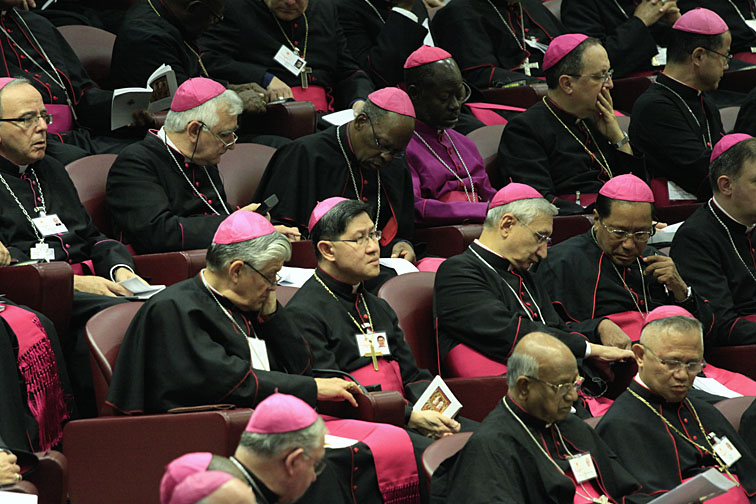
synod2The Extraordinary Synod on the Family concluded over the weekend in Rome (5-19 October, 2014), bookended by the beatification of Pope Paul VI. It proved to be an eventful, even enthralling journey for the Church, two weeks of discussion, passionate debate and prayerful discernment about the way in which the Church can best bring the Gospel to bear on the lives of millions of families as diverse as they are complex.

Given the multidimensions of family life, the issues canvassed by the bishops and participants were also broad. They included the plight of refugees, the care of children with special needs, the situation of migrant workers and the unemployed, the impact of the internet on family bonds, and then there were the distinctive concerns of African bishops whose concerns differ in striking ways from those in the affluent West (e.g. the practice of polygamy and conditions of extreme poverty).

However, and perhaps inevitably, the focus of media and popular attention ultimately fell on two specific matters: the question of Eucharist for the divorced and remarried, and the Church’s pastoral response to homosexual persons.

Controversies of the Synod

synod3As the first synod of bishops to meet under the leadership of Pope Francis, and affirming as it did many diverse views on the way in which Catholic faith speaks to human lives, the synod attracted not only generous media coverage for a Catholic get-together but wide-ranging interpretations of what was said, by whom and for what intent.

Of course, the synod discussions were pre-empted and almost overshadowed by Cardinal Kasper of Germany who in February 2014 advocated for access to communion for Catholics who have divorced and remarried. This was followed by a strong critique of his position by several other cardinals, including in the book-length reply, The Gospel of the Family, which contained a foreword by our own Australian prelate Cardinal Pell (the text of the Cardinal’s introduction is available here).

(For those interested in the pre-history of the synod, preparations began in earnest in November 2013, with a survey distributed by national bishops’ conferences to glean the opinions of Catholics on a number of Church teachings. The survey was a commendable initiative and expressed a sincere desire to be consultative though it clearly suffered from limitations, including the formulation of the questions which could be difficult for the Catholic in the street to say the least e.g. ‘How is the theory and practice of natural law in the union between man and woman challenged in light of the formation of a family?’ This survey was followed in June 2014 by the lineamenta or preparatory document for the Synod which presented the results of the November consultation and set a platform for the synod discussions to begin in earnest).
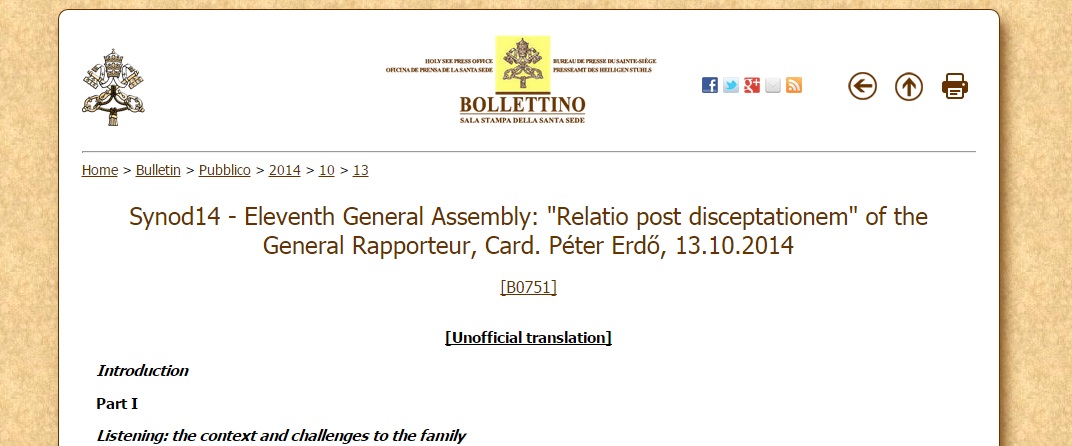
midtermreportAs the synod officially got underway this month, one of the major causes of controversy was the mid-term or post-discussion report known as the relatio post disceptationem. This was intended as a provisional snapshot of the views of the bishops thus far. However, many bishops objected to the content of this summary, noting that it was not only insufficiently grounded in Scripture and Catholic tradition but that it seemed to present the views of one or two particular bishops as the consensus of the whole assembly, which they were not.

The most strident and vocal objector to this interim report was the American cardinal Raymond Burke who argued, ‘[this document], in fact, advances positions which many Synod Fathers do not accept and, I would say, as faithful shepherds of the flock cannot accept’. Controversially, the interim report had included praise for the ‘positive aspects’ of what the Church has long considered ‘irregular’ situations, including civil unions and cohabitation, and even spoke of ‘accepting and valuing’ people of homosexual orientation  (though with the notable disclaimer ‘without compromising Catholic doctrine on the family and matrimony’).

Criticism was particularly focused on the General Secretariat of the Synod which handled the information flowing out of the bishops’ discussion, with accusations that its members, including Cardinal Baldisseri, had manipulated, or at the very least swayed considerably, the content of the relatio to reflect a personal and permissive agenda.

Interpretations of the Synod
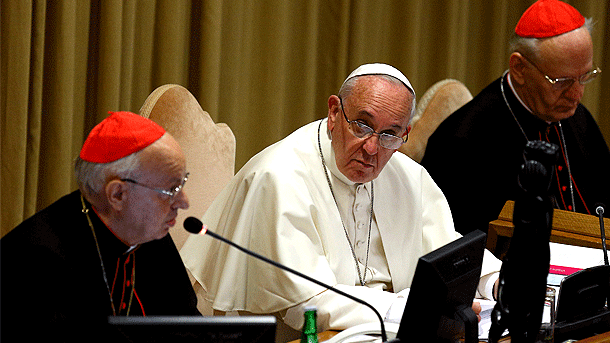
synod4As is customary, and was the case following the Second Vatican Council (1962-1965), the major media outlets interpreted the discussions and debates of the bishops through a political lens, with reports of ‘conservative’ and ‘liberal’ camps pitted one against the other (of course, Pope Francis was read as ensconced within the latter and undermined by the former, taken to be the majority).

Without denying the political nature of all human discourse, including the ordinary desire to influence outcomes and press one’s case, the heart of a synod is not the political motivations that underlie the bishops’ views but the theological arguments that are raised in accounting for those positions. Of course, the media is generally not interested in actual arguments, only assertions, and for the most part lack a theological background or concern.

In cherry-picking lines from the disputed interim report we have mentioned, as well as Pope Francis’ powerful concluding address to the Synod Fathers, the Daily Mail and even the BBC were able to run histrionic headlines such as “Massive Vatican shift on gay sex” and “Pope Francis set back on gay policy”.

The BBC coverage focused on Francis’ critique of ‘hostile inflexibility’ among so-called traditionalists and intellectuals, and implied that these adversarial forces had undermined or ‘setback’ the Pope’s more ‘progressive’ agenda on homosexuals and the remarried. Conspicuously, the report made no mention whatsoever of the pontiff’s critique in the self-same address of those who have ‘come down from the cross’ to ‘bow down to a worldly spirit instead of purifying it and bending it to the Spirit of God’ (you can read the complete address here).

More locally, broadcasters tapped into the local response to the synod, including SBS which while perpetuating the BBC caricature of a Pope Francis opposed by backward bishops, at least tried to seek out a Catholic view of things.

sbsIn my fifteen seconds in the spotlight, I shared the view that the synod represents a healthy and vital discussion for the global Catholic Church and that the Catholic bishops are mindful of the lived situations of people from across the world and mindful also of what the Gospel can bring to those contexts. I tried to underscore that the range of issues being discussed by the synod as they relate to the family were broad and that the synod represents the Church’s ongoing and sincere discernment of how best to accompany people in their life journeys, including divorcees, the civilly remarried, single parents, and gays and lesbians to whom the Gospel also speaks. (Other voices in the report included Paul Collins who can always be relied upon to express more than a healthy scepticism about Church matters).

Discernment is Not Division

The key to an interpretation of the synod and its events is given to us, I think, in Pope Francis’ closing address to the Synod Fathers which is a profound and striking statement (you can read it here). He provides us with ‘the eyes of faith’ to continue talking about these issues with confidence.

Firstly, Pope Francis is not at all unnerved by the differing views expressed in the preceding fortnight and accepts the rigorous debates in faith as an expression of the Church discerning how to enter ever more deeply into the heart of the Gospel by the sensus fidei, the sense of faith of the faithful. As he shared,

Many commentators . . . have imagined they see a disputatious Church where one part is against the other, doubting even the Holy Spirit, the true promoter and guarantor of the unity and harmony of the Church – the Holy Spirit who throughout history has always guided the barque, through her ministers, even when the sea was rough and choppy, and the ministers unfaithful and sinners.

9954008What Francis is affirming by valuing debate over the silence of ‘a false and quietist peace’ is the capacity of the Church to receive God’s revelation faithfully and meaningfully by attending, together as people of faith in the Spirit, to tradition, including the teachings of the Magisterium, and the experience of Christian families in the world (I have written about the Church’s discernment of the Spirit here, in relation to the 2013 papal conclave).

To teach and evangelise the Church must first listen, receive time and again the deposit of faith which constitutes our living tradition and attend to the complex realities of contemporary family life which too can be a source of theological knowing.

The guarantor of the Church’s ongoing faithfulness to Christ in this multidimensional process is the Holy Spirit, as Vatican II’s Lumen Gentium affirms and which Pope Francis cited in as many words,

The universal body of the faithful who have received the anointing of the holy one cannot err in matters of belief. It displays this particular quality through a supernatural sense of the faith in the whole people when ‘from the bishops to the last of the faithful laity’, it expresses the consent of all in matters of faith and morals (Lumen Gentium 12).

This discernment of the sensus fidei, a sense of the faith and the Church’s sense for the faith, should not be a ‘source of confusion and discord’, as Francis remarked in his address, but should be entered into with confidence, trust and utmost faith in the Holy Spirit’s capacity, through diverse and even imperfect people (like you and me) to lead God’s people to the truth and mercy of God (you can read more about this connection between the deepening of tradition and the divine assistance of the Holy Spirit in Dei Verbum 8 as well as the Catechism of the Catholic Church n.892).

As well, in the process of spiritual discernment that will continue until the General Synod on the family in 2015, Francis warns of temptations or polarities. The first temptation is to be fossilised in our faith, exhibiting a ‘hostile inflexibility’ which would in fact impede the ability of the Church to bring the Gospel to new and developing circumstances. This kind of fundamentalism or rigorism can manifest a lack of faith and trust in the Spirit that guides the Church (the Marian dogmas of the 19th and 20th centuries standout as instances in which the Church has developed a deeper appreciation of her own faith). ‘Traditionalism’ is in fact not traditional at all for the pilgrim Catholic Church understands development as a perennial and necessary deepening of her self-understanding in light of the Gospel, and never a departure from it (“Lord, to whom can we go? You have the words of eternal life”; John 6:68)

Christ Mosaic Cefalu Sicily 12th CenturyThe other risk named by Francis, the one that media outlets were less enthusiastic to report, was the capitulation or accommodation of the Church, and the Gospel it bears, to ‘a worldly spirit instead of purifying [the world] and bending it to the spirit of God’.

The Church must engage the world, as Francis has so often stressed, but it engages the world and contemporary culture with a view of what the world really is in Christ, a world of men and women made in the image of God and called to conversion or ‘likeness’ in Christ in whom we find our origin and destiny. Thus, Pope Francis critiques outright in his concluding address,

a destructive tendency to do-gooding, which in the name of a false mercy binds the wounds without first curing them and treating them, that treats the symptoms and not the causes and the roots

with the phrase ‘false mercy’ a nod to no less than St John Paul II. What does Francis mean by this? He means that we cannot truly serve people in their wounds and in their growth through crisis if we disregard the truth, if we cover over the truth with superficial or cheap dressings. As American Archbishop Kurtz put it, ‘Mercy without truth is not mercy’.

While the concrete solutions to the contemporary challenges that confront the family will be the subject of discussion over the next twelve months, the synodal process has already recalled two principles for our view of Church and mission. The first, that all people are called to Christ and the Church – as all are called to the King’s banquet in the parable of Matthew 22 – and second, that all people are called to conversion in Christ who is the source of true life  – as was the guest at the banquet called to change before approaching the table. The Church must both open wide its arms to the sinner and invite a new creation in each one of us, no matter what our state of life or circumstances may be. This is the universal hope and universal challenge of the Gospel.

Much more will be said on family and life issues in the coming year, by each of the local churches (dioceses), episcopal conferences and the observing media. As Catholics, we are being invited by Pope Francis explicitly and the debates of the synod implicitly to trust in the Spirit-filled capacity of the whole Church, all of us together, to know what the faith is and to better accompany all people in their journeys with the promise and joy of the Gospel.
 

forming the adult Church

Candle 4Next week I begin teaching a ten week course, an introduction to Catholic ministry, which forms part of a year-long course offered by the Institute for Mission, an adult education centre in the Diocese of Parramatta. Remarkably, the course has seen over 400 participants undertake studies in spirituality, Scripture, theology and ministry since its inception and includes spiritual direction, companioning groups as well as plenary days.

My particular component of the course attempts to situate ministry within the broader context of baptismal mission and the legacy of the Second Vatican Council, explores the ministry of Jesus as given witness in the New Testament, overviews the development of ministry from the Constantinian area until the present day, surveys the theologies of the ordained priesthood, the diaconate and lay ministry, relates ministry to Eucharist, before concluding with issues in pastoral practice and spiritual discernment.

Over the years I have tried to ground the course as much as possible in the touchstones of the ressourcement movement, and so the participants are exposed to the writings of the Church Fathers, the Scriptural testimony of early Christian life, and are invited to delve into the meaning of the Eucharistic prayers, including a nod to Eastern anaphora recognised by the Catholic Church (the most obscure of which is that of Addai and Mari, an Assyrian prayer distinguished for the absence of an institution narrative. See here for extended analysis of its use and context).

The growth in opportunities for such theological formation of lay men and women since the Second Vatican Council has been tremendous, meeting as these opportunities do the greater baptismal consciousness that flowed from the Council’s reception, and extending the possibility of theological learning and reflection beyond the seminary and religious houses of formation.

Foundational documents in the area of adult faith education include conciliar documents such as Lumen Gentium (1962), Apostolicam Actuositatem (1965), Gravissimum Educationis (1965), and post-conciliar monuments including Catechesi Tradendae (1979), the General Catechetical Directory (1997), and the pastoral plan for adult formation authored by the US Conference of Catholic Bishops, Our Hearts Were Burning Within Us (1999; available here). This last document offers as its model the Emmaus story as a paradigm of encounter and accompaniment on the road to faith in Jesus, in a way which aligns well with the pedagogy outlined by Pope Francis in Evangelii Gaudium.

5382043It is worthwhile noting that the greater opportunities for theological formation of the laity in the contemporary Church reflects, in part, a shift in ecclesiastical culture over the last half century, away from a climate in which ‘religiosity’ was often identified with obeying the will of a superior as opposed to religious practice being the way to obtain our happiness and fulfilment. As the Canadian theologian John Lamont points out of that authoritarian atmosphere, one which extended well in the 1950s, ‘If faith is a matter of obeying orders, then asking questions about Catholic belief is insubordinate’.[1]

This climate also affected theological learning in general, producing an anti-intellectualism because asking questions about the faith was seen as smacking of disobedience rather than looking for new knowledge and a way of approaching God. The second opposite effect was that among the people who did ask questions, which were first the priest-scholars before the laity, there was a certain attitude of rebelliousness (e.g. Hans Kung, Herbert McCabe OP) which has been unhelpful at times to genuine theological development and for freedom of inquiry in other corners of the Church.

Today the possibilities for the faith education of lay men and women are much wider than available to previous generations and a commitment to critical research, historical studies and an awareness of how culture and a globalised context can illumine the mysteries of faith has provided Catholics ordained and lay with a richer theological horizon against which they can make sense of faith, if we are disposed to making use of the resources available to us.

In today’s Church, our Catholic universities continue to serve as the primary venue for formal theological education of lay men and women. However, it is also the case that many laity do not enrol in such accredited courses and degrees for at least two reasons. One is the expense of such courses which can be prohibitive, especially for those without recourse to student loan schemes; the other is that the spectre of rigorous assessments can also discourage participation at this tertiary level, especially for adults who have not studied for some time, even decades, and yet still seek some form of theological input and learning.

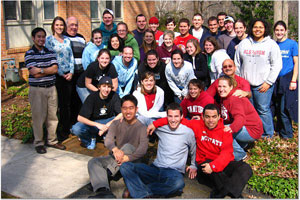
Participants at a recent Alpha Leaders Training Day held in our Diocese

Participants at a recent Alpha Leaders Training Day (c) Diocese of Parramatta 2014

Hence, diocesan centres of adult formation, and the occasional talks, retreats, lecture series and programs facilitated by them (Catholic Alpha, Life in the Spirit seminars, the Siena Institute’s Called and Gifted workshops come to mind) as well as opportunities provided by religious congregations, remain critical to the education and formation of Catholics for mission. Online courses and other new media also offer sources of spiritual nourishment and theological reflection for those stretched for time in a work-a-day world.

Sadly, even in these less formal and more accessible settings for adult faith education there has been a conspicuous decline in the number of people taking up such opportunities. The low participation numbers in many diocesan adult formation initiatives brings into question the ability of the Church (at least the Australian Church) to communicate and deepen its faith and prepare its people for discipleship and outreach now and into the future.

As noted in previous blogs, while homilies, parish bulletins and the liturgy itself are the primary forms of formation experienced in the parish, these are rarely sufficient in themselves for working out that relationship between the faith we have received and the contemporary culture in which we are called to live it. As Thomas Merton remarks, as Christians we do not choose between Christ and the world as if they were utterly opposed. We choose Christ by choosing the world as it really is in Him.[2] However, this ‘catholic’ choice requires formation and discernment lest we choose one to the neglect of the other – either a self-enclosed identity incapable of speaking to the world in the light of the Gospel, or a generalised humanism without Christian substance.

When Christian faith is not deepened through reflection on faith, it becomes difficult to live out that life commitment in both an integral and world-engaging manner. It is true, as Pope Francis has pointed out, that we do not need theological degrees to be Christian but it also the case that ignorance of our faith is not a virtue. As Clement of Alexandria wrote in the second century, of those who do not bother to pursue an understanding of the riches of their own calling as Christians, ‘They demand bare faith alone – as if they wanted to harvest grapes right away without putting any work into the vine’ (Chapter IX, Stromata).

In a more contemporary key, the English theologian, Nicholas Lash, describes well the stagnancy in our midst in his 2002 Prideaux Lectures at the University of Exeter,

I never cease to be astonished by the number of devout and highly educated Christians, experts on their own ‘turf’ as teachers, doctors, engineers, accountants, or whatever; regular readers of the broadsheet press . . .  occasional visitors to the theatre who usually read at least one of the novels on the Booker short-list; and who nevertheless, from one year to the next, never take up a serious work of Christian theology and probably suppose The Tablet to be something that you get from Boots the chemist (Lash, Holiness, Speech & Silence: Reflections on the Question of God, 4-5).

SB048On his part, Lash attributes the decline in adult formation to the ‘systematic failure of the Christian churches to understand themselves as schools of Christian wisdom: as richly endowed projects of lifelong education’ (Lash, Holiness, Speech & Silence, 5).

There is much truth to this. As we have noted, our parishes do not largely understand themselves in this way, as ‘schools’, and therefore depend too heavily on the ability of our people to make sense of their faith and give an account of their hope unaided, without the support of a community of kindred learners who sit at the feet of the kerygma and tease out together the implications for life in this world.

As Richard Lennan of Boston College has written, ‘A secure faith . . . does not merely tolerate questions and thought, but affirms their capacity to act as vehicles for an ever-deeper engagement with the God revealed in history’.[3] Without doubt, we need to grow the opportunities for adult faith education but we must first grow the appetite and desire of our people for such formation, so that they can fully realise their own vocation and make use of the gifts and capacities called forth in them.

To conclude, the tradition of the Church upholds that the ‘catechesis of adults must be regarded as a preferential option’, and that this ‘can bear fruit only within the overall pastoral plan of the local Church communities’. [4]  To form our adults to be constructive participants in the life and mission of these communities, we need to place adult faith education once again at the heart of our intent and pastoral practice. Without such a focus, lay Catholics will lack the confidence to bear witness to the Gospel in a complex world and so the mission of the Church will be impaired on account of the undeveloped faith of the majority.


References:

[1] John Lamont, ‘Why the Second Vatican Council was a Good Thing and is More Important than Ever’, New Oxford Review (July/August 2005), 35. You can read the text on this blog.

[2] Cunningham, Lawrence, ed., Thomas Merton: Spiritual Master: The Essential Writings (New York: Paulist Press, 1992), 387.

[3] Richard Lennan, ‘”Looking into the Sun”: Faith, Culture, and the Task of Theology in the Contemporary Church’, Australasian Catholic Record 84/4 (2007): 467.

[4] COINCAT, Adult Catechesis in the Christian Community: Some Principles and Guidelines, 29; available here. Accessed 30 September, 2014.


recent news in the Australian Church

Bishop Anthony Fisher OP 2 - CopyOvernight Pope Francis appointed Bishop Anthony Fisher OP the ninth Archbishop of Sydney. Bishop Anthony will continue to administer the Diocese of Parramatta until he is installed as Archbishop later in the year, most likely in mid-November as there is a maximum two month window by canon law (so no change in the Eucharistic prayer for now!).

While it is sad to see him leave the Church of Western Sydney for the east, the connections will continue and his appointment will bring renewal and vitality not only to Sydney but, I suspect, to the national church (for those interested in the nitty gritty of church administration, once the new Archbishop is installed the College of Consultors of Parramatta will appoint a diocesan administrator and onwards we go!).

At this morning’s press conference, +Anthony underscored the Catholic Church as the largest multinational organisation in the world and therefore well equipped to play its role in fostering and building up the harmony and social capital of our society at a time when tensions and fears are at a peak. Catholic education is an ongoing priority as are the connection of young people to the Church which needs their faith and leadership, both now and into the future. +Anthony also underscored the seriousness with which he and the Church takes the scandal of abuse and remarked, ‘I think the Catholic Church is going through a period of well-deserved public scrutiny and humiliation and certainly self examination, but I hope we’ll emerge from that purified, more humble, more compassionate and be spiritually regenerated’. A good summary of his comments this morning can be found here.

For the past four years I have been privileged to work for and with Bishop Anthony in the area of adult formation and then in the development of a pastoral plan for the Diocese of Parramatta, a project which had not been undertaken in the past with significant vigour. When the potential of diocesan-wide strategic planning was first aired over a cup of coffee in late 2011, I did not anticipate the theological and pastoral learning that would follow, not merely from the process of bringing about a common vision and intent among the parishes, clergy, agencies and ministries of the diocese, but from +Anthony’s own style of leadership and governance. In exchanging ideas about organisation of ministries, parish life and structure, pastoral outreach, the mission of the Church’s social services, financial considerations and canon law, all in the effort to foster new norms for the diocese and its communities, there was always a good sense of humour and genuine companionship.

There is also leadership which includes an ability to articulate what a better future looks like, and a commitment and strategic mind to bring it to life. His involvement with the pastoral plan has been anything but a ‘tick-a-box’ exercise and the ongoing commitment to deliver what we promise has been the standout feature of his episcopacy since his installation at the beginning of 2010. On a personal note, he has been a wonderful shepherd and been present in the high and lows of some of our lives in ways which should remain private. Suffice to say, it is rare that one works with a leader over years, in a project of great change and overwhelming detail, only to grow in fraternal affection and respect of their person as a Bishop, colleague but most of all as a Christian disciple committed to the harvest, all the while imploring the graces of God.

Bishop Anthony recording the Faith in Our Future pastoral message in late 2013 for the 2014 launch

Present within +Anthony’s ecclesiology is a keen recognition that the Church is both a gift and task, and that church planning does not represent a lack of faith in God to bring us to greener pastures but rather is a response of faith to the gifts, people and resources with which we had been bestowed for His mission. There is a recognition that parishes need to be re-imagined not merely as congregations but entire pastoral areas in which there are many Catholics who were distant from the Church and still others who did not yet know their home was with us. Parishes bear a responsibility to all those in their midst, for their spiritual care, vocation and yes destiny, and therefore must be missionary in intent and missionary in practice.

There is an appreciation of the gift and potential of migrant communities, in Sydney’s west in particular, some groups being as large as parishes and therefore calling on appropriate resources to support their life and receive their gifts and difference into the body of the Church catholic. While the pastoral plan continues to unfold, with parishes aboard and commitments to unfold in the months and in some instances years ahead, here are the highlights of the first year with no small credit to the confidence and support of Bishop Anthony to make things anew:

  • DABAF

    Celebrating Archbishop-elect Anthony Fisher’s appointment to Sydney after the press conference this morning at Parramatta (19.09.14)

    Overseen the consultations, publication and first stage of implementation of our Diocesan Pastoral Plan, Faith in Our Future (a commitment that bodes well for the future of the Church in Australia);

  • Overhauled the Parramatta Chancery with a new structure and an emphasis on service delivery and collaboration;
  • Established a renewed Office for Child Protection and Safeguarding, a comprehensive diocesan youth manual in this area, and strengthened related processes;
  • Launched a comprehensive review of the Religious Education curriculum in our schools, conducted by the University of Notre Dame;
  • Increased the capacity of our social service and welfare agencies to meet increasing needs in Sydney’s West;
  • Opened the Aboriginal Catholic Services centre at Emerton and renewed the structure, identity and mission of migrant chaplaincies;
  • Strengthened and raised the standard of youth ministry in the Diocese through new leadership, and focus on both international and local events;
  • Directed the building of the new Holy Spirit Seminary at Harris Park which is now fully occupied.

There are a number of other ‘big picture’ plans that will proceed and be realised in the Parramatta Diocese over the time to come, thanks to his contribution to the Church of Western Sydney. The Church can be an overwhelmingly complex organisation, with various concerns on the table at any one time but the overriding mission to proclaim the Gospel and build up the Church for the sake of the Kingdom remains a clear point of purpose and mission. +Anthony has exercised this mission in the local church of Parramatta with vigour, calmness and great competency and he will no doubt continue to share those tremendous gifts with the Australian Church in the years ahead.


new ecclesial movements

This week I was pleased to join the ACBC Commission for Church Ministry to address leaders of lay movements from across the country on the possibilities and challenges evoked by Pope Francis’ apostolic exhortation, Evangelii Gaudium. Movements that were in attendance included Catholic Charismatic Renewal, the Focolare Movement, Antioch, the Cursillo Movement, Lay Carmelites, and the Mariana Community among others.

Pope Francis’ first apostolic exhortation has already been well covered by commentators, various conferences and symposiums so I will only share in this post some of the broader issues that were raised with the movements, a form of Christian community in which many find a compelling charism and new forms of spiritual living.

(c) Diocese of Parramatta

(c) Diocese of Parramatta

Ecclesial movements, which are predominantly but not exclusively lay in membership, have been one of the outstanding developments in the life of the Church in the twentieth century and may well present as a significant form of Christian community in the decades to come if they are able to align themselves for growth in a changing ecclesial situation.

After outlining some very real challenges for parishes in the Australian context – including but not limited to diminishing Mass attendance, the age of attenders and absence of youth, our dependence on Catholic migrants for their vitality, and the reality of low participation rates among second generation Australians, that is, the children of these migrants – I went on to contrast the Australian Church to the American and European situation.

The parallels between the Australian and American contexts are stronger than what might first be assumed. In both countries, the Catholic Church established itself within a predominantly Protestant settlement that was the result of British colonisation and saw the oppression of an indigenous population. The Catholic Church then thrived in each nation through the development of parallel infrastructure to the State (e.g. schools and hospitals) and grew with subsequent waves of migration. Both countries have large rural contexts which can be sparsely populated and are shaping the exercise of pastoral ministry in the Church; both have seen increasing structural change in Catholic parishes and dioceses over the last decades, have been impacted by the scandal of abuse crises, and are experiencing increasing disaffiliation with religion and Catholicism in particular (the disaffiliation rate in Australia is around 20,000 people a year, 20,000 who choose no longer to identify as ‘Catholic’ at all).

However, one significant difference I would suggest is that the development of ministry in the United States is two to three decades ahead of the Australian Church. While there has been significant institutional support for the development of lay leadership in the U.S., including the emergence and training of pastoral life coordinators/directors in parishes and specific theological treatment of lay ecclesial ministry in the USCCB’s Co-Workers in the Vineyard of the Lord, as well as strong growth in the diaconate – the U.S. has some 15,000 active deacons serving 17,000 parishes – the Australian Church is yet to make significant forays into these possibilities.

The result is that the American Church is some twenty years ahead in the development of ecclesial ministries which has buoyed the life of their parishes while the Australian Church is some twenty years further down the track in terms of decline, with an attendance rate that makes the U.S. weekly participation rate of 30% seem (almost) a success.

The European story also differs from the American one. Parishes are largely moribund in Europe and this has explained to a great degree the growth of the ecclesial movements which have flourished ever since the Second World War. Many of these groups owe their existence to the well of lay participation in the Church initially fostered by Catholic Action and then given further energy and legitimisation by the Second Vatican Council and then the pontificate of John Paul II.

layecclesialministryBottom line? With the development of lay ministry and the diaconate lagging in the Australian Church and our parishes in a more immediately dire position than in the U.S., our future may look decidedly more European than American with the upshot that lay movements will find only greater opportunities for growth and perhaps stronger official backing in the years ahead.

Unless there is an unprecedented influx of Catholic migrants into Australia or the development of lay ecclesial ministry surges forward with programs of training and formation, all of which demands funding and organisation, our parishes will continue to experience decline and in some cases their very existence will be at risk, opening up possibilities for other forms of Christian community which the ecclesial movements represent.

You can read my more detailed reflections on the pros and cons of such a scenario, growing ecclesial movements in the midst of the local church, in this article written for Compass Theological Review. It is no secret that whenever popes address the movements they raise the risks of spiritual elitism, separation from parish communities and the real challenge of inculturating their charism and service in contexts which may vary from their places of origin. If they are to flourish, movements will need to mature in their ecclesial integration.

In his treatment of mission in Evangelii Gaudium, Pope Francis underscores with relevance to ecclesial movements that the Church’s identity comes about by its focus on something other than itself – its focus on Christ whose body it is and is called to be, and the world for whom that sacramental body exists as a sign and reality of hope. Endowed with a charism or a compelling narrative of holiness, ecclesial movements are called to look outward for their identity can only grow through an expanding engagement with others within the Church and beyond it. Pope Francis insists

[These charisms] are not an inheritance, safely secured and entrusted to a small group for safe-keeping; rather they are gifts of the Spirit integrated into the body of the Church, drawn to the centre which is Christ and then channelled into an evangelising impulse (Evangelii Gaudium 130).

A further point that was made at the ACBC gathering was that movements have arisen out of specific historical circumstances that have required a Christian response and therefore movements are no strangers to a world-engaging mission that connects creation with redemption, nature with grace, and the historical with the transcendent. If the movements are able to adapt and carry their original charism or genius into social and cultural circumstances that are altogether new, these movements can well support the Church in preparing laity to take their place in the contemporary world as disciples, in that world-transforming mission which Pope Francis promotes with urgency.

Unsurprisingly, many ecclesial movements emerged in the wake of the world wars and crises of the twentieth century, calamities which saw not only an uncharacteristic surge in priestly and religious vocations but new forms of lay association as well. For example, the Focolare Movement emerged from service to the poor and deprived in the bomb shelters of post-war Italy, while closer to home the Knights of the Southern Cross finds its origins in the struggle to ensure Australian Catholics had access to jobs and were free from discrimination on return from the First World War.

Lay movements may be especially well placed to offer appropriate resources, a life of prayer and programs of lay formation directed toward Christian engagement with the world because they themselves have arisen in response to specific needs and hungers in human society and culture.

ACBC Lay MovementsI also recommended that lay movements, who are rapidly ageing as are our committed Mass attenders, explore creative forms of collaboration with dioceses and with one another in order that their charism or spiritual vision can extend beyond the one or two generations of leaders which have sustained their groups to date. It is a truism that institution without charism grows weary and mundane while charism without institution and structure risks eccentricity or parochialism. Lay movements can work together with dioceses and provide much needed inspiration and creative forms of spiritual living while dioceses can support movements in their access to parishes which remain, notwithstanding the reality of decline, the experience of the Church for the vast majority of Australian Catholics.

It is true that some movements have gained a reputation for drawing members away from local parishes, especially when they insist on celebrating separate liturgies or else absolutise their own spiritual experience to the exclusion of others forms of Christian life and prayer. However, in my experience, many members of movements, including Catholic Charismatic Renewal for one, have assumed leading roles in parish life and ministry and can be particularly effective in their outreach to those who are on the margins of faith. As Pope Francis himself underscores, it is a sign of great hope when lay associations and movements ‘actively participate in the Church’s overall pastoral efforts’ (Evangelii Gaudium 105), an opportunity which I sense will only grow in the Australian Church.

To conclude, the insufficiencies and unclaimed potential of the present will suggest, in its prophetic utterance, the ‘more’ of the future for the Australian Church. The movements may well take their place in that future with the dynamism, practical intelligence and spiritual gifts of their past. Let us move towards that new possibility with a spirit and the confidence of joy.

Note to readers: For those interested in learning more about the ecclesial movements, their development and implications for the Church, read David Ranson’s Between the ‘Mysticism of Politics’ and the ‘Politics of Mysticism’: Interpreting New Pathways of Holiness within the Roman Catholic Tradition (Adelaide: ATF Press, 2013) or an upcoming publication by Massimo Faggioli, Sorting Out Catholicism. A Brief History of the New Ecclesial Movements (Collegeville, MN: Liturgical Press, 2014).


the rural and regional church

BathurstEarlier this week I was privileged to join Bishop Michael McKenna, the clergy and lay leaders of the Diocese of Bathurst for a day focused on pastoral planning. More and more dioceses are recognising the opportunity that pastoral plans represent, not merely to address immediate challenges but also, and more fundamentally, to translate the life of our parishes and dioceses into a new missionary key. While offering no kitbag of ‘silver bullets’ it was good to share what we have learned through achievement and mistakes in developing a pastoral plan in our own urban context in Parramatta.

In examining the foundations of Church planning I sought to emphasise that planning processes that begin from a bureaucratic or purely administrative perspective may well produce a document but they will not generate life, they will not foster a greater sense of God’s mission, discipleship or belonging among its people.

Authentic planning in the Church cannot be primarily a question of the right structures for a diocese, the right mix of policies or administrative concerns because if flesh-and-blood people and parishes are not growing spiritually in their discipleship, then any structural change a diocese might make is merely a postponement of ongoing decline rather than representing a pro-active and new footing for a 21st century mission.

Pastoral plans must focus on generating life and discipleship for mission. Planning processes, through consultation and a sober and public assessment of the facts, are a way of fostering participation, conversation and ownership of a common vision and practical wisdom that will bring about change. A planning process is a way by which Church leadership can ignite a conversation about the things that matter, challenge views of the Church that are too narrow or complacent, and awaken all people, ordained and lay, to the responsibility to live the change and faith that they would like to see. This primary focus on discipleship and mission is vital because dioceses and parishes do not grow if people don’t.

bathurstAs an outsider I spent some time reflecting on the Diocese of Bathurst as known through research and observation. The diocese was formally established in 1865 and today comprises 19 parishes with other, smaller Eucharistic communities dotted across a vast terrain. There are some 67,877 Catholics in the Diocese (30.7% of the general population) and the average size of parishes is 3,572 Catholics with the sizes ranging from 339 (Eugowra) to 13,709 (Orange).

The average percentage Mass attendance rate across the Bathurst Diocese is about 10.5% which is on par with many other dioceses across the country. With those other dioceses, the Mass attendance rate in Bathurst is likely to fall under 10% by 2016 which only increases the need for good planning in the years ahead. Distance, of course, is a distinguishing feature of the Bathurst Diocese with its faith communities spread across some 103,600 square kilometres. This is 24 times the size of the Parramatta Diocese which takes in a mere 4,289 square kilometres!

Hence, one of the issues that I explored was the response of rural and regional dioceses in Australia and the U.S. to smaller numbers of clergy and parishes, vast distances and limited resources. While not exhaustive, the list below provides some sense of how rural and regional dioceses have led the way in reforming pastoral life and ministries for mission. As Pope Francis has underscored so many times in his pontificate, the prophetic will emerge from the peripheries not the centres which can, in comparison, be rather more complacent and comfortable in the status quo of ecclesial life.

  • Diocesan reconfiguration is the obvious response for rural and regional dioceses to assume in the face of challenging conditions. Amalgamations, twinning and clustering of parishes is a response known to all Australian dioceses (excluding the eparchies and extra-territorial dioceses) though the pastoral fallout of such structural change tends to be less affiliation with the Church among some members as people are simply not willing or even able to travel to identify with a faith community outside their immediate locality.
  • Sunday Worship in the Absence of a Priest is an increasing practice and a legitimate response for many regional and rural dioceses across the world. It is often exercised on alternative weekends when the local priest cannot be present. The Australian norms for this form of worship, promulgated in 2004, are available here in PDF.
  • Accompanying this worship in the absence of a priest is the phenomenon of lay preaching which has developed with vigour in the U.S. Take for instance the rural diocese of Great Falls-Billings in Montana, in the Western United States. Coincidentally, this diocese is about three times the geographic size of Bathurst and contains three times the number of parishes as Bathurst (54 in total) but with the same number of Catholics as Bathurst (around 60,000). Hence Great Falls-Billings has fewer Catholics per parish. I did not endeavour to explore the complexities of Canon 766 which permits lay preaching in certain circumstances other than to say that the U.S. Bishops’ Conference has authorised each diocesan bishop to decide if a lay person may preach in his or her own words when the Sunday Celebration in the Absence of a Priest is used. The uneven history of instructions and decrees from Rome on this subject leaves lay preaching as an exception in the Church, as an instruction or testimony at Eucharistic liturgies that is not to be confused with the homily, and altogether more appropriate at non-Eucharistic liturgies. As far as I am aware, no provision exists for such preaching under the mandate of the Australian Catholic Bishops’ Conference and none is envisaged at this time.
  • Reliance on clergy from the developing world is increasingly common and well known in rural and urban contexts, though this brings with it theological, ethical and pastoral issues, including issues pertaining to the inculturation of international priests and justice for the dioceses from which these clergy originate.
  • Deployment of women religious as parish leaders is also a common response both here and the U.S. In Canberra-Goulburn a group of parishes known as the ‘Western Mission’ has seen a parish priest reside in one faith community but with canonical appointment in another four small communities. The priest then delegates that jurisdiction to four ‘community leaders’ which have included among them women religious.
  • Lay leadership within parishes has been explored in a number of ways here and in the U.S., expressed in multi-parish team structures, coordinating teams of three people (as has been practiced in the dioceses of Ballarat and Sandhurst), deanery communities and the formal appointment of non-ordained pastoral leaders. However, lay leadership of parishes on a day-to-day basis, with the overarching governance and sacramental ministry of clergy, has not yet been systematically or strategically explored by dioceses in Australia.
  • Finally but significantly, in some instances, given that many rural parishes would not be viable without the presence of the school, the absence of a resident priest has seen school leadership exercise a role of spiritual leadership in the local community, with more pastoral significance and recognition of this role than a relatively distant parish priest.

In concluding my time with the clergy and lay leaders of Bathurst, I conveyed that while many hours could be spent exploring the pros and cons of these models employed in other dioceses, it would be to a certain extent in vain for what is of greater importance than the actual solution or response that might be decided upon is the process by which such decisions might be arrived at in this local church at this time in its history.

consultationGood and effective pastoral plans come into being by a collective exploration of realities and potential, not by a process of map-reading. That is, a pastoral plan will never be truly owned, accepted or generate life among the people of a diocese if it is picked out of the handbook of another diocese or parish altogether different from our own. There is no map or pre-ordained model for the future of our dioceses, including Bathurst. A map can only be drawn or outlined after the local community of faith has wrestled with and chewed over the pastoral realities, personnel and unique features of its context.

Regional dioceses in Australia may well arrive at solutions similar to the ones outlined above but if there is a well-designed, consultative process at work, they will have arrived at those same solutions with the support, practical advice and commitment of all rather than the best conjectures of the few.

I concluded this privileged time with the Diocese of Bathurst with the encouragement that once people are fully engaged in a local sense of mission, once they have had a wide and unvarnished conversation about the changing needs of clergy and parishes, once there is inspired animation of practicing Catholics through a specific and targeted consultation process on core issues, and once a diocesan vision is agreed upon, then in fact the right or most fitting solutions will begin to suggest themselves.

I have no doubt that it is rural and regional dioceses such as Bathurst that will lead the rest of us into new ways of living the perennial Gospel. We will learn much from them and be evangelised by their missionary spirit.


evangelisation at the grassroots

Liturgy 5The English theologian Nicholas Lash once noted that people are not saved from drowning by thinking differently about the law of gravity. Their lives are saved by a change in action.

In reflection on the future of our parishes, a change of approach to evangelisation at the grassroots is critical if these communities are not to become relics of a life once lived. Sadly too many parishes today rely on a ‘come and see’ approach to evangelisation that has not proven particularly effective and may even reflect a passivity in regards to mission. There is a need for a change in intent, a renewed commitment to ‘go and tell’ in the everyday conditions of our life.

Working with parish pastoral councils and ministry groups in the past months, I’ve shared some of the following insights as a means of provoking conversation and clarifying intent among parish leaders in their outreach.

In any given parish there is a small core group of dedicated members who attend Mass, serve through various forms of ministry and parish leadership, take part in occasional opportunities for formation and are generally committed to developing their faith and understanding. Then, there is a larger group of Catholics who attend Mass regularly but go no further. The last cohort within the parish is much, much larger, around 90% of all Catholics who live within the parish boundaries, who do not join us for worship and are distant or else disconnected from the faith.

It is this third group, baptised Catholics who no longer connect with what is going on in our parishes, which presents as a starting point for a renewed evangelisation. The question is how do we reach this large number of non-attending Catholics, those who could be described, for convenience sake, as the ‘unchurched’?

From experience, parish responses to the unchurched tend to be limited to letter box drops or advertising Mass times in the local paper, initiatives which are not bad in themselves but can reflect a rather skewed imagination about what is keeping people away. To sharpen the point, non-practicing Catholics are not staying away from our pews because they don’t know what time Mass is on! They are missing from our pews because they don’t see the point in being there or have no sense of what the community is about or where it is going. Evangelisation in the wider community cannot be limited to the dissemination of Mass times and impersonal mail campaigns. Our efforts must be person-centred and relational, an insight that is not unique to Pope Francis but certainly brought to fresh attention by his leadership.

dioceseThe first step toward renewal is to recognise that the unchurched we seek to reach for Christ are not strangers ‘out there’ nor are they statistics without names or faces. The unchurched are in our homes, sitting at the dinner tables of practicing Catholics! They are our relatives, friends, and neighbours who identify as ‘Catholic’ in some way but do not participate in regular worship or intentional acts of Christian service.

It follows that reaching the unchurched is a matter of skilling and empowering practicing Catholics to start the conversation about faith with relatives, friends and neighbours. Unfortunately, resources and practical assistance to prepare our people for this task is rarely found in our parishes. It is worth noting that some Baptist communities offer workshops to support wives in faith-filled conversations and relationships with their husbands who are often less likely to attend a weekend service. It recognises that evangelisation takes place via relationships and via the bridges of credibility in our lives. Parishes might also offer their parishioners personalised invitations, prayer cards and expressions of support to family members or connections at critical times in their lives. Prayer and faith resources that support people in times of distress, in times of life transition (e.g. retirement or new parenting) and times of joy can also form a bridge between faith and life. Welcome teams, ministry groups and others can be readied to offer particular hospitality and friendship to relatives and friends who take up the offer to join us this Easter or Christmas.

While such initiatives of evangelisation can sound a little provincial or homespun, grassroots efforts such as these can make an enormous difference. It locates or embeds the mission of evangelisation in the relationships that already exist between the unchurched and practicing Catholics.

Ultimately, it is not good policy or strategies that make disciples. Disciples make disciples. We need to form practicing members of our Church to have the confidence in faith, skills and relational sensitivity to reach out to those they know and love with the Good News of the Gospel.

Another measure by which we focus on the unchurched is to pray that the outreach of the parish will be effective. Prayer brings us to what is most important to us in our life of faith. Praying for the parish mission to be effective, praying that members will reach out to others with joy, praying that relationships will be transformative, places our efforts to evangelise in the heart and hands of God and in the heart and hands of the worshipping community. A parish that is not praying for new members, that does not explicitly name those who the parish is trying to reach for Christ, can be reasonably questioned on the seriousness of its intent.

On the inside of our church doors, an evangelising parish will also think through all that the parish does through the lens of an ‘outsider’, not through the experience of an ‘insider’. As an example, parishes can often assume they are welcoming and friendly because they think in terms of how existing members treat one another, not how outsiders experience the parish. Some of the most self-identifying ‘welcoming’ parishes and dioceses I have visited barely register the presence of newcomers in their midst. On the flipside, we know that when visiting a parish other than our own, a gesture of welcome or personal recognition by others can be extremely touching and can encourage longer term commitment.

‘Insider’ thinking can also be reflected in a lack of signage in many of our parishes. It is not only the local delivery man who can find it difficult to find the parish office but first time visitors as well. Good signage reduces the need for insider information. The fewer blockages to participation in, and acquaintance with, a community of faith the better.

SB048Evangelising parishes also have mission statements, that is, they have reflected on, defined and articulated their identity and mission in the local community. I recall a priest who commented on the utter uselessness of mission statements. Of course, he is right – they are useless unless they are something other than a ten year old paragraph in an unread parish bulletin.

A parish mission statement, as a guiding announcement or expression of Christian intent, will be valuable to the extent that it is understood, given commitment and lived by the whole community of faith. Sadly, many of our parishes lack a clear sense of self-identity and purpose. Of course, having a strong and defined home of one’s own can lead to selfish exclusiveness, as Pope Francis has warned, but having a home built on clear foundations and direction can also enable us to offer a home to others. What are our parishes about and what is their vision or aspiration for the years to come? Evangelising parishes pray about their mission but they also talk and communicate about their mission. Parishes that neither pray nor talk about their God-given purpose, their existence for others – including the unchurched and people of no faith – are unlikely to mobilise anyone out of the pews.

In closing, Pope Francis has underlined that we will evangelise as disciples and parishes to the extent that we are convinced there is a goal, or rather a relationship, worth embracing and sharing:

It is impossible to persevere in a fervent evangelisation unless we are convinced from personal experience that it is not the same thing to have known Jesus as not to have known him, not the same thing to walk with him as to walk blindly, not the same thing to hear his word as not to know it, and not the same thing to contemplate him, to worship him, to find our peace in him, as not to. It is not the same thing to try to build the world with his Gospel as to try to do so by our own lights. We know well that with Jesus life becomes richer and that with him it is easier to find meaning in everything. This is why we evangelise (Evangelii Gaudium 266).

It is the call of practicing Catholics, all of us in our local parishes, to first know the difference that Christ has made in our lives before moving out into the fields of relationships and networks that form our mission field. It is in our homes and everyday lives that the Gospel must come to life for the sake of the world. It is in this context that we need to form intentional and missionary disciples.


evangelii gaudium

1385914493-evangelii_gaudiumThe first apostolic exhortation from Pope Francis, Evangelii Gaudium, “The Joy of the Gospel”, was published late last month. It received an overwhelmingly positive reception in the Church and beyond (with the notable exception of some U.S. Republicans and Fox News commentators for its commentary on market economics). In my view, Evangelii Gaudium could emerge as a document more ‘programmatic’ for Church renewal than Novo Millennio Ineunte (2001) which has been a foundational document for those involved in Church planning and adult education. Summaries and analysis of Francis’ exhortation are available through various websites and blogs, including America, the National Catholic Reporter, and the ABC (Austin Ivereigh).

Rather than rehearse the content of Evangelii Gaudium, which others have done superbly, I will simply make a few comments on the document through the lens of pastoral planning for Catholic dioceses and parishes.

In providing a compelling vision for the contemporary Church Francis’ document is not intended to serve as a simple instruction manual or a blunt recipe for success but remains a work of theology proper, mediating the tradition in the present with a view to the future of the Church’s mission. Nevertheless, the implications for planning are striking.

Cardinals 5As background, the document represents Francis’ distillation and extension of themes surfaced at the October 2012 Synod of Bishops on the New Evangelisation for the Transmission of Christian Faith. It remains of note how much currency the word ‘evangelisation’ now holds in the Catholic Church in light of a historical reluctance to engage the term at all. While finding its origins in Scripture itself, Archbishop Rino Fisichella notes:

In all probability, it was Erasmus (a Catholic Dutch theologian) who first inserted into our language the derived term ‘to evangelise,’ to designate what he considered to be a form of Lutheran fanaticism (Fisichella, The New Evangelisation: Responding to the Challenge of Indifference, 17).

In other words, ‘evangelise’ was understood by Catholic minds in the wake of the Reformation in a largely pejorative sense, attracting disapproval for its Protestant overtones that included Luther’s exhortation to ‘preach the Gospel alone’. In contrast to ‘evangelise’ Catholics preferred to speak of ‘mission.’ It is only from the middle of the twentieth century, say the 1950s and onwards, that we see the word ‘evangelisation’ reemerge in Catholic idiom with any vigour.

If the ‘new evangelisation’ was a child of the pontificate of John Paul II, and gathered strength and stature as a concept or idea under Pope Benedict XVI, it has reached perhaps not yet maturity but certainly a living presence and tangible dynamism under the leadership of Pope Francis.

jp11 version 2On his part, John Paul II identified a ‘spirituality of communion’ as the basis of ecclesial renewal in Novo Millennio Ineunte as he shared his vision of the Church on the cusp of the third millennium. This letter was and remains exceptional for grounding reform in both the eternal life and relations of the Trinity as well as the temporal conditions in which the Church lives its mission:

. . . it is not a matter of inventing a ‘new programme’. The programme already exists: it is the plan found in the Gospel and in the living Tradition, it is the same as ever. Ultimately, it has its centre in Christ himself, who is to be known, loved and imitated, so that in him we may live the life of the Trinity, and with him transform history until its fulfilment in the heavenly Jerusalem . . . But it must be translated into pastoral initiatives adapted to the circumstances of each community (Novo Millennio Ineunte 29)

The Church is called to manifest its permanent identity and mission as a sacrament of communion in the concrete and changeable conditions of human history. Novo Millennio Ineunte then went on to identify holiness as the abiding measure and goal of all of the Church’s planning and activity, asserting plainly but evocatively,

. . . to place pastoral planning under the heading of holiness is a choice filled with consequences. It implies the conviction that, since Baptism is a true entry into the holiness of God through incorporation into Christ and the indwelling of his Spirit, it would be a contradiction to settle for a life of mediocrity, marked by a minimalist ethic and a shallow religiosity (Novo Millennio Ineunte 31)

Pope FrancisTwelve years on, Evangelii Gaudium contains no such reference to pastoral planning per se though it does, in fact, express much of Pope Francis’ thought on the subject. This becomes clear when we take note of the pontiff’s address to CELAM (the Latin American Episcopal Council) earlier this year in Rio de Janeiro, at the tail end of World Youth Day. In that address he observed:

In Latin America and the Caribbean there are pastoral plans which are ‘distant’, disciplinary pastoral plans which give priority to principles, forms of conduct, organisational procedures… and clearly lack nearness, tenderness, a warm touch. They do not take into account the ‘revolution of tenderness’ brought by the incarnation of the Word. There are pastoral plans designed with such a dose of distance that they are incapable of sparking an encounter: an encounter with Jesus Christ, an encounter with our brothers and sisters.

Such pastoral plans can at best provide a dimension of proselytism, but they can never inspire people to feel part of or belong to the Church. Nearness creates communion and belonging; it makes room for encounter. Nearness takes the form of dialogue and creates a culture of encounter. One touchstone for measuring whether a pastoral plan embodies nearness and a capacity for encounter is the homily. What are our homilies like? Do we imitate the example of our Lord, who spoke ‘as one with authority’, or are they simply moralising, detached, abstract?        (You can read the full text here)

It is apparent that the same ‘revolution of tenderness’ commended to the Latin American bishops in planning for the Church is recapitulated with vigour in the style and letter of Francis’ first exhortation.

StonesApart from the continuing focus on the homily as a key vehicle of pastoral renewal, Evangelii Gaudium includes the same warning of a ‘distant’ and bureaucratic approach to Church reform and planning, ‘a spiritual worldliness’ which can ‘lead to a business mentality, caught up with management, statistics, plans and evaluations whose principal beneficiary is not God’s people but the Church as an institution’ (EG 95). As I read it, Francis intimates that an introverted, managerial and administrative approach to the Church’s life can bring about a neglect for the people of God as church processes end up replacing or even compromising the larger goal of holiness and mission. To draw from the language of Thomas Merton, without due care the ‘cause’ – even a ‘religious’ one – comes to replace concrete persons in their dignity and need of healing, interpersonal bonds and helps to holiness.

Further on in the exhortation, Francis guides the Church and pastoral workers between the Scylla of good intent without action and the Charybdis of practical proposals devoid of genuine spirituality. He writes,

Mystical notions without a solid social and missionary outreach are of no help to evangelisation, nor are dissertations or social or pastoral practices which lack a spirituality which can change hearts. These unilateral and incomplete proposals only reach a few groups and prove incapable of radiating beyond them because they curtail the Gospel
(EG 262).

Those planning for evangelisation and church renewal must, therefore, avoid a sociological reduction of the Church to the status of a commercial enterprise – one in which spiritual fruitfulness is replaced by a concern for ‘efficiency’ and missionary discipleship is reduced to the mere matter of the right ‘technique’. Also to be eschewed is that false elevation of the Church out of history, an abstract ecclesiology that is expressed in the fideistic hope that all will simply fall together and that the Church’s mission will be compelling without our best efforts.

candlesFrancis makes clear that the Gospel calls forth our human engagement and creativity in the work of God. It is a call to a renewed intent, zeal and commitment to mission that resists all self-satisfaction and smugness among dioceses and parishes. He can say, therefore, ‘pastoral ministry in a missionary key seeks to abandon the complacent attitude that says: “We have always done it this way”. I invite everyone to be bold and creative in this task of rethinking the goals, structures, style and methods of evangelisation in their respective communities’ (EG 33).

Finally, in Evangelii Gaudium there is a call for prudence among pastoral workers who are prone to what Francis describes as ‘pastoral acedia’, a dimming of expectation and resolve on account of a variety of factors. These include the pursuit of ‘unrealistic projects’ where pride or ambition overtakes reason, a lack of patience for processes to mature in time, and the aforementioned depersonalisation of the work of the Church in a narrow focus on ‘the road map’ without a consciousness of the journey – those evolving landscapes and human situations to which we are being called to respond in faith.

While never speaking of pastoral planning as such, Francis’ exhortation, clearly informed by his experience of the local Church and the ecclesiology of the Aparecida Document (PDF), seeks to guide the Church toward a more intentional, explicitly missionary mode of existence. Evangelii Gaudium represents a significant addition to the developing tradition of planning within the Church, supporting as it does a ‘new chapter of evangelisation marked by joy’ (EG 1).

As the calendar year comes to a close, thank you to all those who have read my blog over the past first year of its life. I’ve deeply appreciated your comments, critiques and responses and wish you, your families and communities a peaceful and holy Advent and Christmas. Until the New Year, best wishes and every blessing, Daniel A.

reforming our parishes

SB048It is relatively easy to speak and write about ‘the Church’ in general terms. Drawing on our tradition as well as reflecting on the contemporary context and its challenges, it becomes possible to articulate visions of the Catholic Church for the future. It is perhaps ever easier to hold varied opinions about the Church and suggest reforms if you never have to put those opinions or ideas into practice.

The task of translating Catholic identity into mission, theology into practice, is a particular responsibility of local bishops, ministers, planners and lay leaders in the Church, including pastoral workers at a parish level and even those in your local parish ministry group. Again, a serene vision or theology of the Church is one thing, the experience and practical realities of Church life and reform are a little more complex (the move towards reform of the Roman Curia will no doubt prove the rule).

The challenge of implementing church reform has come to the fore in recent days through a number of conversations and forthcoming commitments. There is the task of writing an implementation guide for parishes as part of the Pastoral Plan I’ve been working on for the Diocese of Parramatta (how do you write an implementation guide for parishes that are unique in their gifts and needs, while holding them together as members of one local church?), there are preparations for Proclaim 2014, a conference led by the National Office for Evangelisation, which will continue its focus on transforming parish life, the experience of lay ministers I teach, many of whom experience keenly the gap between their best hopes and experience of community life, and then an upcoming address at a clergy conference for the Diocese of Lismore next month on the very subject of parish culture and practices of evangelisation.

SB058All this has brought home the challenge of reforming our parishes in particular as the primary experience of the Church’s communion for most Catholics and the most immediate opportunity for a new evangelisation. The parish community is where visions of the Church and visions of reform are tested, either brought to concrete life or else struggle in their realisation. Unlike Europe where the new ecclesial movements have filled the void left by parish decline, when we talk about ‘the Church’ in Australia we are most often talking about our parishes (and sometimes, though less commonly, our schools).

In preparing for some of the work above, here are a few points that struck me about our parishes as relevant to our future mission as a Church. I hope these will be helpful as points of ongoing reflection for those at the coalface, serving in our parishes from week to week with inspiring dedication to the Gospel:

  • Sadly, many of our parish cultures can actually work against the call to discipleship by their silence on this very matter. This point is made forcefully by Sherry Weddell of the Siena Institute, “Catholics have come to regard it as normal and deeply Catholic to not talk about the first journey – their relationship with God – except in confession or spiritual direction . . . Unfortunately, most of us aren’t spiritual geniuses . . . To the extent that we don’t talk explicitly with one another about discipleship, we make it very, very difficult for most Catholics to think about discipleship.” (Forming Intentional Disciples, 56). Weddell goes on to note that those who do talk about Jesus and their relationship to God can be viewed with suspicion, as either ‘Protestant’ in spirit or as pretenders to sanctity. I agree. While we are certainly not called to be spiritual exhibitionists, there is, I think, a challenge here – to revive the language of discipleship in our parish culture and to encourage explicit conversations about its meaning at all levels of Church. There is nothing more biblical or traditional than the concept of discipleship as the expression of faith received.
  • SB007Related to this pervasive silence about discipleship, and so a lack of focus on this relationship at a parish level, is the phenomenon in which the Mass and the sacraments in general, given to us precisely for a life of discipleship, have come, for many, to replace that journey. As it has been said, people may be ‘sacramentalised’ without ever having been ‘evangelised’. Flowing from this confusion of one for the other is a surface level emphasis on attending Mass in our parishes rather than an accent on a whole life of discipleship within which the sacraments hold a central, inimitable place. If discipleship is reduced to liturgy alone then even the practice of attending Mass is likely to weaken over the long term as the point of a sacramental life is lost on those participating. This whole phenomenon calls on preachers, parishes and diocesan centres of adult formation to again put discipleship at the front and centre of a parish’s identity but also to make explicit the link between the Eucharist and mission for example so that, as Henri de Lubac notes, it becomes clear that the point of this Eucharist is not simply the conversion of bread and wine into the body and blood of Christ but our conversion by our reception of him. We learn as much from the account of the Last Supper in Luke’s Gospel (Lk. 22:14f) in which Jesus links the remembrance of him at table to the act of service, as well as the description of Eucharistic gathering provided by Justin Martyr.
  • Moving from the internal life of parishes to their external organisation, it has only recently dawned on me that parishes in Australia are likely to becoming, over the long term, geographically larger while often numerically smaller with the practice of parish amalgamations and the continuing erosion in those identifying as Catholic. A fairly simple and obvious point I know. However, this reality of parish structural change only bolsters the argument for reforming our parishes in terms of discipleship and mission for these concepts provide a larger framework in which to understand and respond positively to such change. If laypersons and clergy alike are focused on the mission for which the Church and each of us personally exists, then structural reform may at least be better understood or contextualised even if not always accepted. To put it simply, sometimes dioceses need to close or change parishes in the interests of the mission of the wider Church and structural change does not need to impede or dampen the missionary initiatives and hopes of the people involved. While this broader missionary identity and purpose of the Church has been a constant refrain of our tradition, reawakened in the minds of both committed and nominal Catholics by Pope Francis in particular, the institutional or even territorial view of our parishes and the Church still dominates to the detriment of a sense of mission.
  • Laity 3One final point that could be made about our parishes is that even ‘successful’ or vibrant parishes, and there quite a few around the country, can become victims of their own success if not constantly vigilant. As has been pointed out, even flourishing parishes can become comfortable in a self-affirming culture while the larger culture continues to move in other directions, leaving a disconnect between the parish and the wider community. All structures, and not merely ecclesial ones, can become introverted and Pope Francis has laid emphasis on this danger throughout his pontificate to date. At a parish level, most of us will know of youth groups that have grown quickly only to experience decline as it finds it difficult to integrate new and other members into the existing group. In the Church and its groups there is always a delicate balance between an internal identity and purpose and an outward mission for which the group exists. Similarly to youth groups, parishes can have a ‘family feel’ that is nice and a comforting experience for those within the group but their relationships can be so intimate that it can be difficult for outsiders to join the community or shape its spirit or direction.

The very complexity of parishes expresses the fact that what lies at the heart of each and every parochial community is not simply a geographical jurisdiction but a fundamental network of relationships. In this sense, though properly a constituent of a diocese, each parish must be sustained from below, not merely by what Karl Rahner SJ described as “folkloristic attachment” to the Church but a real and intentional communion based on a lived discipleship for the sake of the world. A Church grows and is reformed by parishes and communities that focus anew on discipleship and the mission that flows from that relationship. Parishes grow and are reformed by having groups and individuals that are focused on the same.

on world youth day

wydrioWorld Youth Day has arrived. This time around it will take place in Rio de Janeiro, Brazil, between the 23-28th July, 2013, the 28th such event in the official count. It will see the first South American pontiff greet hundreds of thousands of young Catholics from around the world, bringing attention to the Church in the Americas and the surrounding social and political milieu to which Pope Francis will no doubt speak.

It is no revelation that opinions differ about the value of World Youth Day, both here in Australia and abroad. In my experience it tends to be fairly evenly split between those who uphold the event as a transforming experience for the young and the cities and nations which host them, while others dismiss World Youth Day as an expensive jamboree that proves of little lasting significance for the ordinary life of the Church.

I think it can be recognised that this triennial – or as it tends to be now, biennial – gathering does in fact shape young Catholic imaginations about the catholicity of the Church, understood as a reference not to the mere geographic reach of the Church but the inherent variety of expression or styles that it contains and embraces.

More fundamentally, it offers the young an experience of pilgrimage, a tradition reaching back to first centuries of the Church’s history (this practice has largely been rejected by Protestantism due to the devotions and relics often associated with such travel). What has been said of the life of the French theologian Yves Congar can be affirmed more generally, “a journey only becomes a pilgrimage through consciousness of the goal that gives meaning to the way”. Pilgrimage calls for interior work that brings together an outward practice with the person and message to which such an undertaking intends and World Youth Day provides just such an opportunity for such growth in faith.

A Mixed Picture

PIGLRIMS PRAY DURING EUCHARISTIC ADORATION AT WORLD YOUTH YOUTH DAY VIGIL IN MADRIDOf course, the real impact of World Youth Day – which epitomises on a grand scale the events-based approach to youth ministry which is becoming more popular in dioceses and even our parishes – depends largely on the receptivity of participants themselves.

As the American journalist John L. Allen noted some years ago, World Youth Day pilgrims can usually be divided up into three broad groups:

  • those attending with personal intent, commitment and fervour (described as a “gung-ho inner core”). These “evangelical Catholics” are devoted believers, often attend Mass more than once a week, accept Church teachings and have a strong sense of Catholic identity;
  • a more lukewarm cohort who are open, identify as Catholic but are not as zealous about the faith; are willing to agree with some Catholic teachings but don’t necessarily accept them all;
  • and then there are others who are just along for the ride, perhaps because friends are going or their parents were prepared to pay for World Youth Day but not a summer in the Bahamas. These are the kids you find playing handball or loitering outside during the catechetical sessions; they have a looser affiliation with the Church and low levels of religious practice.

As for the cities that host World Youth Days, the responses are now familiar. The initial announcement of the event is normally greeted with negativity (as it was in Sydney and has been the case for Rio which hosts two other world events in as many years), there are predictable fears of disorganisation and a cost blowout, but all this eventually gives way to a warmer reception as the prospect of a civic apocalypse recedes.

wydsydPope Benedict XVI himself recognised this gradual acceptance of World Youth Day in host cities, in remarks to a seminarian soon after the Sydney event (2008):

At first [Australians] looked at this World Youth Day with great scepticism because it would obviously cause a lot of bother and many inconveniences to daily life, such as traffic jams etc. However, in the end – as we also saw in the media whose prejudices crumbled, bit by bit – everyone felt involved in this atmosphere of joy and faith; they saw that young people come and do not create problems of security or of any other kind, but can be together joyfully. (L’Osservatore Romano, 13-20 August 2008).

Is It Worth It?

Catholics, too, can be tempted to take the line of scepticism or cynicism towards World Youth Day with the concerns being twofold: accessibility and impact.

SB050Given that for Australians World Youth Day involves a substantial airfare, insurances and accommodation, there can be concerns that the event is not only unsustainable for families, local churches (dioceses) and their parishes but that the expense involved restricts access to a privileged few unless participation is heavily subsidised. On average, the cost of attending World Youth Day from down here in the Antipodes ranges between $5,000-8,000 depending on destination and it is unlikely to get any cheaper in years to come. Hence the need for concerted fundraising to get people there.

The second concern is that World Youth Day has little impact or effect on the lives of young people let alone the dioceses and communities from which they come. The two polarised views we hear about the effect of World Youth Day – the conviction that absolutely each and every participant becomes a fully-fledged disciple of Jesus Christ following the event, and the opposite belief that no one is moved a jot – underscores the need for research in this area.

As a nod in that direction, study of World Youth Day Sydney has demonstrated that the impact of the event on a believer has much to do with their starting religious point. Those starting from a lower point of religiosity – there more for the social than the spiritual aspects of World Youth Day – tend to report some increase in confidence in their faith (“I’m not embarrassed now to let others see that I am a believer”, “I’m now more interesting in learning about my faith”). For those with a stronger religious starting point, World Youth Day often serves as a catalyst to make an even more decisive commitment to their faith (“To accept Jesus as Lord of my life”, “Now I want to live as a disciple of Jesus, a witness to Him”).

Notably, it is usually from among those in the second group that you’re likely to hear World Youth Day described as a “life-changing experience”. Perhaps it is because these young people are already devout that this large-scale, Spirit-filled event fires their energy and consolidates their identity in ways that just aren’t experienced by those of lesser conviction, hence the claims to its power of conversion.

You can read more about the impact of World Youth Days in this session of the Annual Meeting of the Society for the Scientific Study of Religion (2009), entitled “Shoring up the foundations:  the large-scale international youth festival as a strategy for the retention of Catholic youth”.

Most of us with involvement in youth ministry would view World Youth Day in positive terms while at the same time acknowledging it is no silver bullet for outreach to and engagement of youth.

Implications for youth ministry

wydsyd2For those close to the ground in ministry with youth, is the events-based approach – epitomised by World Youth Day – the way to go? As intimated, it has certainly become a dominant model in dioceses and some parishes, and the advantages are apparent.

Youth ministry programs and groups often fail or succeed on their ability to attract a “critical mass” of attenders. No young person wants to go to an event with only a handful of participants. In the youth ministry game, for better or worse, numbers matter. So, rather than the week-to-week youth program of old, some parishes and dioceses are favouring the occasional, bigger budget, showcase event.

The downside of this approach is that it can lead to a rather lazy form of youth ministry where one-off events are thrown on the parish or diocesan calendar without any thought to the faith development of young people over the medium to long term. Unfortunately, this is all too common today and the lack of continuity and personalisation of youth ministry can lead to a loss of potential young disciples who were open, maybe even seeking but who never quite found a place to land.

While large youth events make everyone feel good and may serve the youth minister well in terms of visible accountability (‘proving’ the position is justified), the capacity of such gatherings to bring about actual growth in faith can never be assumed. People turning up doesn’t mean people ‘turning on’ or people ‘turning around’. Holding an increasing number of youth events may actual divert energy from more intimate forms of ministry which may better generate disciples and help identify future leaders than the event-driven model.
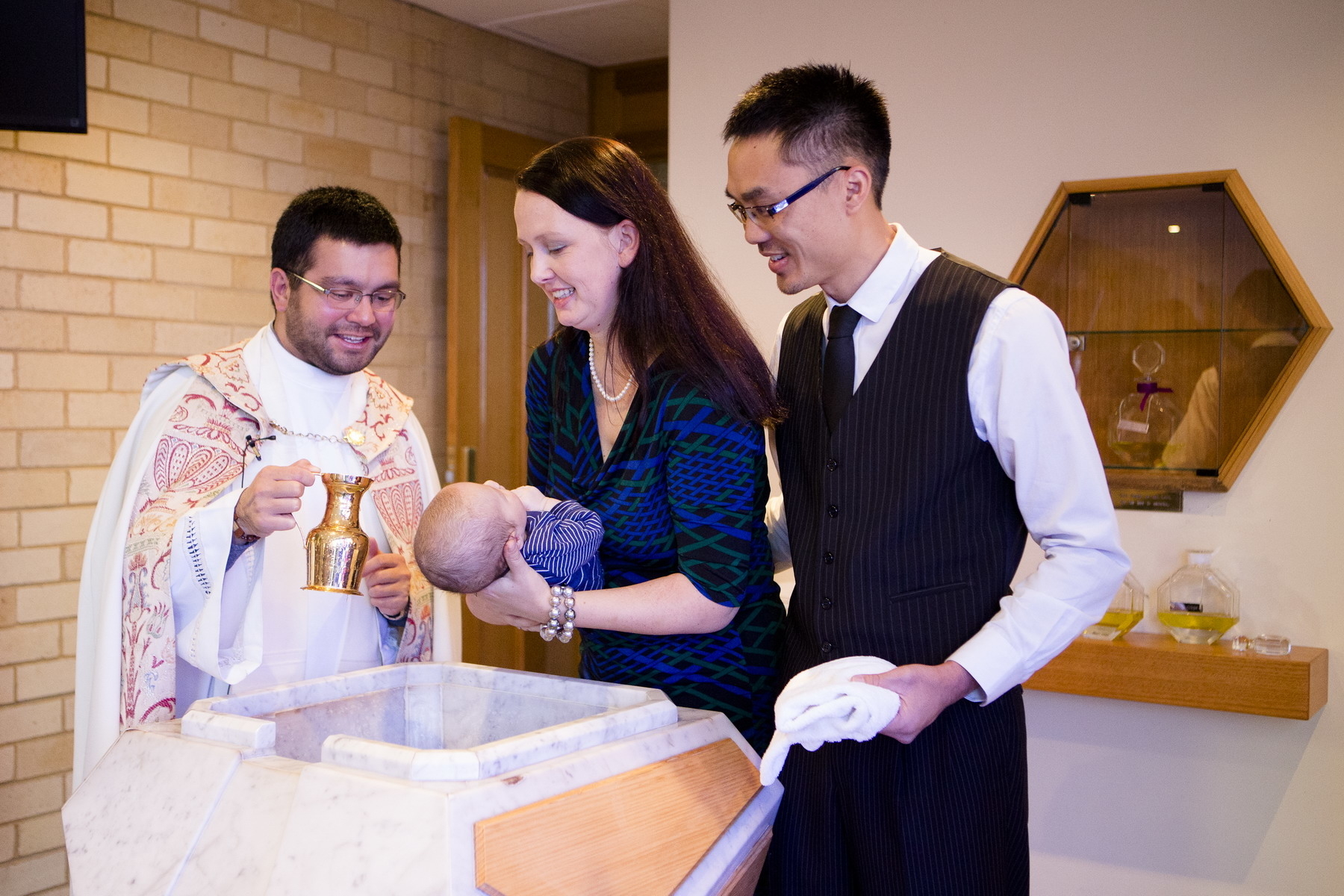
SB051Whatever the preference, consistency in youth ministry is key because each generation deserves to hear the Gospel in the context of a community. Curiously, some would suggest there is too much emphasis on youth in our Church. Others would counter with humour, “Look around – everything we do seems to be for the elderly!”
While parishes do not hesitate in organising and funding services and outreach to the aged, primary school aged children and other distinct segments of the community, they often need real encouragement in responding to adolescents and young adults. One would have thought evangelisation and pastoral care admit of no exceptions.

As I’ve suggested in a previous blog, our parishes so often want these young people for their energy, witness and the hope that they bring to a greying Church but young people will not be attracted to communities that show no life, enthusiasm or generosity in themselves. I maintain that the absence or presence of young people in the life of the Church is, in part, a function of the vitality of its adult members whom they will one day become.

Conclusion

christtheredeemerAll in all, as a recurring feature of the Church’s outreach to youth, World Youth Days should be commended and supported. Of course, cynicism within and beyond the Church about this international event will continue to abound. However, cynicism is often a buffer against personal commitment and the folly of hacks and commentators who often make little effort themselves in this area of the Church’s life. An alternative to cynicism is hope and World Youth Day brings tonnes of it.

As for the next World Youth Day? The safe money is on Krakow, Poland, given John Paul II’s impending canonisation and his status as the originator of the World Youth Day events. 2015 also marks the 10th anniversary of the pontiff’s death so we could see the next World Youth Day a little sooner than expected. World Youth Day has been held in Poland just once before, in 1991, hosted by the southern city of Częstochowa.

As a local plug, you can read about the experiences of pilgrims in Rio from my own Diocese of Parramatta at their blog. Don’t hesitate to share your own views on World Youth Day and comment on how it might be better supported and integrated here in Australia.

lumen fidei

benedictfrancisOriginally intended for publication earlier this year as Pope Benedict’s fourth encyclical and the final in a trilogy on the theological virtues, Lumen Fidei (‘The Light of Faith’) was promulgated this past Friday in the name of Pope Francis.

In the same way as Benedict’s first encyclical in 2005, Deus Caritas Est, brought to completion the unfinished writings of John Paul II, so Francis’ inaugural encyclical represents to a significant degree the thought of his German predecessor on the meaning and implications of Christian faith. This inheritance and continuity between recent papal documents aligns well with Benedict’s own remarks, just days before his abdication, on the writings of ‘Peter’:

Peter was not alone in writing [his] Letter but it expresses the faith of a Church . . . He does not write alone, as an isolated individual; he writes with the assistance of the Church, of people who help him to deepen the faith, to enter into the depths of his thought, of his rationality, of his profundity. And this is very important: Peter is not speaking as an individual, he is speaking ex persona Ecclesiae, he is speaking as a man of the Church.

Likewise, Francis’ encyclical is received not as the word of a private individual apart from or above the Church but an expression of the faith of the communion of which he is called, in his person as ‘Peter‘, to be witness and shepherd.

The Possibility of Faith

lumenfideiLumen Fidei begins by addressing the very dilemma of faith in the contemporary world. Christian faith is so often seen by many as contrary to reason, not as a light that opens up the world but a darkness which stifles and even represses human creativity and the quest for knowledge. Even those who have sought to make room for faith have undermined it by promoting faith, erroneously, as a ‘leap in the dark’ driven by blind emotion. Others who champion autonomous reason as the answer to humanity’s future have often realised that their questions remain unanswered and this has led to an abandonment of the very search for truth itself in favour of “smaller lights which illumine the fleeting moment yet prove incapable of showing the way” (LF 3). Humanity remains hungry for a firm ground on which to stand and hence remains unfulfilled as it experiences the darkness and insufficiency of the world and itself.

On reading these opening remarks, the influence of Benedict stands out. His 1968 work Introduction to Christianity begins with this same confrontation of the very possibility of belief in the world of today. Indeed, the same temptations for the believer and unbeliever alluded to in Lumen Fidei (that of fideism or refuge in rationalism in the face of life’s questions) are raised by the early Ratzinger as prompts toward a fuller understanding of the ‘openness’ of faith, “Just as the believer knows himself to be constantly threatened by unbelief, which he must experience as a continual temptation, so for the unbeliever faith remains a temptation and a threat to his permanently closed world” (Ratzinger, Introduction to Christianity, 45). The recurring challenge of human finality and the quest for human understanding rescues both the believer and unbeliever from being shut up in their own worlds, resisting any tendency to self-satisfaction and urging humanity onwards in the search for truth.

9954008Lumen Fidei seeks to propose the light of faith as the guide to this truth that we seek, a light that illumines all aspects of our existence in illuminating God as one who addresses us personally. It notes that the word of God that called Abraham, ‘our father in faith’, is not alien to human experience but always present at the core of our being. It follows that Abraham’s response to that divine calling, Abraham’s faith, “sheds light on the depths of his being, it enables him to acknowledge the wellspring of goodness at the origin of all things and to realise that his life is not the product of non-being or chance, but the fruit of a personal call and a personal love” (LF 11). Faith in God, then, as one who creates and calls is not an extrinsic act or a merely ‘religious’ commitment but an integral and humanising project and gift which, when received, unveils our true vocation in the life of God himself.

The faith of Israel that would follow Abraham further reveals faith as a summons to a pilgrimage with the Lord that calls through the concrete events of our life. The history of Israel also sounds a note of warning, that of idolatry which reveals our own tendency toward control and vanity, as Lumen Fidei makes clear, “Idols exist, we begin to see, as a pretext for setting ourselves at the centre of reality and worshipping the work of our own hands” (LF 13). While commentators have seen in this discussion of idolatry the hand of Pope Francis, it is one that was certainly shared by his predecessor in his writings on the liturgy among others (see Ratzinger, Spirit of the Liturgy, 22f). The overall thrust of the text is to underline the paradox of faith, that is, as in all loving relationship, by our constant turn towards the one beyond our control, and by the surrender to what we did not initiate, we become more and not less ourselves, freed from the slavery of our own self-absorption and insecurities.

Ultimately, it is in Christ Jesus that the total manifestation of God’s faithfulness arrives in history, the crucifixion of Christ being the “culmination of the gaze of faith; in that hour the depth and breadth of God’s love shone forth” (LF 16). It is a total gift of self that precedes us and allows one to entrust themselves completely to the utter reliability of God’s love, manifest not only in this death-in-love but in his rising in love, a “tangible and powerful love which really does act in history and determines its final destiny, a love that can be encountered” (LF 17). It echoes the thought of Ratzinger for he affirms elsewhere, “Christian faith is more than the option of a spiritual ground to the world; its central formula is not ‘I believe in something’ but ‘I believe in you’. It is in the encounter with the man Jesus, and in this encounter it experiences the meaning of the world as a person.” (Ratzinger, Introduction to Christianity, 79).

After a brief word on the ecclesial form of faith, perhaps surprisingly brief given the demise of the Church’s credibility in the wake of the abuse scandal, the encyclical turns to the relation of faith to the truth which human beings seek (the theme of the Church is picked up again in Chapter 3 of Lumen Fidei though, again, without any theological treatment of sinfulness within the Church).

A Reasonable Faith

fidesEngaging an epistemology that may not be accessible to all, Lumen Fidei then goes on to underline the significance of truth for faith. Without truth, faith remains only “a beautiful story, the projection of our deep yearning for happiness, something capable of satisfying us to the extent that we are willing to deceive ourselves” (LF 24). Knowledge of the truth, Lumen Fidei asserts, is to be found in love which cannot be reduced to ephemeral emotion but is, most deeply understood, union with the Other. Without this love, “truth becomes cold, impersonal and oppressive for people’s day-to-day lives”; without truth, love becomes mere sentimentality, a fleeting emotion and cannot be a ground on which a future can be sustained. Love without truth “cannot stand the test of time” (LF 27). It is this discovery of love as a source of knowledge, as an interpersonal communion built upon truth that is capable of pointing us toward our ultimate fulfilment, that finds expression in the biblical understanding of “faith” (LF 28).

Returning to the concern of the opening paragraphs, Lumen Fidei then turns to the dialogue between faith and reason, drawing on the insights of John Paul II’s Fides et Ratio and also St Augustine, a perennial influence in Benedict’s own thought. As in the writing of John Paul II, faith and reason are presented not as opposed – as if faith were an irrational undertaking or that reason leaves behind the necessity of faith – but are recognised as having the same end or finality which is to know the truth. The reception of divine revelation and the ongoing human question for meaning, or philosophy, are not exterior to one another but intrinsically linked as Lumen Fidei seeks to show by the example of scientific inquiry,

The light of faith is an incarnate light radiating from the luminous life of Jesus. It also illumines the material world, trusts its inherent order and knows that is calls us to an ever widening path of harmony and understanding. The gaze of science thus benefits from faith: faith encourages the scientist to remain constantly open to reality in all its inexhaustible richness. Faith awakens the critical sense by preventing research from being satisfied with its own formulae and helps it to realize that nature is always greater. By stimulating wonder before the profound mystery of creation, faith broadens the horizons of reason to shed greater light on the world which discloses itself to scientific investigation (LF 34).

popejohnpauliiAs Fides et Ratio affirmed for philosophers so it may be said for the scientist, “it is necessary not to abandon the passion for ultimate truth, the eagerness to search for it or the audacity to forge new paths in the search. It is faith which stirs reason to move beyond all isolation and willingly to run risks so that it may attain whatever is beautiful, good and true. Faith thus becomes the convinced and convincing advocate of reason” (FR 56). As it has been said, it is faith that challenges reason to more audacious undertakings.

An Ecclesial Faith

The third and penultimate chapter of Lumen Fidei expands on the ecclesial context of faith that is only touched upon at the end of Chapter One (LF 22). Addressing the maternity of the Church, as one who brings about the birth of Christ in the believer, the encyclical draws attention to the living tradition of the Church.

The Church passes on the light of faith through the generations, “just as one candle is lighted from another”, an image that certainly recalls Pope Francis’ preaching style. Raising the question of the verification of knowledge, the encyclical underlines the relational way in which knowledge is transmitted, “Language itself, the words by which we make sense of our lives and the world around us, comes to us from others, preserved in the living memory of others. Self-knowledge is only possible when we share in a greater memory” (LF 38).

This sociological reality illuminates the theological significance of the Church as a “remembering subject” for it is this living communion that precedes us, and into which we are baptised, that teaches us the very language of faith. In plain terms, the Church came before us and rather than stifling our personal engagement with God in Christ, this very fact makes possible our personal faith with all the riches and insights of those that preceded us.

noahangbaptismP_041In faith, we respond to a word which did not originate with us – in the language of Lumen Fidei, “Our belief is expressed in response to an invitation, to a word which must be heard and which is now my own; it exists as part of a dialogue and cannot be merely a profession originating in an individual” (LF 39). Ratzinger’s earlier text makes the point in a similar way, “Faith comes to man from outside. . . [It is] not something thought up by myself; it is something said to me . . . This double structure of ‘Do you believe? – I do believe!’, this form of call from outside and the reply to it is fundamental to it” (Ratzinger, Introduction to Christianity, 91-2).

The ecclesial form of faith also expresses itself in the Church’s sacraments which “communicate an incarnate memory” (LF 40). Lumen Fidei even intimates the sacramental structure of faith itself for “the awakening of faith is linked to the dawning of a new sacramental sense in our lives as human beings and as Christians, in which visible and material realities are seen to point beyond themselves to the mystery of the eternal” (LF 40). Following this there is catechesis on the sacraments of baptism, confirmation, Eucharist, the creed, the Decalogue and prayer before the fourth chapter turns to the social consequences of the nature of faith outlined.

An Incarnate Faith

In continuity with Pope Francis’ preaching on the sociality of faith and the Church’s mission, the encyclical concludes by relating faith to the common good, affirming faith not as a privatised journey of introspection or pious isolation but a “process of building, the preparing of a place in which human beings can dwell together with one another” (LF 50). Faith does not only provide interior firmness, it also allows the believer to see others in their inherent dignity and vocation, born of love for union with God’s own self. Faith, because it is loving, does not draw believers away from the world but ever deeper into the concrete concerns of the men and women of our time. Families and the young are called to be bearers of faith in the midst of the world (LF 52-53) while faith brings as well a respect for creation as a gift for which all are indebted.

woodencrossA powerful section of Lumen Fidei is its treatment of human suffering in which it recognises human pain, hunger and loss is not at all extinguished by faith but placed in a new context of meaning. The encyclical affirms in this regard, “Faith is not a light which scatters all our darkness, but a lamp which guides our steps in the night and suffices for the journey. To those who suffer, God does not provide arguments which explain everything; rather, his response is that of an accompanying presence, a history of goodness which touches every story of suffering and opens up a ray of light” (LF 57). Pope Francis reminds us that it is Christ who has occupied the place of suffering, in the Gethsemane Garden and on the Cross, and as the endurer of humanity’s suffering he will be “the pioneer and perfecter of our faith” (Heb. 12:2) (LF 57).

As is tradition, Lumen Fidei concludes with an affirmation of the ‘Marian profile’ of faith for it is Mary who demonstrates the fruitfulness of faith from the Annunciation to the Cross. As figure of the Church and as one whose motherhood extends to each of his disciples, Mary leads us always and only to the blessing of faith which is her Son.

Conclusion

LUMEN FIDEI encyclical provisional cover_ B 13.inddLumen Fidei is a timely encyclical for a challenging moment in the Church’s history, calling for a return to the purity and plenitude of the faith that we have received and are called to live in the present. As this most recent teaching is received and settles within the tradition of the Church (and it calls for future reading together with its forebears Deus Caritas Est and Spe Salvi), many more insights and implications will no doubt come to light. What is obvious by its absence is significant reference to the “new evangelisation” as another manifestation of the Church’s self-understanding (with the exception of LF 42). We might hope that a future exhortation on this subject will build connections and so further expand the implications of faith for the Church’s mission in a new time, in the context of a globalised church and with a variety of ad intra and ad extra influences impacting on the Church’s relation to the world.