
 In the previous session, we acknowledged those factors impacting upon parish life today – a new and unchartered context for faith, the presumptions of our pastoral practices and questions of fruitfulness that invite change, as well as the biblical and magisterial foundations for reclaiming discipleship as our central commission.
It is clear that the missionary conversion of our parishes to which we have been speaking bears implications for the ministry of the ordained, in particular the priesthood which is that Order most commonly lived within the parish and which remains the most familiar to the ordinary Catholic Christian. There is no need to rehearse at great length the way in which ordained ministry is situated within the context of the Church. Suffice to say that the ‘communion ecclesiology’ of the Second Vatican Council recovered baptism as the primal sacrament of Christian life and brought about a renewed appreciation of the Church as an icon of the Trinity, a relationship that promotes a mutuality of exchange between believers in their various charisms, vocations and office as an expression of the unity-in-diversity of God’s own life. It is by our baptism into this Triune life that we are brought into communion not only with God in Christ by the Holy Spirit but also into communion with our fellow believers and the worldwide community of the faithful, into communion with those who have gone before in faith, and with the generations of the faithful yet to come.
In regrounding the life of the Church, including the ordained, in shared baptismal faith, the Council also promoted the mission of the Church as the responsibility of all, a task to which each of the baptised is commissioned, and I quote from Lumen Gentium, ‘by the Lord himself’. The source of apostolic courage for this project as Christians is our common regeneration and anointing by the Holy Spirit, our consecration into a spiritual house and into the one priesthood of Christ, in its priestly, prophetic and royal dimensions.[1]
What, then, of the unique charism of the ordained set within this baptised and missionary people? It is first important to acknowledge that the understanding and practice of ordained ministry has undergone significant development and refinement – from the apostolic ministry found in the New Testament, through the age of the Church Fathers, the impact of the medieval theology of order (the effects of the eleventh and twelfth century Gregorian Reforms e.g. shift from patristic emphasis in Holy Order on God’s action upon the believer to its definition in terms of the sacred character imparted), and the baroque theology which followed the Reformation, to the insights of the Catholic revival (cf. John Henry Newman and the Oxford Movement), leading to the eventual ressourcement achieved at Vatican II.
 It is enough to trace the various emphases that have shaped the theology and practice of the ordained ministry through this history to appreciate that, in speaking of the ordained vocation, ‘God-given’ is not the same thing as ‘set in stone’. There are a variety of ways in which the priestly life can and has been lived. To borrow from the thought of Fr Aidan Nichols, the ‘pattern’ of the presbyterate has in fact a variety of key elements that open themselves to the evangelisation and disciple-making we have discussed.[2] Within this ‘pattern’ of priestly life, developed and clarified over centuries, we find at least nine elements, each of which informs the other:
- Evangelising those who do not believe
- Teaching sound doctrine in faith and morals to those who do
- Forming others to be apostolic
These constitute dimensions of the prophetic office, the exercise of teaching that leads the faithful to God in the Spirit and truth.
- Celebrating sacraments and other rites of the Church
- By the celebration of Penance and Eucharist in particular bringing the Paschal Mystery to bear on the lives of the faithful (to die to sin and live with Christ)
- In the Mass, acting as intercessor for the Church and for all creation
These are aspects of the priestly office, the cultic or liturgical work of the presbyter.
- In union with the bishop to build up, as pastor, the communion of the Church, gathering the faithful and opening them to the fullness of the Church’s life
- Visiting, and so counselling and encouraging, individual members of the Church community, especially the sick and the poor
- Overseeing the community’s wider attempt to meet the needs of its members, and of the wider realm in which their lives are set
Last but not least the royal dimension of the presbyter, his pastoral government of the local community of faith.
We see here in these prophetic, priestly and pastoral offices distinct elements that nevertheless inform one another in a unity. For example, the pastoral government that the priest exercises over the whole community – a form of rule that can never be exercised by the non-ordained in the sense of which a cleric does – supplies his teaching mandate with its proper form or modality, while his teaching is to be undertaken in such a way that the people committed to his charge (under his pastoral government) live ever more deeply in communion with the Church, with one another and with holiness in the wider communities and contexts in which their lives are set.
Needless to say, the sacramental and liturgical assignment of the priest informs all other aspects. As Cardinal Henri de Lubac observed, the gift of the Eucharist in the hands of the priest is not merely the conversion of bread and wine into the body and blood of Christ but, ultimately, the conversion of God’s people by its reception.[3] Here we see the connection between the liturgical presidency of the priest and the responsibility to form others for the apostolic life, enabling the faithful to live Eucharistic lives in self-donation to others.
We see in this broad outline the ecclesial nature of ordained ministry, in service of the Church’s communion and its mission. In the language of the Letter to the Hebrews, the priest is in Christ a ‘pioneer and perfecter of faith’, shepherd of the faithful and is to equip the saints, particularly by his teaching, for building up the body of Christ in the midst of the world (Heb. 12:2; 13:20; Eph. 4:11).
Key Opportunities
 I would like to focus in particular on how the priest’s teaching office and his responsibility for pastoral government can best be lived today in order to serve the growth of discipleship in our parishes and evangelisation beyond the pews (sets one and three of that tripartite pattern of priestly life).
Evangelising Those Who Do Not Believe
It is sufficient to note that by ordination the priest does not cease to have a commitment to the evangelisation of those who are not gathered in Christ. The priest, as for the bishop and deacon, is included in the orientation of the entire Church toward mission in the world and so is called to reach out to not only those who might present with faith or form part of the existing parish but all those in their neighbourhood who do not yet know their home is with us. When priestly ministry becomes disconnected from the real experience of meeting and ‘breaking bread’ with the poor in spirit and circumstance – those without faith, those who those are existentially homeless and even those who oppose – then the call and instruction of the laity to reach beyond their boundaries of the parochial and the familiar can lack transparency and relevance. Acting in Christ the Head, the priest is called to be a pioneer in finding the lost, shepherding even those who are not yet part of the flock, and bearing his own dedicated witness to Christ in the unvarnished circumstances of people’s lives and dilemmas. We know that the future of our Church is always connected to those who are not yet believers. This calls the labour of the priest to extend to the harvest field, well beyond the confines of the ecclesiastical ‘barn’.
Teaching Sound Doctrine in Faith and Morals to Those Who Do
In teaching sound doctrine for the ongoing conversion of the faithful, the priesthood demands not only disciplined training in the content of faith, but also an acute recognition that teaching, to be effective, implies that there is in fact some learning taking place. In the terse words of Richard Gaillardetz, a mere “commitment to the epistemic objectivity of Church doctrines” does not mean subjective appropriation has followed.[4] In other words, much like the sacraments, teaching is not magic, a blunt tool applied without regard for the disposition of those who are being taught. When there is little or no understanding of the faith, we are challenged to do more than just say the same thing a little louder.
As the lives of laity can change at a pace (their lifestyles, social and material circumstances), the act of teaching on the part of the priest will also mean receiving into one’s own faith and knowledge that insight of ordinary believers as they attempt to apply doctrine or practice belief in the concrete conditions of their life. In short, I would suggest that the priest teaches best by drawing not only from doctrine, as an abiding expression of faith, but also by attending to and learning from the narratives and daily practices of Christian men, women and families, which supplies genuine theological insight for the art of teaching a perennial faith in new times. The Church is not faithful to its apostolic roots merely by presenting doctrinal statements, as if there the matter rests. Effective teaching leads people to a Jesus-shaped life by connecting the meaning of doctrine, which is the Gospel, with the hopes and trials of the learner. The primary challenge for the homily, as a primary form of teaching, is not poor oratory or exegesis but the need to bring the insight of Scripture and tradition into conversation with the deepest experiences of daily life, especially for post-modern people who are intimately aware of the pain of their own past but struggling towards a coherent future. Expressed in Evangelii Gaudium as the need for synthesis, not detached ideas, this form of inculturated teaching and preaching is the work which our era demands of us and is the path which the Church has followed for twenty centuries.[5]
Forming Others to Be Apostolic
 Of course, even in the case of sound and effective preaching, the priest cannot be expected to carry the responsibility for the missionary conversion of our parishes alone. As we have acknowledged, it is not obvious in our day that the hearts of laity are burning with the fire of Jesus’ mission in the Church and the world, as evidenced by our gentle decline and the culture of maintenance or immobility we can sometimes encounter in our parishes.
How can we best move people beyond a closed culture towards a culture of apostolicity, from a routine of comfort to the boldness of mission? As leaders it first demands a shift in our own outlook and approach, from engaging our people to build up the Church to becoming a Church that builds up people. When we routinely engage people to build up the Church, the focus inevitably falls on our structures, maintenance and functionalism. For example, a parish calls people forward to maintain its own life, its ministries, functions and tasks for which there is never enough human labour. We engage people, in other words, to ‘fill the gaps’ and out of a mindset of deficiency, with the best of our energy, dedication and resources flowing into the upkeep of our established groups, ministries and schedules. However, our parishes are not called to be factories, to keep the cogs turning over at any cost. We cannot confuse our means with our end which is the abundant spiritual life and personal change of our people. As it has been expressed, ‘If you build the Church, you rarely get disciples. If you make disciples, you always get the Church.’ Parishes begin to change their culture towards mission when all forms of its preaching shift from a focus on what it wants from people to what it wants for them.
In experience, our tendency to focus on deficiency and ecclesial need rather than vocation and personal calling can stymie our work, including in the raising up of young leaders. When youth leadership is recognised as the call to equip young people to lead within their life, in the context of their personal and professional relationships, this opportunity takes on a different hue that goes well beyond our parish need for more ministers. The model of a youth leader for a parish group on a Sunday night is one reality, the model of young Christian leaders in our culture is quite another.
In sum, when a community understands itself as existing not for its own preservation but for the invitation of spiritual and personal change among its members and non-members, then all that the parish undertakes, its programs, groups, structures, and finance, will be seen and considered in the light of its mission to make and send disciples. We will begin to measure our parish life not by the standards of conservation – the managing of internal concerns, the parish patrimony, nest egg or tranquillity – but by the standards of our outwards mission. We will begin to gauge our life not only by our seating capacity but also by our sending capacity, and the extent of the spiritual fruit and personal change we nurture into life.
Pastoral Government
 In turning to the pastoral governance of the priest as whole – including building up the communion of the Church and overseeing the parish’s attempts to meet the needs of its members – there are practical steps that can be taken to lead parish renewal in a focused and also a sustainable way. To bring these practices and principles to real life, I will engage the parish of Saint Benedict in Halifax, Canada, as an example of best practice.
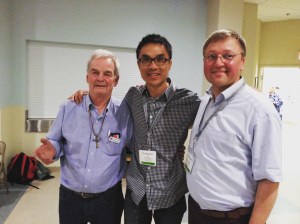
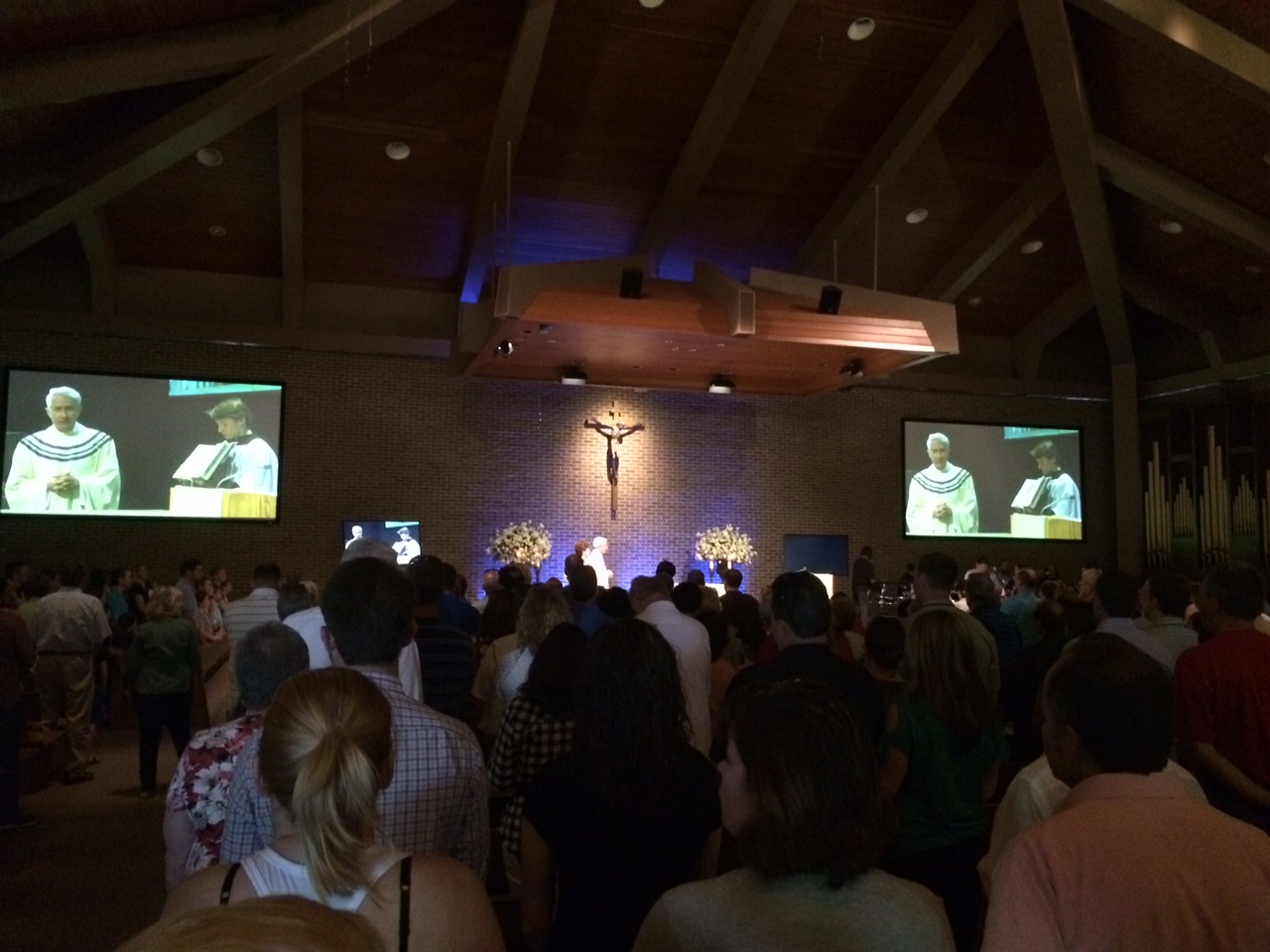
While no parish can serve as a strict blueprint for another, and every parish differs in demographic, resources, history, leadership and personality, there are basic principles that can be shared and that are transferable from one context to another. The Parish of Saint Benedict has, over some six years of experience, missteps and learning, developed a ‘Game Plan’ that has been put into practice with great commitment over the past three years, and that has assisted this parish to become an authentic school of discipleship. The focus of the community’s leadership is on cultural change and not a mere change in mood music. Last year, I was privileged to travel to this parish and to experience the community for myself in the context of a conference. In the first instance, what was most striking about the parish of Saint Benedict is its familiarity. While the discipleship process that has developed there is exceptional, the parish building, its context, and equipment are not unfamiliar or exotic in anyway. The process of developing disciples at Saint Benedict, in other words, does not lean on its facilities.
Exemplified by this example of Saint Benedict Parish, are four practical steps that we can take forwards to nourish a culture of discipleship and evangelisation in our own parishes, steps that are scalable for communities of different circumstance. Even if a community is not prepared to undertake such a process as a whole, it can be taken up by a parish ministry group, movement or association seeking direction and to focus its outreach. The four steps include:
Vision – Why
Priorities – What
Strategies – How
Actions – Who, When and So What?
As we have said, a first point of renewal for growing parishes is to clarify vision, the why or purpose of community life. We have seen the vision cast by Saint Benedict Parish, the image of a preferred future which the parish seeks to pursue at every turn: “Saint Benedict Parish is a healthy and growing faith community that brings people to Christ, forms disciples, and sends them out to transform the world. Our members commit to worship, to grow, to serve, to connect and to give”. Again, this ecclesiological vision helpfully combines welcome with expectation, as Jesus did in John’s Gospel when he expects the vine to bear fruit, and even prunes and expects more from those vines already producing. In working with parishes, some helpful prompts to prayerfully discern and form community vision can include the following questions:
- What does our parish exist for?
- What do we hope and dream to be as a community of faith?
- What spiritual fruit do we want to see in our people?
- What kind of disciples do we want our parish to make?
Ideally, the parish vision will focus in some way or another on discipleship. It will in some way cast a vision that centres itself on the spiritual change of its members.
Priorities, Strategies and Actions
 Having established a parish vision, a parish can then identify the priority areas where it intends to live that vision most immediately within a given time frame, say three to five years. Returning to the ‘Game Plan’ of Saint Benedict Parish, there were five priorities discerned by the community as areas for focus. The parish proceeded to identify those core systems of a church, which like the systems of a body, are essential to the growth of the ecclesial body.
Saint Benedict Parish arrived at the five priority areas of evangelisation, community, ministry, discipleship and worship. It was these priorities that then informed the development of the ‘Game Plan’. Special interest groups such as youth or family are noticeably absent from this list of priorities, as it is trusted that if the core systems of the parish are renewed, this rising tide in the parish will float all boats.
For the ministry in the priest in particular, I am mindful that when a community has a vision but no particular priority areas in which to achieve it, it will tend to simply ‘add on’ new programs and activities to an already busy routine hoping this will affect a difference. Yet we know, even implicitly, that addition is not synonymous with increase; that ‘more’ is not always tantamount to ‘better’. We are learning on a national, diocesan and parish level that a ‘spaghetti’ approach to Church life, over-programmed with a splattering of disconnected activity, tends to encourage silos rather than unity or strength of mission. This is because events, programs and groups compete for space on the common calendar, rivalling one another for the same pool of finite resources, increasingly busy people and limited attention. If we become content with the unrolling of copious activity, without heed of the fruit these initiatives bear or otherwise, we in fact succumb to the “spiritual worldliness”, or busyness for its own sake, of which Pope Francis warns.[6]
Given that all parishes have limited resources – time, energy and personnel – there is a need for the priest to discern those priority areas which will best serve its local mission for discipleship, naming what gets done first and what is done later. Prioritising ensures the best use of constrained resources, improves the speed of decision-making as we have something to assess any new initiatives against, it can bring order to the chaos of a ‘spaghetti’ approach when there is a lot of activity but it is disconnected or not relating to a bigger vision, and reduces parish stress.
We know from experience, even if it is not always named, that no one parish can ‘do it all’ and so we must choose the best things to do even over good things to do, recognising that whenever you set some priorities in a parish some people will be disappointed with our choices. We need to resist the temptation to try and meet every possible need as this will not only be impossible and impractical, or lead to burn out for your own ministry, parish pastoral council or parish staff, but responding to particular ‘needs’ does not necessarily serve the greater vision of the parish, especially when the loudest voices tend to dominate and are not necessarily the most important.
How can we best determine our own parish priorities in prayer and reflection? We can examine the current life of the parish. Our local demographics and observations can reveal urgent and significant areas that call for our response as a parish. We have tools for this self-understanding including the National Church Life Surveys conducted by many Australian dioceses. We can also consult our people for these priorities, though it is worth noting from experience that consultation processes typically surface similar and predictable priorities including youth, family life, adult faith formation, and outreach. This approach can help grow engagement within the community though it demands time. Alternatively, like Saint Benedict Parish we can examine core systems of a healthy church, systems which like those of the body contribute to the working of the whole.
 Once parish priorities are identified, the parish can then conduct a simple SWOT analysis – identifying its strengths, weaknesses, opportunities and threats in each area of priority. This assists a parish identify its areas of strategic action. We can narrow these strengths and limitations that call for a response to a limited and workable number, by asking questions such as:
- What strength in this area can your parish most easily build upon?
- What weakness in this area would be the easiest one to fix?
- What is the greatest opportunity in this area we could seize upon with the least amount of time and resources?
- What is the most immediate or greatest threat we need to address, and how?
The result is that a parish has a manageable number of focus areas to address, enabling it to move forwards in areas of priority. Finally, having established a vision, prayerfully discerned key areas of priority, and identified specific strategies through a look at its strengths and weaknesses, we can then select appropriate actions to bring our strategies to real life.
Awakening the Priestly Charism
This form of intentional planning in priestly governance has been shown to be essential to growth and cultural change in a parish, and requires dedication, the holding of nerve and apostolic courage. However, I believe it is no more demanding than the labour of maintenance which, to draw from the imagery of the Cappadocian Fathers, can resemble toiling up sand dunes with much movement but very little progress. The often disheartening alternative in the parish is to ask ‘What should we do next?’ without the clarity and motivation of a coherent purpose or vision for ourselves in ministry and for the people in our care.
In this context, it is important to say that casting vision and discerning strategies for the growth of discipleship are not meant to be undertaken alone. Christian governance in its deepest sense does not imply leading alone but leading out of a team, in relationship to others. Indeed, the unique charism of the priest, who acts in Christ the Head, is to discern those of the laity with whom the baptismal, Eucharistic and missionary unity of the parish can best be advanced.
 What is more, the flourishing of the laity and their involvement in the pastoral plan or initiatives of evangelisation and mission is critical to the vitality of the ordained. When discipleship and conversion are unleashed in Christian community through vision, priorities, and strategies that support cultural change, this rich spiritual life will organically evoke or call forward the governance of the priest. Such flourishing of the People of God will draw out the fullness of teaching, sanctifying and governing from the ordained. When community faith and charisms abound, it demands the office of pastoral government, expressed in the priest’s cooperation with laity in mission to the world, listening to and recognition of lay expertise, awakening and deepening the priest’s call to co-responsibility, to entrust to and invite initiative of the lay faithful, and for the priest to explore and discern with them lay vocations and apostolates.[7]
In the absence of active discipleship in the parish, little governance needs in fact to be exercised by the priest. The parish routine does not invite laity to discern and actively live their call and so the priesthood itself does not flourish as God intends it to. In contrast, Lumen Gentium announces the type of pastoral governance that the Church wills for its priests,
It is not only through the sacraments and the ministries of the Church that the Holy Spirit sanctifies and leads the people of God and enriches it with virtues, but, “allotting his gifts to everyone according as He wills,” He distributes special graces among the faithful of every rank . . . Those who have charge over the Church should judge the genuineness and orderly use of these gifts and it is especially their office not indeed to extinguish the Spirit but to test all things and hold fast to that which is good.[8]
We have here the legacy of Congar and the school of ressourcement at the Council, the firm insistence that the Spirit is not monopolised by hierarchical office as though it were a kind of reservoir dispensing gifts from above. The laity too are subjects of the Spirit’s action as persons of baptismal faith and that this calls forward the unique pastoral government of the priest to order those gifts toward mission. As affirmed at that same Council:
While testing the spirits to discover if they be of God, they [the presbyters] must discover with faith, recognise with joy, and foster diligently, the many and varied charismatic gifts of the laity, whether these be of a humble or more exalted kind . . . Priests should confidently entrust to the laity duties in the service of the Church, giving them freedom and opportunity for activity and even inviting them, when opportunity offers, to undertake projects on their own initiative.[9]
In total, this sets forth a vision of the Church in which the priest exercises his ministry in service of the gifts and charisms of the laity, given for God’s mission in the world, and through this exercise of governance fulfils the pastoral dimension of his office. It is worth sharing the reflection of Fr Michael Fones OP, cited by Sherry Weddell, on this often untapped potential of the priesthood,
I often wonder what it would look like if a pastor intentionally focused on this aspect of his priesthood; how would parishioners respond if they were challenged to consciously discern their gifts and call (and given help to do so), and then intentionally supported by the parish in living that call? I also wonder if a whole set of young men aren’t being drawn to the priesthood because their call is most closely associated with the royal (or governing) aspect of a priest’s office. I know priests whose priesthood is most deeply felt when they’re celebrating the sacraments, and others for whom teaching and preaching are the cornerstone of their lives. Might there not be men who would respond to an invitation from Christ to be a priest if they saw the royal function expressed more clearly and powerfully?[10]
The priest exercises leadership in parish evangelisation by forming and ruling the priestly people through his discernment and empowering of God’s gratuitous gifts, given to the whole Church for the sake of God’s mission.
Conclusion
Whether proclaiming and teaching the Word of God, sanctifying through the sacraments and acts of worship, or building up the Church and calling out the gifts of the laity through his pastoral governance, the priest is a privileged presence of Christ’s life and mission. The riches of the priesthood are needed now more than ever, to call and awaken the charisms and gifts of the faithful through a teaching office in tune to the lived experience of those who learn, through a sanctifying office that mediates grace, a grace that calls to be received and bear real fruit among active disciples, and through a royal office or pastoral government that marshals those gifts and charisms of disciples to bear witness to Christ in the Church and the world. Divinely ordained and living in history, graced and building upon the gifts of nature, God-given and yet not set in stone, the priesthood, as much as the episcopacy and diaconate, will flourish to the extent it is expressed in faithful and effective living. Thank you for your dedication to Christ’s priesthood and mission here in the Archdiocese and in a wider world that cries out for God.
References:
[1] Lumen Gentium 10, 31-33.
[2] Aidan Nichols, Holy Order: Apostolic Priesthood from the New Testament to the Second Vatican Council (Dublin: Veritas Publications, 1990), 142-143.
[3] Cf. Henri de Lubac, The Splendor of the Church, translated by Michael Mason (San Francisco: Ignatius Press, 1999). There are echoes of de Lubac’s thought in St John Paul II’s 2003 encyclical, Ecclesia de Eucharistia.
[4] Richard Gaillardetz, “Power and Authority in the Church: Emerging Issues”, A Church with Open Doors (Collegeville, MN: Liturgical Press, 2015): 93-94.
[5] Pope Francis, Evangelii Gaudium 143.
[6] Pope Francis, Evangelii Gaudium 93-97.
[7] Sherry Weddell, Forming International Disciples (Huntington, Indiana: Our Sunday Visitor, 2012), 84.
[8] Lumen Gentium 12.
[9] Presbyterorum Ordinis 9.
[10] Weddell, Forming Intentional Disciples, 85-86.
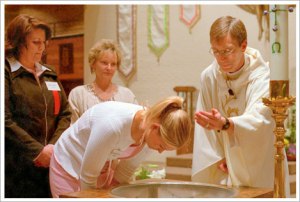
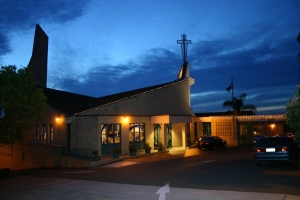 On the 24 November, 1999, on a drizzly Wednesday evening, I was baptised in a parish in the north-western suburbs of Sydney. Heralding from a family of Buddhist and Taoist heritage, I entered the Church at the age of twenty, gathered with a priest, sponsor, fellow catechumens and a mixed group of close friends, mostly of no religious background. A small but powerful group had accompanied me through the process of initiation and I was fully conscious and grateful for the fact that in God and this community I had been granted something which I would spend the rest of my life learning to be faithful to, learning to enter into, learning to trust.
 Reflecting on the Australian Church, I would concur that the central challenge for parish life is this: we are caught between a call and desire for renewal and the weight of our own church culture towards maintaining the status quo. In this moment which cries out for new apostolic zeal, we can feel bound by layers of expectation that demand the continuation of the old even while new forms of parish life and mission long for expression.
 Fundamentally we are called to be a Church of the Great Commission. This is our vision, the ‘northern star’ guiding our resolve. “Go therefore and make disciples of all nations, baptising them in the name of the Father and of the Son and of the Holy Spirit, and teaching them to obey everything that I have commanded you” (Matt. 28:19). As it has been pointed out, in our Catholic Church we have certainly learnt to “go” and can claim a presence at all corners of the earth. We “baptise” and confirm relentlessly. We “teach” and catechise great numbers in our schools and sacramental programs. However, our ability as Church to “make disciples” remains in question, as raised by the pastoral realities for the Australian Church we have explored.
 When we communicate a vision of the parish, how we seek to respond to God in this context, in this time, in this local community, when we can articulate a vision of the kinds of spiritual growth we are seeking to raise up in our people, this passionate purpose becomes the heartbeat or pulse of a parish. Conveniently, and not incidentally, a renewed vision provides the case for change.
 It is worth noting that when a parish makes a commitment to a clear vision of personal discipleship and spiritual community, presenting this before its people, other good things begin to flow. With a vision pointing the parish beyond its own concerns and circumstance, the parish can begin to move from a culture that engages people to build up the Church to become a Church that builds up people.
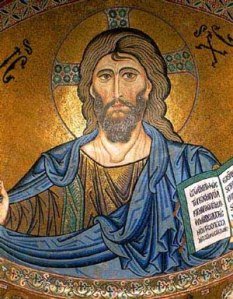 First of all, at the heart of evangelising communities is the proclamation of the Good News, specifically the kergyma which is the basic truths of our Christian faith. This word kerygma, or keryssein in Greek, may not be very familiar to us but it in fact appears in the New Testament some nine times, and refers to the very heart of the Gospel, the core message of the Christian faith that all believers are called to believe and proclaim.
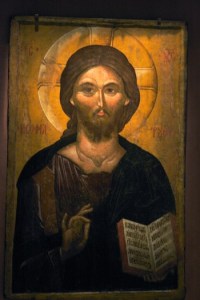 The heart of evangelisation is to announce who Jesus is, the Son of God, the Word made flesh, the man who is God, who died for our sins and was raised on the third day. It is to announce the Good News of the Risen Christ who is with us even now and opens up for us the way to life without end. Evangelising parishes proclaim Jesus’ ascension, his seating at the right hand of the Father as King, and his sending forth of the Holy Spirit. It is this Spirit which reveals Christ and even enables us to say ‘Jesus is Lord’ and it is this Spirit who empowers the Church, who empowers us, to be faithful to Christ’s mission in our own lives and in this moment of the world’s history. Finally, this Good News of Christ calls us to conversion, to repent and believe in this Gospel, calling for a change of life in the light of what God has done and is doing in Jesus Christ whose life we share by baptism, the anointing of the Holy Spirit, in communion with his mystical body, the Eucharist, and by our communion with His ecclesial body, the Church. In prioritising this proclamation, we seek to build up a culture in which Jesus is not swept into our parish story intermittently but our parishes and lives are swept into his.
 However, the bold proclamation of Jesus’ name, life, promises, Kingdom and mystery, in itself is not sufficient for the growth of a missionary culture in our parishes. As a second foundation, evangelising parishes cultivate personal discipleship, create room and opportunity for a personal response to the Good News proclaimed. The call to be a disciple is a gift but it also involves a choice and personal decision that cannot be delegated to any other.
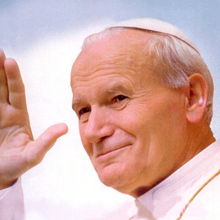 Bringing together these first principles of evangelising communities, we hear St John Paul II affirm, “Faith is born of preaching and every ecclesial community draws its origin and life from the personal response from every believer to that preaching”.
 Personal discipleship also calls for the nourishment of an ecclesial community of faith. Evangelising parishes create disciples in the midst of the Church.
 While our vision needs to be as large as the Kingdom, our implementation of that vision needs to begin small. With encouragement for us, it is worth noting that when large evangelical and Pentecostal communities are asked what they seek for their future it is to establish smaller, stable communities in the midst of a local neighbourhood, offering a consistency and intimacy of worship and local service in personal connection with the wider community. In other words, what many megachurches are seeking is a parish.
 Finally, we recognise that the proclamation of the Gospel, the call to personal discipleship and the life of the Christian community are not for their own sake but for the sake of the world. All that has gone before must bear fruit in our connection with others beyond our communities of faith, beyond the boundaries of the parish.
 Indeed, it can be seen that these foundations encourage and direct our efforts in this Jubilee Year of Mercy, in which the tenderness and compassion of God calls for announcement. An evangelising community proclaims the mercy of God whose face is Jesus Christ, nurtures our people to know themselves as personally forgiven by God and brought into the freedom of a new life, offers the experience of forgiveness and compassion within the life of the Church, sacramentally and in the companionship of fellow Christians; and equips and emboldens the forgiven to ‘go out’ to share mercy with others who too await someone to pour oil on their wounds, who await the Good News given in Jesus Christ, who is the promise and presence of God’s mercy.
 We cannot change that of which we are not aware. We must name and face head on the present challenges for our culture as Australian parishes, parishes that I believe desire to be missionary and in their heart of hearts wish to receive the grace of God who still desires much for our parish life.
 I recently returned from the Divine Renovation 2016 Conference which provided an opportunity to learn from and be immersed in the experience behind the book of the same name. For those who may not be familiar with this work,
 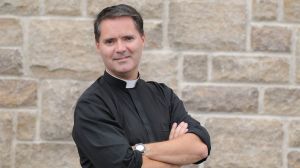 So where to start with Divine Renovation? First and foremost St Benedict’s has been driven by the desire for a model of a renewed parish. While many have looked to the ecclesial movements for discipleship, authentic community and evangelisation, Fr James is adamant and passionate about the fact that our Catholic parishes do not have to be centres of mediocrity or minimalism in which people come forward for the sacraments but little else. Parishes can yet be evangelising communities in which dynamic Christian life, conversion and discipleship can be born and raised.
 The confrontation of Divine Renovation, and much of the contemporary literature on evangelisation in the Catholic Church, is the suggestion that many of the people in our pews are not sufficiently converted, are not yet disciples or furthermore missionary disciples. As reiterated at the conference, while much energy can be dedicated in parishes on managing decline in our pews (or the limited number of our people actively involved in parish ministry and mission), our pews and mission will remain dormant or listless unless this first radical and personal conversion takes place (as it was shared mere “bums in pews are not going to change the world”).
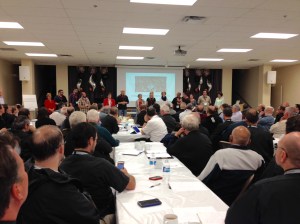 In terms of team roles, it is worth noting that the parish pastoral council at St Benedict’s is dedicated solely to five year strategic planning, while the parish team dedicates itself to implementing those rolling plans through the laity they engage. Importantly, the parish team works on the organisation, not in it, are not “doers” of ministry but rather leaders who call forth and equip others who “do”.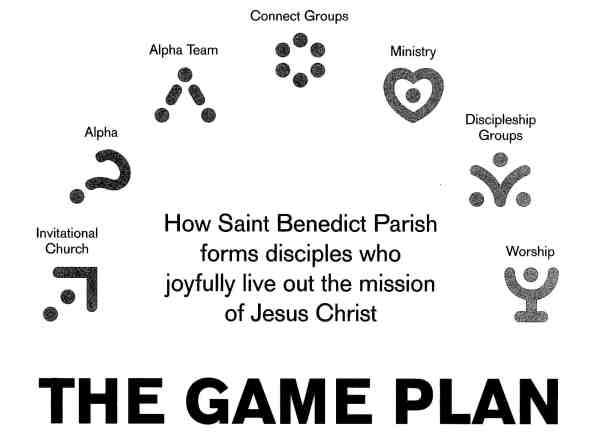
 In discussion with facilitators of Alpha in Australia, it has been recommended that Alpha be first piloted by your parish with a mix of parish staff, parish pastoral council members, committed parishioners who may not already be involved in a ministry, and new Catholics. It is notable that St Benedict’s engages Alpha not only to initiate the journey of discipleship but to develop lay leaders, as a part of their RCIA process, and as an element of marriage preparation for couples.
 While the processes of evangelisation and discipleship above are indeed impressive and can be overwhelming to consider for the parishes we know and love, it was assuring to learn that the parish of St Benedict’s has not achieved this clarity of vision and process overnight. The parish at the heart of Divine Renovation has arrived at this point after at least six years (if not more in the ministry of the pastor) of considerable trial and error, experimentation and ongoing refinement and reflection.

















 timeofthechurch