
The address below was given at the invitation of Divine Renovation Australasia, a ministry focused on the renewal of Catholic parishes by recovering the primacy of evangelisation.
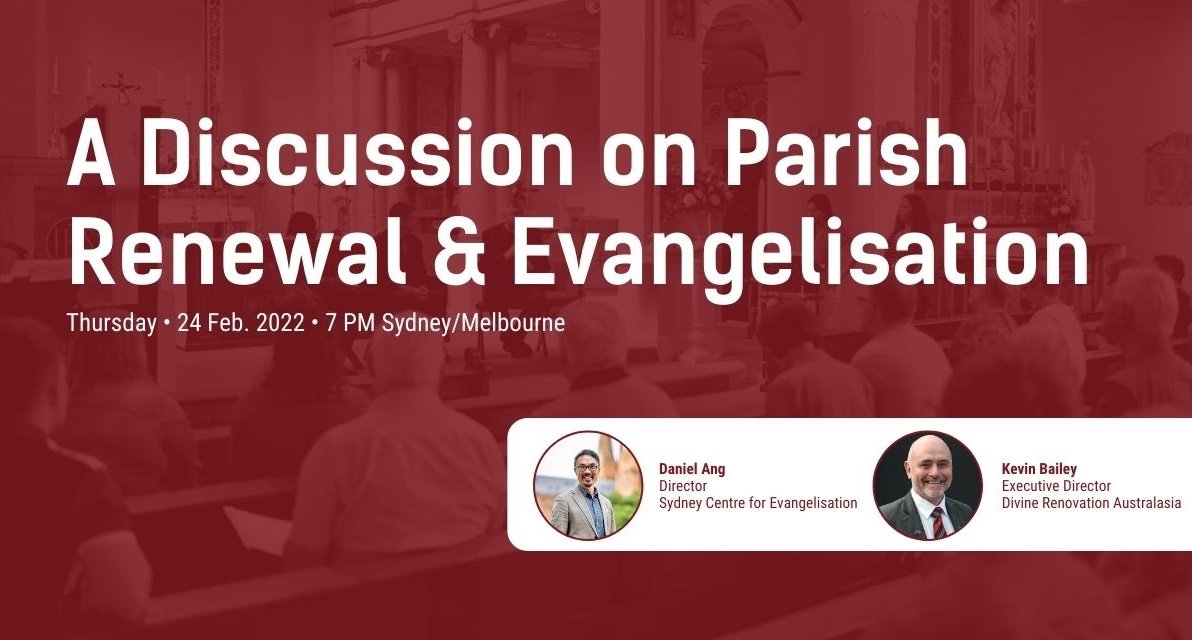
It is exciting to see here in Australia and in New Zealand so many parish and diocesan leaders embracing not only the need for the renewal of our parishes but recognising the urgency of that task.
We are at a critical moment as a Church in the West. We know this from the realities on the ground in our parishes, and the trends of decline we have seen across our dioceses, trends that have been only accelerated by the pandemic.
We also know as leaders who care about our communities that we shape the life and mission of the Church by our participation in it. We play our role in the project of parish renewal by 1) our dependence on the Holy Spirit who guides us into the truth, allows us to proclaim Jesus is Lord, who bestows the Church with a great variety of gifts and charisms, and 2) our personal and active commitment to labour in hope toward that vision and task that Jesus gives us – to “go make disciples”.
We were privileged to host Dr Mary Healy in Sydney online just recently, and she reminded us that this “go” proclaimed by Jesus was not an instruction to set up a church, get some programs on the shelf, and put out some fliers. It is a commission to go out to the lost, to disciple people and bring them to the feet of Jesus in the power of the Spirit, the Spirit who enables us to be faithful to Jesus in the present.
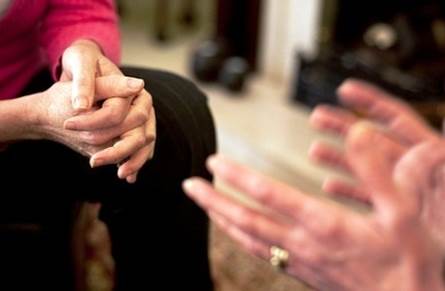
In fact, one of my favourite images of the Church is that given by the poet John O’Donohue. It is of ‘hands clasping hands going back in time to hold the hand of Jesus who holds the hand of God’. So we are all a part of this continuing story of the Church, a story which has always been of an existing community of faith into which others are incorporated. It turns out that evangelisation is our Great Tradition.
We can say that the future of our Church depends on the Holy Spirit and, importantly, those who currently don’t believe. Without the Spirit we are left to our own meagre resources. Without a genuine commitment to evangelisation in our parishes, we risk becoming a Church content to grow old and smaller, rather than a Church that moves forwards.
In fact, one of the characteristics of our Christian hope – our ‘birth right’ as the baptised – is that hope never leaves us where we are. We give evidence to our hope by the courageous commitment to reform and renew our own lives and our communities; we “live” hope by affirming that decline and death are not the last word and that the Holy Spirit can open doors and bring about more possibilities than we can imagine.
Already today, hundreds of Catholics in our parishes, chaplaincies and movements in Australia recognise this need for renewal, earnestly desire that their own discipleship and that of their parishes becomes ever more missionary, are committed not just to talking about evangelisation while keeping everything the same, but to make those changes in our practice so we can be more faithful and fruitful.
I think more and more Catholics in Australia want to see the personal and spiritual change in our parishes that we have experienced ourselves. Our parishes are where the mystery of Jesus is already present and at work – it is a gift that is calling for our response.
Fundamental Questions
So our vision and purpose as parishes is clear. We have a task that embraces all of us – whether as a priest, religious, or lay leader: to bring people into an encounter with Jesus, to the surrender and the decision of faith.
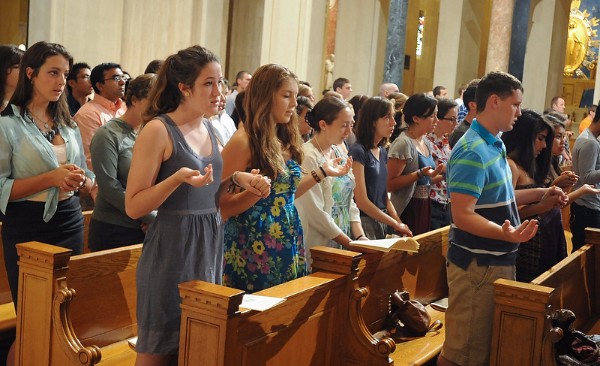
However, before launching out into this project of renewal, we have to make a fundamental decision ourselves. I’d propose this as a first step in the journey of renewal.
I think there are at least two questions we need to ask ourselves before we attempt anything as demanding and challenging as parish renewal, to be able to face the challenges and even the resistance that change can bring.
The questions are these: ‘Do I believe Jesus is who He says He is?’, and ‘Do I believe His message is true?’
Those two questions are usually enough to get us going and keep us going in mission when our energy is low or at the times when parish renewal can seem hard or even overwhelming. They are questions that ressource or reground our energies in a vision bigger than our own – in what God desires for our parishes, the liberating truth of the Gospel, a truth to which we need to first give ourselves if we are to be convincing witnesses.
So that’s one of the first things I wanted to share with you – that this project of parish renewal is radically self-implicating, demanding faith and commitment not simply from others but from our own deep wells. Are we also willing to changed and to live as the Church we are looking for? So often we want God to do something new while we stay the same.
So it’s important to bear in mind that whenever we talk about the conversion of parishes we are talking about the conversion and renewal of people.
In seeking to transform the culture of our parishes for evangelisation, we have to realise that culture isn’t the starting point but is the end-product of individuals living out holiness, community and mission. And that begins with discipleship or people making a personal, conscious decision to follow Jesus with their whole lives, in and through His Church.
So if you want to build a new Catholic culture in your parish, you have to start with forming disciples, and that project has much to do with helping individuals to discover a living and personal faith in the midst of the Church.
Casting Vision
It can seem obvious but the second step we need to take is to cast a vision of discipleship which people can embrace, aspire to and grow within. As Sherry Weddell remarks if nobody in our parish talks about what discipleship looks like, it becomes difficult for people to begin to walk on that road:
Unfortunately, most of us are not spiritual geniuses. If nobody around us ever talks about a given idea, we are no more likely to think of it spontaneously than we are to suddenly invent a new primary colour. To the extent we don’t talk explicitly with one another about discipleship, we make it very, very difficult for most Catholics to think about discipleship” (Weddell, Forming Intentional Disciples, 56).
It is difficult to believe in and live something that you have never heard anyone talk about or unpack as the goal of following Jesus and our involvement in the life of the Church. Sometimes we suspect that ‘showing up to Church’ can be for some an exercise in ‘ticking boxes’ rather than expressing a living relationship, a more extrinsic routine rather than an interior desire.
Do our people know that a disciple is one who has encountered Jesus personally in the midst of the Church, who has surrendered his or her life to His way, and made the decision to live by His teaching in all aspect of life? It is one of the curiosities of our Catholic culture that we don’t tend to talk about our relationship with God except in the confessional or perhaps in spiritual direction.
However, if we fail to cast a vision of discipleship in our parishes it is not without consequence. The fact is we are all going somewhere, whether we know it or not, and will arrive at a destination in life. The road that we are currently on will lead to a destination, and we generally don’t drift in good directions.
There are physical paths that lead to physical locations, and roads and highways that lead to certain destinations. There is a dietary path that leads to predictable health outcomes. There are financial paths that lead to financial destinations. There are relationship paths that lead to relational destinations. In fact, parents have an interest in who their young adults are dating for this reason. They enquire about their relationships not so much because they are interested in whether their child is happy in the relationship now (though they certainly hope they are). They are more interested where that relationship will take their child, whether that relationship will take them in the right direction.

So all of us are on the way to somewhere and that applies to our spiritual life as well. Unfortunately we have seen the impact of too many Catholics staying on a path of ignorance of the faith or merely routine behaviour and too many parishes comfortable on the path to decline. We have seen too many Catholics disengage from the Church altogether and even from any living relationship to Jesus himself, not necessarily because they are bad people but far too often because they never actually knew a personal relationship with Jesus was even possible. They were never given a destination that made the journey worthwhile.
We need to implant a clear vision of discipleship in our parishes because, biblically speaking, we reap what we sow. It is this life of discipleship which remains still today too obscure for too many of our people.
Naming the Challenges
In the light of that challenge, a third step as parish communities is to name the ‘gap’ between this vision of life changing discipleship that Jesus gives and our current realities and strategies.
I was reminded of this need to honestly name our current pastoral realities by Fr James Mallon on Twitter, when he shared an observation by G.K. Chesterton: “It isn’t that they can’t see the solution. It is that they can’t see the problem”.
One of the tasks that parish renewal demands is a clear recognition of the discipleship dilemma we face – a familiar story of declining engagement, decreasing giving and participation, a lack of manifest charisms and fruit, and the implications of this trend for our future as a Church and as local parishes.
Another way of saying this is, if you don’t define the problem, then people aren’t going to want the solution.
In effect, as leaders we have to elicit the desire for change. No change is likely when there is no desire for change, and there is no desire for change if we are perfectly comfortable with gentle decline and an ever ageing community.
In a world and Church already heavy with demands, busyness and division, we can be tempted to prefer ‘the peace of a graveyard’ rather than welcome the disruption and the change that evangelisation demands.
However, as someone once said, the difference between where we are and where God wants us to be is often the pain we are unwilling to bear (that is, the pain of change). Recognising where we are, as individuals and parishes, can be a painful confrontation and truth but the Paschal Mystery reminds us that this truth, even painful as it may be, is the place of grace and the beginning of transformation.
The plain fact is that comfort and complacency has never moved anyone closer to being a saint, and comfort and complacency have never helped a parish grow. On the desire that should animate and sustain our efforts at renewal, I’m reminded of the words of St John Henry Newman who recalls for us our deepest purpose: “holiness rather than peace”.
Now being honest and truthful about the situation of our parishes or perhaps a ministry does not mean pointing the finger, blaming people, priests or parishioners, for the circumstances in which our parishes find themselves. In truth, the decline of our parishes is often decades old with a myriad of complex causes, some that fall at our own feet as a Church and others that are well beyond our control.
However, we do have a calling and responsibility to respond to God where we are placed. We do not have the first word in evangelisation or the last word, but we do have a word. Our task, in this generation, is to start clearly identifying the obstacles that are preventing growth and missionary discipleship and to take the steps that might enable it.
An Example
As an example, one of the challenges that we face, a part of our present reality, is the cultural circumstances of the West, a context in which some may know of Jesus but in which the majority of Australians and Kiwis, including some of our own flock, do not know Him personally.

Now as Catholics we believe that the full life of every person and community can be unlocked only by this encounter with Christ. However, the stark reality is that Christian faith remains for most a vague background influence, well short of having any actual explicit or personal claim on their lives.
How can we begin to understand this and so respond to our times?
If we consider the long arc of Western history at least, our story begins in a pre-Christian world, a world soaked through with divinity, with many gods, a whole pantheon of divine influences and spiritual forces. Think the Roman Empire before the coming of Jesus.
People understood themselves as living in an enchanted world where both the divine and demonic were at play. The world and the self was considered porous, open to the transcendent, and life was vulnerable to the incursion of the sacred, and life involved successfully navigating these forces by various means (e.g. potions, chants, charms).
Then comes Christ and with His believers, the development of a Christian culture which is creedal and monotheistic with its sacred texts and virtues. Christ proclaims and embodies within himself a Kingdom of justice and mercy, and this faith shapes the entire character of Western culture (e.g. in contrast to a cyclic understanding of life as in the East and in oriental religion and philosophies, with provide no incentive to such a thing as social justice, the Christian schema proclaims a trajectory of life that reaches a fulfilment, an end which is shaped by our response rather than being inevitable or fatalistic).
However, today we experience the challenge of following and proclaiming Jesus in a post-Christian culture (influenced by the Enlightenment), a culture which is not a religious ‘year zero’ or pre-Christian, that has not entirely thrown off the vision of the Kingdom, that still carries the Christian Kingdom dream of equality and justice and mercy, but wants this Kingdom without the King.
Post-Christian culture might want to even deconstruct the gifts and traditions of Christian faith but yet it cannot quite shrug off the ache and discontent that remains. To echo the English writer Julian Barnes: “We don’t believe in God, but we miss him”.
In a sense, like the crying onlookers in France amidst the ashes of Notre Dame Cathedral, we remain resistant to religion but are still haunted by our Christian origins.
So when the current culture speaks about equality or justice today, it is not necessarily that we are talking about the same thing. There is a secular schema of salvation that has not lost the Kingdom dream that was planted by the Christian faith, but it wants this dream without the authority or the influence of Christ. We want progress without presence, to continue the Christian project without Christ, feasting on the fruit of the Christian proposal while forgetting its source.
Many today look for and feel some sort of transcendent power in technology or even politics, but it is all disenchanted power, while the deeper desires remain. In fact, the current COVID-19 crisis has confronted many with this yearning without Someone to encounter, and when it becomes all too much it can end in disastrous consequences.
So, within the Christian inheritance that underpins our cultural moorings, evangelisation will be about connecting many of the innate desires that people carry with them today and revealing to them their fulfilment in Christ who literally makes sense of the world in which they live. It cannot be taken for granted that people know the kerygma, the essential story of Jesus himself, but we can proclaim it with confidence that Christ still speaks to and meets the deepest desires and questions of humanity today as he asks us “Who do you say I am?” and beseeches “Come, follow me”.
A new evangelisation must be centred in the proclamation of Jesus’ life, death and resurrection as it touches on our culture and lives today, on Christ who is ‘always news’, who is always contemporaneous in the Spirit rather than being an artefact of our cultural history.
Implications
Moving to practicing evangelisation in this culture milieu, one of the gifts that Divine Renovation has offered Catholic parishes in recent years is the reminder that we can no longer rely on a pastoral approach that assumes the sacraments will simply ‘take care of it’.
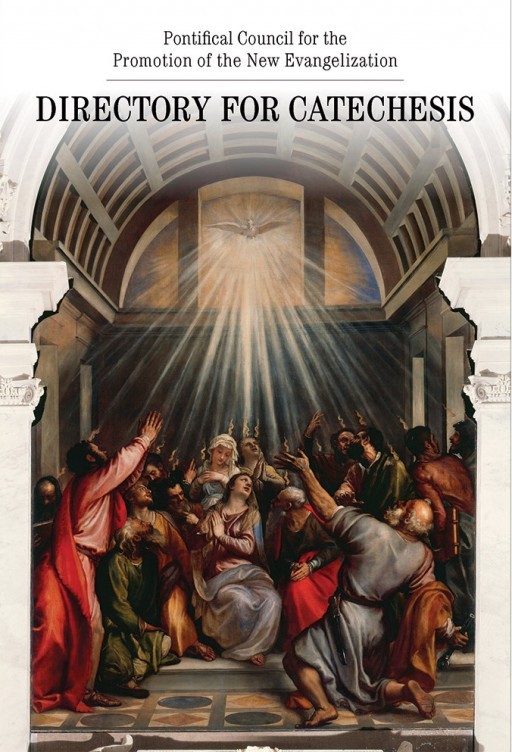
As the new General Directory of Catechesis exhorts the Church, “A process of missionary conversion must be begun that is not limited to maintaining the status quo or guaranteeing the administration of sacraments, but presses forward in the direction of evangelisation” (General Directory of Catechesis 300).
If we do not take up the task of evangelising those ‘far’ from the Church and those who are near but may be only ‘sacramentalised’ and not yet evangelised, we risk neglecting our duty to awaken in each person that active and personal faith, that fertile soil, in which the grace of the sacraments can takes root and bears fruit.
This point was explicitly made by the Congregation of Clergy when it spoke a word to our bishops and priests:
Not infrequently, pastoral agents receive the request for the reception of the sacraments with great doubts about the faith intention of those who demand them… With different but widespread accents, there is a certain danger: either ritualism devoid of faith for lack of interiority or by social custom and tradition; or danger of a privatization of the faith, reduced to the inner space of one’s own conscience and feelings. In both cases the reciprocity between faith and sacraments is harmed (Congregation for Clergy, The Reciprocity Between Faith and Sacraments in the Sacramental Economy 9; my emphasis).
So mere administration of the sacraments without attention to supportive processes of evangelisation is not enough. As Canadian Catholic evangelist Marcel le Jeune keenly observes, most fallen-away Catholics in our Church have left the active reception of the sacraments because something non-sacramental was missing. So, we need to aim to replace that missing item – in most cases, it is relationship.
There is an important perspective here that we need to keep in mind, especially for those of us who have been committed to parish life for decades, who have worked hard at the frontline with various programs, strategies, courses and events.
We are called to remember that while good and helpful, all these programs, courses and events are only proxies or the means for the evangelising relationships by which people come to faith in the midst of the Church. This is because it is not programs that make disciples, but disciples that make disciples.
To make the point, we have so many great resources in hand and available to us today, more than any other generation of Christian believers. Consider St Paul who did not even have the four Gospels in hand as he embarked on his apostolic mission across the Mediterranean.
However, St Paul had people – disciples making disciples. He had Barnabas, John Mark, Silas, Timothy, Erastus, Aristarchus, Gaius, Trophimus, Tychicus and Luke. We may need programs and materials as a kind of crutch or support but we need to be mindful about allowing these supports to replace the relationships. A good program with unevangelised leaders is not going to convert anything.
Another way of saying this is that if you build the Church, you rarely get disciples. If you make disciples, you always get the Church. Now focusing on disciple-making relationships within the parish takes the longest time and investment, but it is also the shortest route to creating missionary parishes. Any other path, focusing on program after program for example, will not see the fruit we hope to see.
A Pathway of Discipleship
Finally, a positive step we can take, which the experience of growing Catholic parishes has affirmed, is the importance of clearly communicating or making it or making it very explicit what people can do to grow in relationship to Jesus and the journey in the parish that will help them to grow in this relationship.
For example, what is on the on-ramp, or shallow end of the people, through which people in your church might start the discipleship journey? How do people actually get connected to the group and what is a strategy for this connection, rather than merely hoping they will hang around long enough to connect?
As it’s been observed: “Imagine a ladder with all the lower rungs removed. It wouldn’t be very useful for climbing. Sometimes churchworld can seem like that. The churchpeople are on the top of the ladder. With the lower rungs removed, the unchurched are left with no chance of climbing up. We churchpeople can make it difficult for the unchurched to come to church, even when they want to” (Fr Michael White and Tom Corcoran, ChurchMoney, 105).
A pathway helps identify the ‘rungs on the ladder’, to support people take a next step in faith, rather than expecting them to work it out for themselves.
Your pathway might begin with the need to have an invitational strategy for newcomers to be drawn into an encounter with the Gospel and community via an initiative such as Alpha which explores life and the Christian faith. Following this initial encounter, participants can then be encouraged to join the organising team for such a course or otherwise join a small group in the parish to connect more deeply with others in community. They might join a bible study in order to deepen the faith they have discovered. As a next step, the parish might then encourage participants to commit to active mission in the form of service to others; for example, to become involved in a parish ministry or share their God-given talents in social outreach to the wider community.
Such a discipleship pathway enables your ministry to determine where people are on the journey of faith and how to move them to the next step in faith in the context of parish ministries. This avoids treating or assuming everyone is at the same stage of faith.
We know that churches and ministries that have an explicit pathway for discipleship have a much higher rate of conversion than those that do not, than those who are more haphazard in their outreach and overloaded with group upon group, programs upon programs.
If we had all the money, people and resources we needed, we would not need a strategy. But in our parishes we need to discern and articulate clear pathways by which people come to faith, just as we ourselves have taken steps to arrive where we find ourselves today.
Conclusion
So in this time together, I hope you have been encouraged and challenged in this mission of evangelisation which has become as important and urgent as ever.
In the midst of the conversation that the Church in Australia and indeed the Church worldwide is having about its future, it is people like yourselves at the frontline of our parishes that will shape the future of our Church by your leadership and witness.
When we cast a vision of discipleship, of the full Christian life to our people; proclaim the life, death and resurrection of Jesus as it touches upon the world today; develop the discipleship of our own people so that programs and resources become effective and attractive; and when we explicitly articulate a path of spiritual growth open to all, we begin to see the promise of parish renewal come to real life.


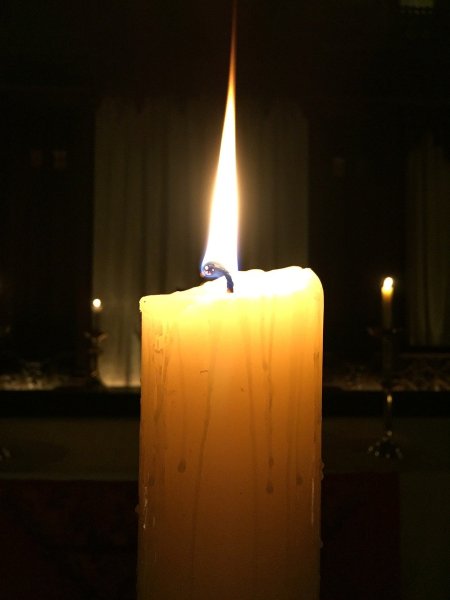 We celebrate the Ascension of Christ and approach the Feast of Pentecost in the light of the Resurrection. Christ is risen. Truly, He is risen!
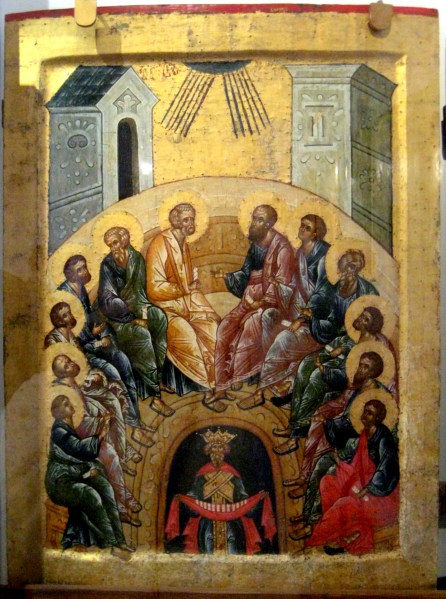 As we learn from the Acts of the Apostles, it is the coming of the Holy Spirit at Pentecost, promised to them by Jesus at his Ascension, that marks a new chapter in the disciples’ faith.
 It happens that in these past months the experience of surrender has come to us. A global pandemic has left us dependent upon and yet strangely cautious of others, all at once. Individuals and entire communities are now vulnerable to a terrible scourge, originating on a distant horizon, that has brought life as we know it – in our homes, schools, workplaces and churches – to a collective and sudden halt. This global disruption is a striking reminder for us as Christians, and others besides, that we are not masters of our own world.
 As we pray and reflect on the role of the Holy Spirit in the world, we find this life-giving presence in the opening verses of the Hebrew Scriptures. Here we see the Spirit of God at the beginnings of creation as it “sweep[s] over the face of the waters” (Gen 1:2).
 This spirit-filled history of salvation continues into the New Testament where the revelation of God comes to fulfilment in Jesus Christ. Jesus’ entire life unfolds under the sign of the Spirit.
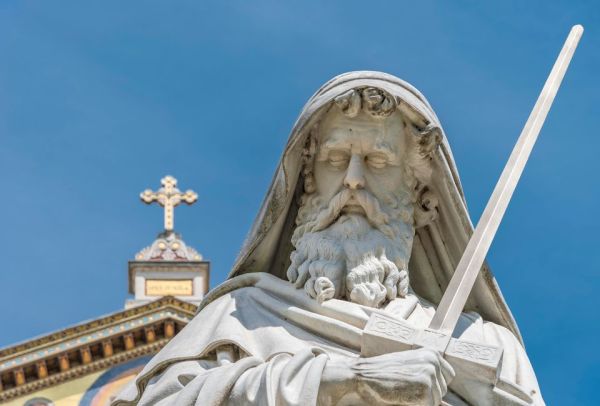 This Spirit comes to each one of us as a gift but also as a challenge to the ongoing conversion of our heart and mind. As the source and giver of all holiness, we implore the Spirit to keep us in grace and remove those artificial obstacles, habits and ways of thinking that prevent us from living fully in and for Christ. As St Paul writes in the Letter to the Romans, our baptism in Christ calls us to live no longer by the flesh, by the material things or selfish desires of this world, but to live according to the Spirit (Rom 8:5). It is for this new life that the Spirit of God dwells in us, the very same Spirit that raised Jesus from the dead (Rom 8:11).
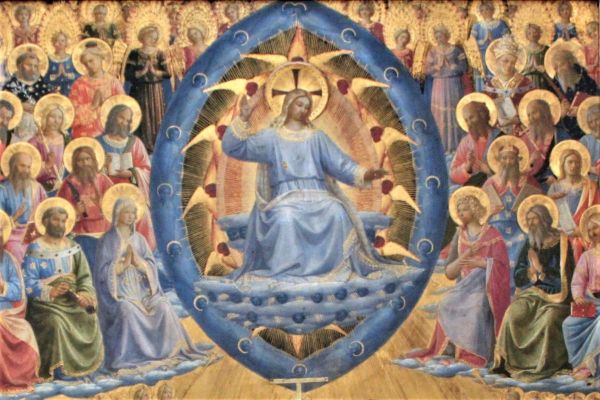 Of course, the fruits and gifts of the Holy Spirit are especially manifest in the saints. These ‘bright patterns of holiness’ remind us that Christian sanctity is not just an ideal or possibility but a reality in concrete persons and the concrete conditions of the world. This cloud of witnesses, these Christian exemplars, are models of holiness who have responded to the needs, challenges and opportunities of their time. These saints allowed themselves to be filled with the Spirit. In the pattern of Mary, “full of grace” the saints give birth or expression to Christ in the world.
 The Church, as the third-century theologian St Hippolytus affirmed, is “the place where the Spirit flourishes”. The Church is the dwelling place of the Holy Spirit, the Spirit animating and bringing to life and holiness its members through the Word and sacraments, the ministry of the ordained (our bishops, priests and deacons), the various gifts and charisms of the faithful of every rank, the varieties of religious orders and ecclesial movements that express the Spirit’s power and anointing.
 As the Feast of the Ascension brings us to reflect on our Christian pilgrimage in this world and to the next, we do not have a choice between God and the world. As Christians, we choose God by choosing the world as it really is in Him. We choose God by working toward the transformation of the world as disciples, empowered by the Holy Spirit who inspires true freedom and furthers God’s plan of salvation.
 In the wake of the worldwide spread of COVID-19 and the limitations it places on human interaction and activity, the ability for Catholics to physically gather for liturgy comes under increasing threat. It is worth noting as attendance at churches thins and may well be prohibited into the future in some jurisdictions, there may be an increased appreciation for something that that has been taken away by these circumstances. Once precautions surrounding the Mass are lifted many may return to our parishes, including those whose participation has been infrequent or irregular.
 This includes for we Australians. While the number of marriages in our Church has declined sharply over the years, the number of families and children who continue to seek the Sacraments of Initiation in our parishes remain substantial, in their many thousands.
 So, what explains this phenomenon which sees thousands ‘sacramentalised’ but few appearing to be ‘evangelised’, that is, become intentional and life-long disciples of Jesus Christ? It cannot a deficiency of the sacraments in which we encounter the power and presence of Christ himself.
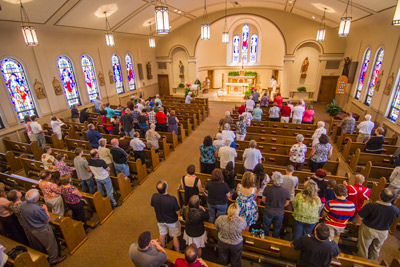 We know that reception of the sacraments can be treated as a mere social custom, a family tradition practiced without intention, or else sought for purposes other than itself. Whether it is driven by a desire for enrolment in Catholic schools, a bending to family pressure or social conformity, thousands continue to seek out sacraments in our parishes but often little else. Not only this, but the mixed motivations behind the demand for Baptism can be known, accepted or even encouraged by our silence on the matter. If this pattern persists, we risk nothing less than “a ritualism devoid of faith” (9).
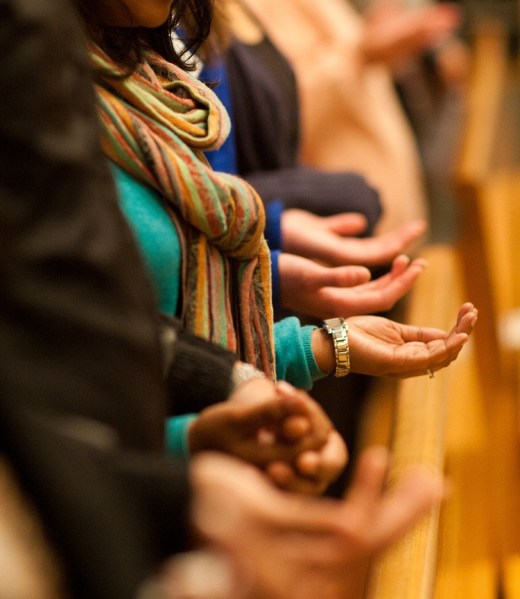 Of course, this is not to say the efficacy of the sacraments depends on the one who receives. Baptism, for instance, confers a real “sacramental character” as God’s grace is truly given. But what baptism places within us is a capacity to believe. It cannot be a substitute for an active response, the ‘act of faith’ on the part of the graced subject. A sacrament can be valid but for it to be fruitful, it must be received in faith for “God makes the acceptance of this gift dependent on the cooperation of the recipients” (32). As St Augustine put it, God ‘did not will to save us without us’.
 It is now eight months since the road to Plenary Council 2020 was formally opened at Pentecost 2018. It will be the first Plenary Council that the Church in Australia has held in over eighty years and comes at a time when the challenges for and to the Catholic faith – and so the allied possibilities for reform – are multiple. Consider parish decline, the shape of Catholic education, failures of governance, and the future of religious freedom alone.
 Underlining these reactions to the Plenary Council will be varying understandings of the Church itself and of the possibilities for reform. Contrasting ecclesiologies about the best way in which the Church can exercise its mission are certainly not new. Polarisation has been an increasing mark of Catholic exchange particularly since the Second Vatican Council and intensified in the ‘phase of disillusionment’ that followed. These divisions about the way forwards for the Church have been inflamed by the Church’s waning influence in the Australian community and the search for a response to a loss of credibility and public voice over past decades which risks for the Church what Greg Sheridan has described as ‘complete strategic irrelevance’ (‘Christian churches drifting too far from the marketplace of ideas’, The Australian, 4/6/2016). The resulting ecclesial tensions and ideological rifts will inevitably spill over to shape people’s expectations and engagement with the Plenary Council as an initiative of the Church, explicitly geared as it is towards reform.
 Towards this end what the Plenary Council will do and is doing is generating a significant, even if for some unsettling, conversation about the way in which the Church can best practice its mission in Christ into the future. A Plenary Council can, for example, pass legislation regulating how doctrine is to be taught, how worship is to be regulated and how governance is to occur in practice. It is to these matters that diverse input is needed for the benefit of the Church’s missionary mandate.
 Under present canon law, the decisions of the Council are made by bishops by nature of their episcopal ordination as successors of the Apostles. However, it would be mistaken to read this exercise of authority as an isolated act for in casting their deliberative vote the bishops are required to be attentive to the counsel of the people in their dioceses and at the Council sessions themselves. The magisterium must sense with the Church as a whole where the Spirit’s inspiration is leading. Lay delegates at the Council will have a consultative vote, namely a real vote which will be written and tallied and is to be considered seriously by those with a deliberative vote. So it is that the bishops are obliged to make decisions on the basis of their careful discernment of the work of the Holy Spirit in the minds and hearts of the People of God, recognising that the sense of the faith of the faithful – what is known as the sensus fidelium – is a source of the Church’s life and learning as it pilgrims through history.
 Nor does it represent the intent of the listening process underway until Lent 2019. The thousands upon thousands of submissions and voices they represent will shape the major themes that will constitute the agenda of the Plenary Council. Naturally in the abundance of data received will be conflicting interpretations of what has been revealed in Jesus, the Scriptures and our Catholic tradition and varied proposals on how best to incarnate the Gospel in our present situation and our future. This interpretive maelstrom is not a new experience for the Church (think of the disputes of Saints Peter and Paul, and the divergences of the Pauline and Johannine communities).
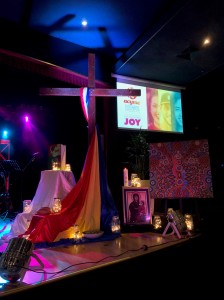 workshop will extend the theme of ‘missionary discipleship’ to consider how youth ministry can support young people to move and grow from participation in youth ministry to exercise their discipleship as adults in broader parish and community life. If youth ministry gathers for the purpose of sending out, how can our ministries best prepare young people for that future? One of the claims of this workshop is that if we can identify the issues of our moment, and we know the destination at which we want to arrive, then this will shape the steps we can take to get there. If our purpose is sending young people out into mission, into the full life of the Church and world, then how does our youth ministry best prepare them for that future?
 The poet Gerard Manly Hopkins developed this term ‘inscape’ for the individual structure of a living being (like a tree or a leaf), an inner structure which results from the history of this being, an inner design made by the tree through its life in the way it has responded to life. We are much the same, our life is a work of art and all the good and the bad, conflicts and sufferings, troubles and happiness in our life all add up to something, all produce this inner structure, and this is what we are judged on, our encounter with Jesus and the direction that we chose to live. We are judged not on small incidentals (eating meat on Fridays) but rather the whole structure of our life – all that we wanted to do, tried to do, our relationships. This all adds up to our identity which God knows. Hence the value of youth ministers as spiritual guides who can help the next generation to be in touch with the whole direction and meaning of their life as a whole, what it is all adding up to and to encourage them to develop in this direction and not another.
 I was grateful to be part of a workshop this week hosted by the Australian Catholic Youth Council in North Sydney. It drew together a select group of parish and diocesan youth leaders in conversation with Australia’s delegates for the October Synod on youth, Archbishop Anthony Fisher OP and Bishop Mark Edwards OMI, as well as Archbishop Comensoli.
 As the Church in Australia considers its future, it is imperative to understand the interactions and experiences that comprise young people’s lives for these provide the building blocks for renewed mission with and to young people. While the Catholic faith may today occupy less surface space in Australian culture, the rise of dedicated disciples within promises to bring new depths to our Christian living and cultural impact, and encourage the whole Church in its mission to the concrete people of each generation.
 Challengingly, among Australian Catholic youth the influence of Church or religious leaders in their key decisions and directions is thin, identified as significant by just 11% of those surveyed and aged between 16-18 years. This meek influence might be explained by a lack of personal relationship amongst some clergy and young people, the broader collapse of the Church’s credibility in the light of the sexual abuse crisis, and the real struggle of Church leaders to listen or ‘hold’ the questions that young people are asking of the Church. On this score, young Australian Catholics rated their experience of being listened at a modest 5.9 out of 10.
 Positively, when Australian youth were asked how the Church can be of help to them, the responses actively invited our communities to provide guidance, to assist and counsel young people in their anxieties, personal challenges, understanding of sexuality and relationship issues.
 Frustratingly for many, the accompaniment urgently desired by young Australian Catholics and urged by Pope Francis cannot be found neatly contained within a package or program. It demands in fact an entire culture of ecclesial life in which discernment is a norm and in regular evidence. When genuine discernment is not practiced in our sacramental programs, leading to fruitless reception, when RCIA processes teach people about Catholicism but neglect to train them to live as disciples, when parish pastoral councils and parish groups are more focused on ‘who will do it?’ rather than ‘where are we going?’, the offer of accompaniment to young people will appear more like false advertising than the expression of a community fully open to what God wants for the Church. The preparatory document for the Synod minces no words, “We cannot expect our offer of pastoral accompaniment towards vocational discernment to be credible to young people, unless we show that we are able to practice discernment in the ordinary life of the Church”.
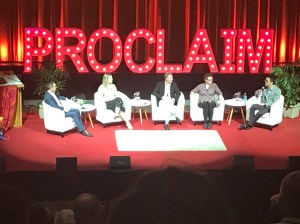 Held in Brisbane for the first time in its short history, Proclaim Conference 2018 gathered more than 600 participants from 12-14 July to discuss parish evangelisation with its theme drawn from John’s Gospel, “Make your home in me”. Keynote speakers over the three days included Archbishop Mark Coleridge, Cardinal John Dew from Wellington, Ron Huntley of the Divine Renovation network, Karolina Gunsser from Citipointe Church in Redcliffe, and Lana Turvey-Collins from the national facilitation team for the Plenary Council.
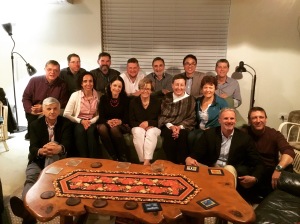 As a former ‘outsider’ to the Church it has taken some twenty years to learn to live as a baptised person and still the learning continues. Through my own faith experience I have come to believe that the parish is essential to Christian growth and discipleship. Indeed, if we did not have parishes we would have to invent them – local communities of faith gathered around the Word and Eucharist where faith is given shape and social support, fostered into discipleship and then enters the world through our living witness.
 The Church is not for ourselves. In Pope Francis’ language, our community is called to be a ‘field hospital’ serving those who most need help now, the wounded and the lost. This is the antithesis of the self-referential Church. We are called to leave the ninety-nine to find the one, or in our Australian reality, leave the one to find the ninety-nine.
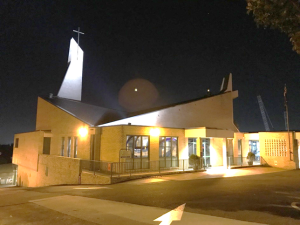 In fact, inward looking churches create consumers with preferences, while outward looking churches create missionaries with larger hearts and stories to tell, stories about how Jesus has changed their life. This is the heart of an evangelised parish culture – one beggar telling another beggar how he found bread.
 A classic example of the need to prioritise our mission over method can be found in the story of Kodak, the photography business established at the turn of the twentieth century, with the expressed purpose of preserving memories which is a seemingly indestructible mission.
 A third horizon we can move toward in forming evangelising parishes is structures that support the mission. We want to grow but many parishes are not necessarily structured to grow. There can be literally “no room in the inn” for change.
 The fourth horizon we can move towards is putting mission into action, perhaps the hardest pilgrimage of all. As a friend once shared, conferences can sometimes be a bit like this: “Glory be to the Father, and to the Son, and to the Holy Spirit” and when we get home, it is more “… as it was in the beginning, is now and ever shall be, world without end”.
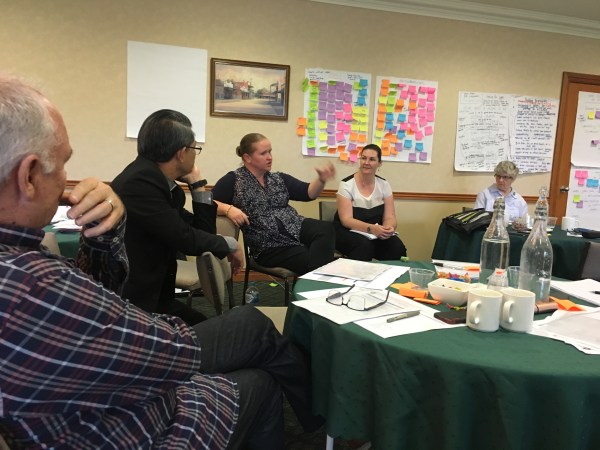 In October 2017 members of the
  Then in 2013 came the surprise election of Pope Francis. By his papal exhortations and by his convening of the 2014 and 2015 synods on the family, the Pope placed a clear emphasis on the Church’s need to journey in discernment together with closeness to the people unified in baptismal faith and informed by the Holy Spirit.
 As such a Plenary Council is an expression of the ‘synodality’ of the Church, the nature of the Church as a communion of persons ‘walking together’ in faith as disciples of the Lord. The Plenary Council recognises that all the baptised have received a common vocation to be a ‘sacrament or instrumental sign of intimate union with God and of the unity of all humanity’ (
 Pope Francis himself has encouraged the need to prayerfully discern together what the Spirit is saying to our Catholic community at this time, remarking “A synodal Church is a Church which listens, which realises that listening ‘is more than simply hearing’. It is a mutual listening in which everyone has something to learn. The faithful people, the college of bishops, the Bishop of Rome: all listening to each other, and all listening to the Holy Spirit, the ‘Spirit of truth’ (Jn 14:17), in order to know what he ‘says to the Churches’ (Rev 2:7).”
 It is obviously a difficult time to be of Catholic faith and the Church has been rightly dislocated and unsettled on account of its own shameful past and yearnings of its present culture. With disappointment an experience for many Catholic people, for a variety of personal and ecclesial circumstances, cynicism toward a national ecclesial event such as a Plenary Council is understandable. Reactions point to what lies within. However, pessimism need not be our final post.
 Ahead of our Plenary Council, I also think we learn from Pope Francis that ecclesial leadership and subsidiarity of local communities need not contradict one another. Indeed, he shows forth subsidiarity as a way or manner of exercising leadership. It is a well-recognised fact that Pope Francis has strengthened the influence of the papacy as a global authority while at the same time promoting its decentralisation. What he has sought to do, in alignment with his magisterial teaching, is to ‘initiate processes’ rather than to ‘occupy or possess spaces’, to enable initiatives without the need to control their outcome (Evangelii Gaudium 222-223; Laudato Si’ 178; Amoris Laetitia 3, 261). Pope Francis exhibits genuine trust in the speaking and guidance of the Spirit and intervenes only when the realisation of goals appears unattainable or if proposals threaten the faith and unity of the Church universal. He governs in such a way that involves the many. I think this is the gift and challenge of the Plenary Council not only for the bishops of Australia but also all those who exercise leadership or ministry within the Church, from parish pastoral councils to ministry leaders in service of others. A synodal Church is precisely a growth in the capacity of local communities and baptised persons to practice faith in fruitful dialogue with others, by listening, and as a communion reach out to humanity in Jesus Christ through the enlightenment of the Holy Spirit.
 In the previous session, we acknowledged those factors impacting upon parish life today – a new and unchartered context for faith, the presumptions of our pastoral practices and questions of fruitfulness that invite change, as well as the biblical and magisterial foundations for reclaiming discipleship as our central commission.
 It is enough to trace the various emphases that have shaped the theology and practice of the ordained ministry through this history to appreciate that, in speaking of the ordained vocation, ‘God-given’ is not the same thing as ‘set in stone’. There are a variety of ways in which the priestly life can and has been lived. To borrow from the thought of Fr Aidan Nichols, the ‘pattern’ of the presbyterate has in fact a variety of key elements that open themselves to the evangelisation and disciple-making we have discussed.
 I would like to focus in particular on how the priest’s teaching office and his responsibility for pastoral government can best be lived today in order to serve the growth of discipleship in our parishes and evangelisation beyond the pews (sets one and three of that tripartite pattern of priestly life).
 Of course, even in the case of sound and effective preaching, the priest cannot be expected to carry the responsibility for the missionary conversion of our parishes alone. As we have acknowledged, it is not obvious in our day that the hearts of laity are burning with the fire of Jesus’ mission in the Church and the world, as evidenced by our gentle decline and the culture of maintenance or immobility we can sometimes encounter in our parishes.
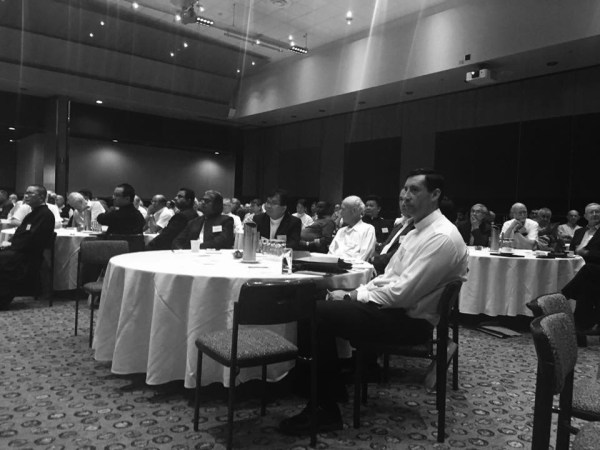 In turning to the pastoral governance of the priest as whole – including building up the communion of the Church and overseeing the parish’s attempts to meet the needs of its members – there are practical steps that can be taken to lead parish renewal in a focused and also a sustainable way. To bring these practices and principles to real life, I will engage the parish of Saint Benedict in Halifax, Canada, as an example of best practice.
 Having established a parish vision, a parish can then identify the priority areas where it intends to live that vision most immediately within a given time frame, say three to five years. Returning to the ‘Game Plan’ of Saint Benedict Parish, there were five priorities discerned by the community as areas for focus. The parish proceeded to identify those core systems of a church, which like the systems of a body, are essential to the growth of the ecclesial body.
 Once parish priorities are identified, the parish can then conduct a simple SWOT analysis – identifying its strengths, weaknesses, opportunities and threats in each area of priority. This assists a parish identify its areas of strategic action. We can narrow these strengths and limitations that call for a response to a limited and workable number, by asking questions such as:
 timeofthechurch