With the commencement of a new year, one of the immediate priorities has been preparations and planning for Plenary Council 2020. It has been helpful in these early days to gather thoughts, recollect on where we have travelled to date, and look ahead.

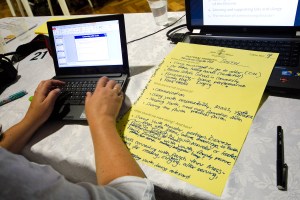
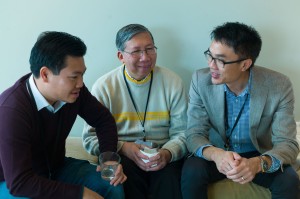
First face-to-face meeting of Bishops Commission & Executive Committee for Plenary Council 2020, St Joseph’s Retreat Centre, Baulkham Hills, 19-20 Oct., 2017.
In September 2017 an inaugural forum was hosted by the Broken Bay Institute at Mary MacKillop Place in North Sydney. It gathered leaders in Catholic education, social support services, and other agencies and religious institutes of the Church. The forum reflected on the meaning of ‘synodality’, a deepening of the Church’s communion as a means to faithfully interpret the living voice of God in this time and circumstance.
The first gathering was hopeful and matter-of-fact about the challenges that lie ahead for the Plenary Council, including the need to establish clarity on the appropriate structures and the agenda or themes of concern that might galvanise that journey. The need to make clear the parameters of the national conversation arises not only from the want to respect the expectations of those who involve themselves but also to bring transparency and coherence to the process. As Chesterton long ago remarked, “The finest thing about a free meadow is the hedge at the end of it. The moment the hedge is abolished it is no longer a meadow, but a waste”. Structure can stifle but it can also enable. So, many of these first days of the year have been dedicated to thinking through structure and process surrounding the national dialogue as well as for our Diocese of Broken Bay.
In my own view, with the cultural reform of the Australian Catholic Church on the table, a key task will be to identify those systemic or gravitational forces that move the tides if you will, that lift up or otherwise upend the boats in our exercise of Catholic life and mission. If a culture is constituted by behaviours and relationships, unspoken assumptions, a universe of ideas, a material reality and language, then it will be important to name the underlying issues raised or highlighted by particular concerns (for example, talk of renewing or eschewing parish pastoral councils invites us to confront the current limitations of lay-clergy relationships and of priestly formation for practical leadership). The process of dialogue with all of God’s people will be essential to discerning these fundamental themes and I have great hope that this coming year will present a first and significant step toward the task.
 In October 2017 members of the Bishops Commission for the Plenary Council and the Executive Committee then gathered to learn and discuss the opportunity that this national ecclesial council presents for our Church. I have to say I left the gathering greatly encouraged and more hopeful than I had (admittedly) arrived. With planning meetings scheduled for the Executive Committee in the weeks ahead, there is still much yet to be clarified but the infrastructure and practical matters are fast becoming clearer and more concrete.
In the closing days of 2017 I was able to sketch some of the ways in which our own Broken Bay Diocese might meaningfully and substantially take part in the national process, for the benefit of the Australian discernment as well as for the vitality of our local diocese. Local processes and opportunities in Broken Bay will be announced at Pentecost 2018, providing enough time to organise the diocesan journey with formation, resources, training for dialogues and assemblies.
In the meantime, in order to make sense of Plenary Council 2020 I have gathered together an outline and reflections on the Council that might also be of help to you and your communities. I would be grateful for any feedback you might have on these initial thoughts and proposals!
As the year slowly gathers pace, I wish you and your communities a blessed and happy new year, Daniel.
Walking the Path of the Plenary Council
“Listen to what the Spirit is saying to the churches” (Rev 2:7). Since 2001, in the wake of St John Paul II’s apostolic letter from at the turn of the millennium, the Australian Catholic Bishops Conference has been giving consideration to a national ecclesial event, involving all Australian dioceses. St John Paul II’s 2001 apostolic letter Novo Millennio Ineunte called for new energy and depth, what it called a genuine ‘spirituality of communion’ within the Church, a spirituality which ‘by prompting a trust and openness wholly in accord with the dignity and responsibility of every member of the People of God, supplies institutional reality with a soul’ (Novo Millennio Ineunte 45). It called for nothing less than the conversion of the Church in spirit and structure.
This call led to growing discussion within the Australian Catholic Bishops Conference in 2006 about an event of ecclesial communion within the Australian Church, with Archbishop Philip Wilson (Archdiocese of Adelaide) a leading voice. In time this conversation developed into the decision to hold a Year of Grace which began in Pentecost of 2012 and was dedicated as a year of discernment and prayer, of ‘contemplating the face of Christ’ in order to renew our self-understanding as a Church of Gospel faith and mission.
 Then in 2013 came the surprise election of Pope Francis. By his papal exhortations and by his convening of the 2014 and 2015 synods on the family, the Pope placed a clear emphasis on the Church’s need to journey in discernment together with closeness to the people unified in baptismal faith and informed by the Holy Spirit.
In the same year and month of Pope Francis’ election the Royal Commission into Institutional Responses to Child Sex Abuse commenced, following its announcement in November of 2012. A searing grace for the Catholic Church, the Royal Commission makes it clear that ‘business as usual’ is not possible nor even desirable for the Church whose culture has failed and even betrayed on a spiritual and institutional level the very Gospel for which it is intended to be a clear sign and witness.
It was these collective currents or combination of factors that I understand influenced and moved the Australian Catholic Bishops Conference to announce a Plenary Council of the Church in Australia to be held in the year 2020. The Bishops Conference has formally sought the approval from Pope Francis for this Council, official endorsement which is expected in due course.
Put simply, a Plenary Council is the highest form of communion between the various local or particular churches of a nation. The Plenary Council will be, then, not simply a meeting of bishops as individuals but a meeting of local churches and a process that calls for the participation of the entire Catholic community. It invites the whole Church, through dialogue, to discern how its communities can live the Gospel with renewed vitality amidst new questions and challenges. The Plenary Council itself will feature representation from among the laity, religious and ordained ministers, together with the bishops of Australia, as the culmination of a sustained pilgrimage in faith.
 As such a Plenary Council is an expression of the ‘synodality’ of the Church, the nature of the Church as a communion of persons ‘walking together’ in faith as disciples of the Lord. The Plenary Council recognises that all the baptised have received a common vocation to be a ‘sacrament or instrumental sign of intimate union with God and of the unity of all humanity’ (Lumen Gentium 1) and upholds with faith that it is by our mutual listening to the Holy Spirit – who guides the Church ‘into all truth’ (John 16:13) – that we can realise our mission most deeply as a community of faith.
As set out in Canon Law, a Plenary Council has legislative power with the final decisions reserved to the bishops by nature of their episcopal ordination as successors of the Apostles. The bishops are obliged to make decisions on the basis of their careful discernment of the work of the Holy Spirit in the minds and hearts of all the People of God, recognising that the sense of the faith of the faithful – what is known as the sensus fidelium – is a source of the Church’s life and learning as it seeks to fulfil its Gospel mission.
This means that the Plenary Council is more than a single event to be held in the year 2020 but an extended process that invites the entire Catholic community, even now, to ‘walk the path of dialogue’ and interpret what God is doing today and how God is calling the Church to live the Gospel into the future. It calls the Church to undertake a pilgrimage of listening and learning, to be a synodal and receptive church that engages in honest speaking and mutual listening to the Holy Spirit, to share insights and also hear insights shared.
Throughout this process of listening, dialogue and prayer, the experiences of diverse lives will be invited to share their sense of faith, questions and hopes for the Catholic Church – from those who are attempting to live a committed and sacramental life in the Church, those baptised Catholics with lesser involvement in ecclesial life, to those who are vulnerable in Australian society, who may be more distant from the Church, or who have been hurt and who may or may not still regard themselves as Catholic in some way. From these voices there are questions and challenges that clarify the Church’s self-understanding in response to the Gospel and society, genuine ‘seeds of the Word’ that provide insight.
We are invited by the announcement of a Plenary Council to develop together a culture of dialogue and discernment to determine how best to ensure the pastoral needs of the people of God are provided for and with regard for the universal law of the Church, ‘to decide what seems opportune for the increase of faith, the organisation of common pastoral action, and the regulation of morals and of the common ecclesiastical discipline which is to be observed, promoted and protected’.[1]
Following their listening to and discernment with the whole Church the members of the Plenary Council will convene in 2020. This will include all active bishops, vicars general, episcopal vicars, some major superiors of religious institutes, rectors of major seminaries and Catholic universities, and deans of faculties of theology and canon law. Others that can also be called to the Plenary Council include lay persons, retired bishops, other priests, and religious. The bishops will have a deliberative vote (that is, cast a ballot to determine outcomes) while other council delegates will have a consultative vote (the right to speak about the issues under discussion). The Plenary Council will then enact laws which, subject to approval of the Holy See, will bind the Catholic Church in Australia.
In calling a Plenary Council the Australian Catholic Bishops Conference has recognised that the patterns of change confronting the Church and the wider community impel the Australian Catholic Church to review, analyse and discern the signs of the times and interpret them in the light of the Gospel (Gaudium et Spes 4). It has opened up a pathway for dialogue, for the exchange of faith and ideas, and to encounter the Holy Spirit and the Church in one another.
 Pope Francis himself has encouraged the need to prayerfully discern together what the Spirit is saying to our Catholic community at this time, remarking “A synodal Church is a Church which listens, which realises that listening ‘is more than simply hearing’. It is a mutual listening in which everyone has something to learn. The faithful people, the college of bishops, the Bishop of Rome: all listening to each other, and all listening to the Holy Spirit, the ‘Spirit of truth’ (Jn 14:17), in order to know what he ‘says to the Churches’ (Rev 2:7).”[2]
In addition to the call of Pope Francis for a synodal and discerning church, the Royal Commission into Institutional Responses to Child Sex Abuse has also raised the critical need for reform within the Church and its manner of governance, themes with which the Plenary Council will also wrestle. As a way of being Church ‘synodality’ promotes a form of governance that involves all the People of God, with governance referring to those processes for making and implementing decisions so that each of the baptised can fulfil their personal calling as well as our shared mission as a communion of faith.
Plenary Council 2020 will be the fifth plenary council in Australia’s history with the last plenary council held in 1937, some eighty years ago. There is likely to be more than one session, one for summative documents to be discussed which reflect the discernment of the Australian dioceses through dialogue, then a period of authoring pastoral decrees and legislation, and then a second session of the Council at which the Australian bishops will vote on these statutes. As such the Plenary Council will be a decision-making council and bear significant and lasting consequence for the life of Australian Catholics.
The Australian Catholic Bishops Conference has now established a Bishops Commission to oversee, plan and prepare for the Plenary Council which will have three phases: preparation, celebration and implementation. The Chair of the Bishops Commission for the Plenary Council is Archbishop Mark Coleridge (Archdiocese of Brisbane). Other members of the Commission include Archbishop Timothy Costelloe SDB (Archdiocese of Perth), Archbishop Philip Wilson (Archdiocese of Adelaide), Bishop Vincent Long Van Nguyen OFMConv (Diocese of Parramatta), Bishop Michael Kennedy (Diocese of Armidale), and Bishop Antoine-Charbel Tarabay OLM (Maronite Diocese of St Maroun).

A Facilitation Team was appointed last year including Ms Lana Turvey-Collins, Fr Noel Connolly SSC, and Mr Peter Gates (Catholic Mission) together with an Executive Committee for the Plenary Council which includes people with particular expertise related to the holding of a Plenary Council. The Executive Committee members have a range of backgrounds, are diverse in their experience and will offer advice and guidance to the Facilitation Team and the Bishops Commission throughout the Plenary Council journey.
As a local Church, the Diocese of Broken Bay will enter into this national process of dialogue and discernment beginning with a year of listening in 2018, followed by discernment throughout 2019 and the sharing of proposals to the Plenary Council in 2020. This local dialogue will not only inform the national Plenary Council but also the discernment of our Bishop, parishes and local communities, our schools and agencies in the Broken Bay Diocese on how best to express the life and mission of Jesus at this critical juncture of our life as Church.
It will be an opportunity for us to name those issues that are important to our faith in charting a course for the future of the Catholic Church in Australia, and to share perspectives and practices that God can use to touch ordinary lives. Dialogue on the faith and mission of the Church will be encouraged across our Broken Bay parishes, school communities, migrant communities, and social outreach services, these constituting “the Church living in the midst of the homes of her sons and daughters” (Evangelii Gaudium 26). All people are welcome and invited to engage in this process locally. Support, guidance and resources for this process of dialogue will be provided by our Office for Evangelisation, our Catholic Schools Office and CatholicCare in collaboration with the national Facilitation Team. As intimated, means of participation, training and resources will be announced around Pentecost 2018. Still much work lies ahead.
Material Considerations
 It is obviously a difficult time to be of Catholic faith and the Church has been rightly dislocated and unsettled on account of its own shameful past and yearnings of its present culture. With disappointment an experience for many Catholic people, for a variety of personal and ecclesial circumstances, cynicism toward a national ecclesial event such as a Plenary Council is understandable. Reactions point to what lies within. However, pessimism need not be our final post.
A Plenary Council might indeed call some of us to ‘hope against hope’ (Rom 4:18). It will certainly call Catholics to engage in conversation about the Church and world with the eyes of faith, with patience and forgiveness, with openness and boldness, and above all the Spirit-filled expectation that more is possible than the current experience of limitation.
The Plenary Council demands above all, then, a spiritual conversion of the whole Church as it moves through history striving to perceive how the Gospel calls to be applied to new situations. As shared in Novo Millennio Ineunte in 2001, ‘Let us have no illusions: unless we follow this spiritual path, external structures of communion will serve very little purpose. They would become mechanisms without a soul, ‘masks’ of communion rather than its means of expression and growth’ (Novo Millennio Ineunte 43)
This conversion will not be an easy task as it will ask of us – all of us – a genuine change of heart, outlook and witness or behaviour. We can intuit the difficulties in implementing synodality in the Church from our everyday experience of parish and diocesan life as well as from the difficulties that all human communities encounter in the desire to walk and change together. When authority is exercised in local communities without accountability to the people it serves, when local empowerment is sought but problems and issues are habitually bounced upwards, when clericalisation is rightly condemned but passivity among the laity endures, we are confronted with the concrete challenges of becoming the ‘church of churches’ that the Catholic Church is in principle but not always in expression.
 While we have in hand a rich theological heritage and can, for instance, affirm the sensus fidelium as an active capacity by which all the faithful are able to receive and understand what God has revealed, or similarly uphold ‘co-responsibility’ of the laity as a gift to the Church’s life, our experience tells us that these theological principles are not so easily translated into pastoral practice, even at the level of the local parish. Our ability to listen to one another, to stretch our imaginations beyond our own enclave, to propose with charity and not aggravation, to resist colonisation by secular political models and to be genuinely open to what the Spirit ‘says to the churches’ (even if this is not to our own preference!) – these are the real world challenges which our communities will experience through the Plenary process.
In truth, the gap between our theology and practice is never completely overcome but it is my hope that the national Council will encourage and challenge local communities to look to the Gospel and then to their own life to discern the change that needs to be brought about in their particular context for the sake of a more effective evangelisation.
In considering the potential for a synodal Church, I note Pope Francis’ consistent call for a healthy and sound ‘decentralisation’. By itself, this term makes clear what the pontiff seeks to move our Church away from (Evangelii Gaudium 16). What Pope Francis is prompting the Church towards is subsidiarity, well described by the theologian Richard Gaillardetz as the principle that ‘the primary responsibility for the realisation of the individual Christian vocation and the fulfilment of the mission of local communities lies with those individuals and local communities themselves.’[3]
The Pope has expressed his commitment to subsidiarity in a number of ways, from retrieving the Second Vatican Council’s theology of the local church (of the diocese, shepherded by a local bishop, and not a branch office of the Holy See) and by encouraging their local initiative, his convening of synods and exercise of collegiality in discernment on the family in 2014 and 2015, and in his motu propio Magnum Principum which effectively shifted the responsibility of liturgical translations to episcopal conferences. Pope Francis’ regard for these national ecclesial structures, established after the Second Vatican Council, has already been evident in his frequent citation of the teaching of episcopal conferences in his magisterial documents to date (e.g. Laudato Si’), a habit which expresses the collegial way in which Pope Francis views and exercises his Petrine ministry.
In the Pope’s repeated emphasis on a ‘sound’ and ‘healthy’ decentralisation there is an awareness that increased agency and responsibility at a local level can lead to division if communities cut themselves off from the larger or universal, mistake agency as unaccountable autonomy. Hence, even in the reform of processes regarding liturgical translations there remains a role for the Apostolic See, which will review and evaluate the adaptations put forward “in order to safeguard the substantial unity of the Roman Rite”. It could be said that Pope Francis is encouraging the Church to be increasingly episcopal without being ‘Episcopal’. Our own Australian Plenary Council will in the same way call forward the voices of the faithful in response to the Gospel experienced and lived in our context but with regard for the universality of the Church, to recognise that we are a part of a universal Catholic communion and called to be ‘a church of churches’ in unity.
 Ahead of our Plenary Council, I also think we learn from Pope Francis that ecclesial leadership and subsidiarity of local communities need not contradict one another. Indeed, he shows forth subsidiarity as a way or manner of exercising leadership. It is a well-recognised fact that Pope Francis has strengthened the influence of the papacy as a global authority while at the same time promoting its decentralisation. What he has sought to do, in alignment with his magisterial teaching, is to ‘initiate processes’ rather than to ‘occupy or possess spaces’, to enable initiatives without the need to control their outcome (Evangelii Gaudium 222-223; Laudato Si’ 178; Amoris Laetitia 3, 261). Pope Francis exhibits genuine trust in the speaking and guidance of the Spirit and intervenes only when the realisation of goals appears unattainable or if proposals threaten the faith and unity of the Church universal. He governs in such a way that involves the many. I think this is the gift and challenge of the Plenary Council not only for the bishops of Australia but also all those who exercise leadership or ministry within the Church, from parish pastoral councils to ministry leaders in service of others. A synodal Church is precisely a growth in the capacity of local communities and baptised persons to practice faith in fruitful dialogue with others, by listening, and as a communion reach out to humanity in Jesus Christ through the enlightenment of the Holy Spirit.
This shift in culture should be the underlying, or even better the overriding, goal for the Plenary Council. Again, we know through experience that while articulating sound structures and processes within the life of the Church is paramount, these cannot alone secure the health and vitality of Catholic communities. As Pope Francis has noted, ‘even good structures are only helpful when there is a life constantly driving, sustaining and assessing them. Without new life and an authentic evangelical spirit, without the Church’s “fidelity to her own calling”, any new structure will soon prove ineffective’ (Evangelii Gaudium 26). It is with this hope of new life and a reformed culture that we enter into a new year and take steps toward a Plenary Council, all so that we together might better live the life and mission of Jesus in contemporary Australian society now and for generations to come.
References:
[1]Code of Canon Law, c.445.
[2] Address of His Holiness Pope Francis Commemorating the 50th Anniversary of the Institution of the Synod of Bishops, 17 October, 2015. The full text is available online at: http://w2.vatican.va/content/francesco/en/ speeches/2015/october/documents/papa-francesco_20151017_50-anniversario-sinodo.html.
[3] Richard R. Gaillardetz, An Unfinished Council: Vatican II, Pope Francis, and the Renewal of Catholicism (Collegeville, MN: Liturgical Press, 2015), 126.
 In the previous session, we acknowledged those factors impacting upon parish life today – a new and unchartered context for faith, the presumptions of our pastoral practices and questions of fruitfulness that invite change, as well as the biblical and magisterial foundations for reclaiming discipleship as our central commission.
 It is enough to trace the various emphases that have shaped the theology and practice of the ordained ministry through this history to appreciate that, in speaking of the ordained vocation, ‘God-given’ is not the same thing as ‘set in stone’. There are a variety of ways in which the priestly life can and has been lived. To borrow from the thought of Fr Aidan Nichols, the ‘pattern’ of the presbyterate has in fact a variety of key elements that open themselves to the evangelisation and disciple-making we have discussed.
 I would like to focus in particular on how the priest’s teaching office and his responsibility for pastoral government can best be lived today in order to serve the growth of discipleship in our parishes and evangelisation beyond the pews (sets one and three of that tripartite pattern of priestly life).
 Of course, even in the case of sound and effective preaching, the priest cannot be expected to carry the responsibility for the missionary conversion of our parishes alone. As we have acknowledged, it is not obvious in our day that the hearts of laity are burning with the fire of Jesus’ mission in the Church and the world, as evidenced by our gentle decline and the culture of maintenance or immobility we can sometimes encounter in our parishes.
 In turning to the pastoral governance of the priest as whole – including building up the communion of the Church and overseeing the parish’s attempts to meet the needs of its members – there are practical steps that can be taken to lead parish renewal in a focused and also a sustainable way. To bring these practices and principles to real life, I will engage the parish of Saint Benedict in Halifax, Canada, as an example of best practice.
 Having established a parish vision, a parish can then identify the priority areas where it intends to live that vision most immediately within a given time frame, say three to five years. Returning to the ‘Game Plan’ of Saint Benedict Parish, there were five priorities discerned by the community as areas for focus. The parish proceeded to identify those core systems of a church, which like the systems of a body, are essential to the growth of the ecclesial body.
 Once parish priorities are identified, the parish can then conduct a simple SWOT analysis – identifying its strengths, weaknesses, opportunities and threats in each area of priority. This assists a parish identify its areas of strategic action. We can narrow these strengths and limitations that call for a response to a limited and workable number, by asking questions such as:
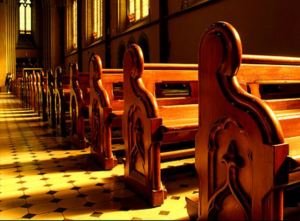
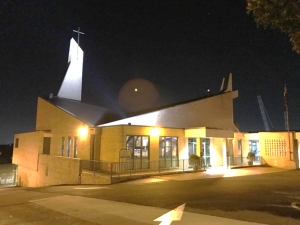 Amidst the unfussy pews of the parishes we know and love the grace of Christ continues to move and mould hearts to his own. The local parish, even in its ordinariness, remains a privileged location of God’s transforming grace in the world.
 As the mainstay of ecclesial life, the parish is, however, undergoing a process of undeniable change and has become an increasingly complex reality on account of a number of factors. Parishes are becoming geographically larger and yet numerically smaller with the practice of amalgamation and diminishing attendance. We experience growing multicultural diversity and new immigration in our pews and on the altar in our active clergy; we are impacted by a shortage and ageing of priests as we inevitably baptise more than we ordain; and we see the beginnings of more regional planning in the light of our resources and a desire for more creative ways of organising ourselves as Church.
 Looking forwards and taking into account the complexity and variety of this new situation, I would suggest three principles or areas for consideration in the effort to renew and strengthen the evangelising mission of the local parish.
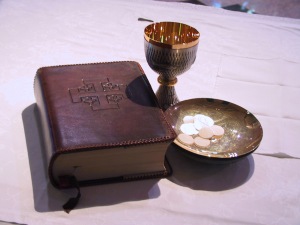 We must acknowledge that if we were to measure how many of those hundreds who receive the sacraments in our local parish each year, pass through our sacramental life in initiation or from week to week, and emerge on the other side as ‘missionary disciples’, we would have to admit that there is much less fruit than we might hope to see. Our pastoral experience tells us that we have in our communities no lack of those who have been ‘sacramentalised’ but not yet evangelised, those who are merely ‘done’ but not yet discipled.
 At the level of the parish, this gap between our presumptions (our unspoken ‘sacramentalism’ that assumes the sacraments will simply ‘take care of it’) and the active faith and discipleship to which all the baptised are called is palpable. Time and again how often have we heard parents, good and faithful parents, lament that their grown children are now disconnected from the Church, that they are no longer going to Mass, and even now hold no faith at all. Yet they did all they were supposed to do, received all their sacraments, and their children served as altar servers and so on. There can also be a latent notion, and I think a false hope, that the grace of the sacraments might ‘kick in’ many years later, like a time release capsule, but there is very little evidence that this is true. Again, hear the laments of old generations of Catholics who did all they thought they had to do, received all the sacraments, were never encouraged to ask questions and carried out the practice of the Catholic religion but lament never experiencing a life-giving or transforming faith. Where is the fruit?
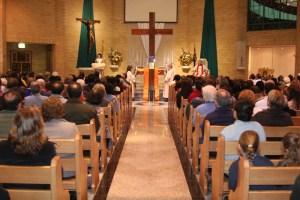 As an attempt to set discipleship at the heart of my home parish of St Bernadette’s Parish, Castle Hill, we introduced four weeks of parental preparation for entry into the sacramental program (the parish celebrated the sacraments of Reconciliation, Confirmation and Eucharist all in the one nine month period). This formation was focused not on children but on parents who were asked to attend four 2 hour sessions – on God and us, God and his Church, God and the sacraments, and living God’s way. Each session was offered three times a week to accommodate parents’ commitments, and completion of all four sessions was a requirement of entry into the sacramental program and preparation for the year.
 We turn now to consider how we might move our communities from a casual acceptance of sacramental minimalism to the apostolic zeal of an evangelising parish. A third key opportunity to move from maintenance to mission is the development of an articulate vision that goads, challenges and stimulates the parish toward change. Our parishes are often caught between a call and desire for renewal and the weight of our own church culture towards maintaining the status quo. In this moment which cries out for new energies, priests and people alike can feel bound by layers of expectation that demand the continuation of the old even while new forms of life and mission long for expression.
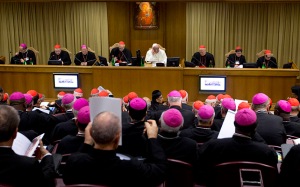 It is a great honour to join other Catholics from a diverse range of backgrounds, experience and perspectives on the Executive Committee for the Plenary Council of the Church in Australia marked for 2020. The role of the Executive Committee will be to provide advice to the Bishops Commission for the Plenary, with details of membership
 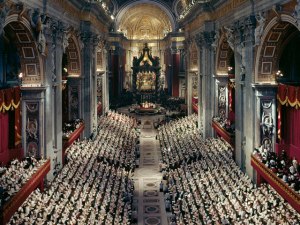 In deliberations over reform, Vatican II will and must be a touchstone for the Plenary Council in style and substance. The trials and tribulations of the post-conciliar era are in part a consequence of the absence of operating paradigms of reform at the time of the Council. In contrast, the Plenary will be able to benefit from and indeed extend the example, insights and challenges of Vatican II as an instance of reform in recent memory. The varying loci receptionis, or various contexts of reception, is but just one lesson we have learned from Vatican II, the recognition that we are as a community of communities extraordinarily diverse and that this will impact upon the translation of deliberations into real life.
 On the point of process, which I anticipate to be the foundational consideration of the Executive Committee, there is much to imbibe from Pope Francis’ well-worn expression, ‘time is greater than space’ (EG 222-223; LS 178; AL 3, 261). While seemingly obscure, the point Pope Francis seeks to make, with direct relevance to the Plenary, is that it is more important to initiate processes than to occupy positions or possess spaces. Pope Francis notes that we can often be dominated by short-term goals which result in ‘madly attempting to keep everything together in the present, trying to possess all the spaces of power and of self-assertion’ (EG 223) without due attention to longer term processes for the development of the Church’s life. This ‘life’, to draw from the Pope’s theology, is found not in ideas but in the faith that really dwells in the hearts and hands of God’s people, a faith that grace wishes to bring forth and keep alive as a sign and reality in the world.
 Paradoxically, however, I would suggest that these misgivings about process sit alongside another experience, which is that process is essential to our identity and life together. In various spheres of human activity – including but not limited to education, politics, economics and religion – we recognise, even implicitly, that the way things are done matters at least as much as what is achieved, if not more. Indeed, for the Church a synodal and collegial mode is not simply a means or technique for a particular outcome but a deepening of the Church’s own nature as a communion. Hence Pope Francis’ citation of Saint John Chrysostom who avers, “Church and Synod are synonymous”.
 We find a few scant references to accompaniment in Pope Francis’ exhortation on marriage and family Amoris Laetitia, especially in relation to those in the early years of marriage and those who have experienced relationship breakdown or divorce (AL 223, 241-244). The concept is most fully elaborated, however, in Pope Francis’ first Apostolic Exhortation Evangelii Gaudium (‘The Joy of the Gospel’) where we find four articles dedicated to what he describes as the “art of accompaniment” (EG 169-173). These references are in the third chapter of the Exhortation, under the fourth section entitled “Evangelization and the deeper understanding of the kerygma”.
 Pope Francis has commented that we in the twenty-first century live not simply in an ‘age of change’ but in a ‘change of age’. He sees, as we do, the shifting ground of global politics, the movements of people around the world, including a disastrous refugee crisis, and the changing nature of how people communicate and relate to one another (to make the point, each day the equivalent of 110 years of live content is watched online while development such as OTT apps have essentially turned messaging services into a new form of communications infrastructure).
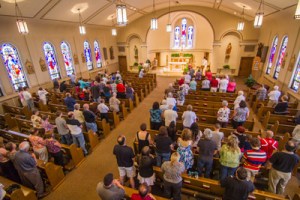 Moving from those who no longer engage with us to those who are still present in our churches, there is no longer a ‘cookie cutter Catholic profile’ if there ever was one. Many of the only-affiliated Catholics can be found in our sacramental programs. Many self-identifying Catholics do not believe in God at all but send their children to our Catholic schools in any case, and many more would pick and mix among various traditions – Eastern meditation over here, the occasional Easter Vigil over there.
 What is the upshot of this complexity for our outreach and accompaniment? Prior to any proclamation of the Church being heard, today’s missionary outlook will begin with building trust and authentic personal relationships (from which consequent invitations and participation might then come about).
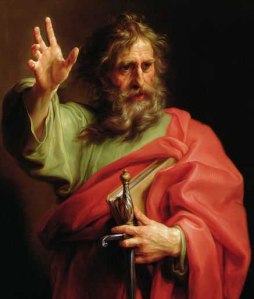 To make this opportunity concrete and practical, the outreach of St Paul, perhaps the greatest evangeliser in the history of the Church after Jesus himself, can be a resource for our thinking on this ‘art of accompaniment’.
 When we consider how many people receive the sacraments in our Church, whether the sacraments of initiation or each weekend, and how many come out the other side as disciples on mission sharing faith with others, we can see the need for accompaniment to support that journey. We have learnt that the sacraments simply won’t ‘take care of it’, that discipleship needs the support of relationships via a process such as Alpha that builds trust and encourages sharing in faith.
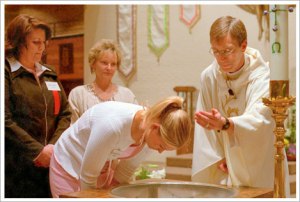
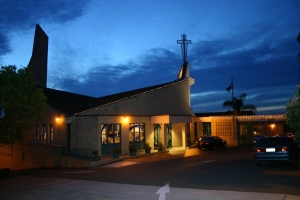 On the 24 November, 1999, on a drizzly Wednesday evening, I was baptised in a parish in the north-western suburbs of Sydney. Heralding from a family of Buddhist and Taoist heritage, I entered the Church at the age of twenty, gathered with a priest, sponsor, fellow catechumens and a mixed group of close friends, mostly of no religious background. A small but powerful group had accompanied me through the process of initiation and I was fully conscious and grateful for the fact that in God and this community I had been granted something which I would spend the rest of my life learning to be faithful to, learning to enter into, learning to trust.
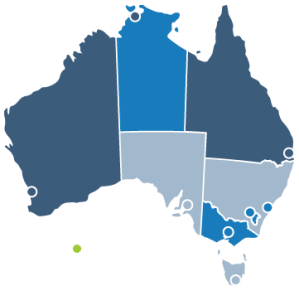 Reflecting on the Australian Church, I would concur that the central challenge for parish life is this: we are caught between a call and desire for renewal and the weight of our own church culture towards maintaining the status quo. In this moment which cries out for new apostolic zeal, we can feel bound by layers of expectation that demand the continuation of the old even while new forms of parish life and mission long for expression.
 Fundamentally we are called to be a Church of the Great Commission. This is our vision, the ‘northern star’ guiding our resolve. “Go therefore and make disciples of all nations, baptising them in the name of the Father and of the Son and of the Holy Spirit, and teaching them to obey everything that I have commanded you” (Matt. 28:19). As it has been pointed out, in our Catholic Church we have certainly learnt to “go” and can claim a presence at all corners of the earth. We “baptise” and confirm relentlessly. We “teach” and catechise great numbers in our schools and sacramental programs. However, our ability as Church to “make disciples” remains in question, as raised by the pastoral realities for the Australian Church we have explored.
 When we communicate a vision of the parish, how we seek to respond to God in this context, in this time, in this local community, when we can articulate a vision of the kinds of spiritual growth we are seeking to raise up in our people, this passionate purpose becomes the heartbeat or pulse of a parish. Conveniently, and not incidentally, a renewed vision provides the case for change.
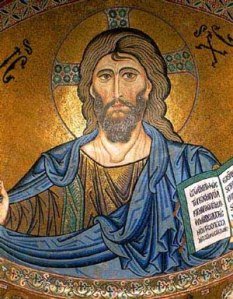 First of all, at the heart of evangelising communities is the proclamation of the Good News, specifically the kergyma which is the basic truths of our Christian faith. This word kerygma, or keryssein in Greek, may not be very familiar to us but it in fact appears in the New Testament some nine times, and refers to the very heart of the Gospel, the core message of the Christian faith that all believers are called to believe and proclaim.
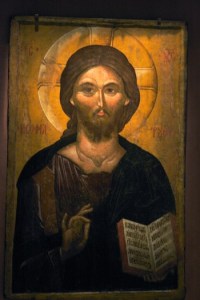 The heart of evangelisation is to announce who Jesus is, the Son of God, the Word made flesh, the man who is God, who died for our sins and was raised on the third day. It is to announce the Good News of the Risen Christ who is with us even now and opens up for us the way to life without end. Evangelising parishes proclaim Jesus’ ascension, his seating at the right hand of the Father as King, and his sending forth of the Holy Spirit. It is this Spirit which reveals Christ and even enables us to say ‘Jesus is Lord’ and it is this Spirit who empowers the Church, who empowers us, to be faithful to Christ’s mission in our own lives and in this moment of the world’s history. Finally, this Good News of Christ calls us to conversion, to repent and believe in this Gospel, calling for a change of life in the light of what God has done and is doing in Jesus Christ whose life we share by baptism, the anointing of the Holy Spirit, in communion with his mystical body, the Eucharist, and by our communion with His ecclesial body, the Church. In prioritising this proclamation, we seek to build up a culture in which Jesus is not swept into our parish story intermittently but our parishes and lives are swept into his.
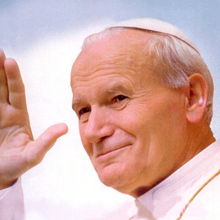 Bringing together these first principles of evangelising communities, we hear St John Paul II affirm, “Faith is born of preaching and every ecclesial community draws its origin and life from the personal response from every believer to that preaching”.
 Personal discipleship also calls for the nourishment of an ecclesial community of faith. Evangelising parishes create disciples in the midst of the Church.
 While our vision needs to be as large as the Kingdom, our implementation of that vision needs to begin small. With encouragement for us, it is worth noting that when large evangelical and Pentecostal communities are asked what they seek for their future it is to establish smaller, stable communities in the midst of a local neighbourhood, offering a consistency and intimacy of worship and local service in personal connection with the wider community. In other words, what many megachurches are seeking is a parish.
 Finally, we recognise that the proclamation of the Gospel, the call to personal discipleship and the life of the Christian community are not for their own sake but for the sake of the world. All that has gone before must bear fruit in our connection with others beyond our communities of faith, beyond the boundaries of the parish.
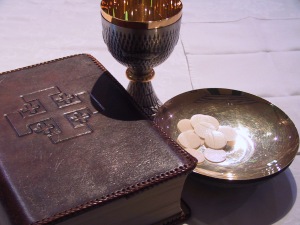 We cannot change that of which we are not aware. We must name and face head on the present challenges for our culture as Australian parishes, parishes that I believe desire to be missionary and in their heart of hearts wish to receive the grace of God who still desires much for our parish life.
 I recently returned from the Divine Renovation 2016 Conference which provided an opportunity to learn from and be immersed in the experience behind the book of the same name. For those who may not be familiar with this work,
  So where to start with Divine Renovation? First and foremost St Benedict’s has been driven by the desire for a model of a renewed parish. While many have looked to the ecclesial movements for discipleship, authentic community and evangelisation, Fr James is adamant and passionate about the fact that our Catholic parishes do not have to be centres of mediocrity or minimalism in which people come forward for the sacraments but little else. Parishes can yet be evangelising communities in which dynamic Christian life, conversion and discipleship can be born and raised.
 In terms of team roles, it is worth noting that the parish pastoral council at St Benedict’s is dedicated solely to five year strategic planning, while the parish team dedicates itself to implementing those rolling plans through the laity they engage. Importantly, the parish team works on the organisation, not in it, are not “doers” of ministry but rather leaders who call forth and equip others who “do”.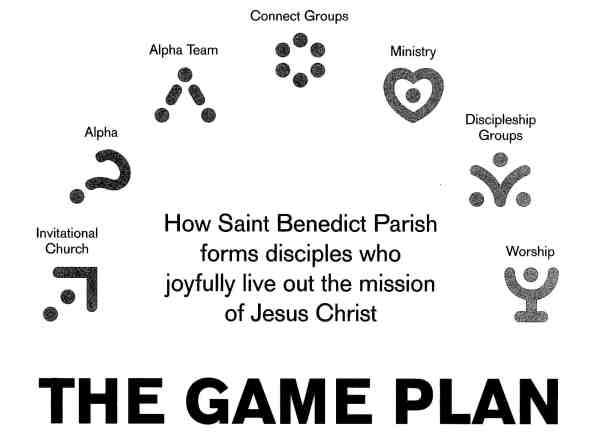
 In discussion with facilitators of Alpha in Australia, it has been recommended that Alpha be first piloted by your parish with a mix of parish staff, parish pastoral council members, committed parishioners who may not already be involved in a ministry, and new Catholics. It is notable that St Benedict’s engages Alpha not only to initiate the journey of discipleship but to develop lay leaders, as a part of their RCIA process, and as an element of marriage preparation for couples.
 While the processes of evangelisation and discipleship above are indeed impressive and can be overwhelming to consider for the parishes we know and love, it was assuring to learn that the parish of St Benedict’s has not achieved this clarity of vision and process overnight. The parish at the heart of Divine Renovation has arrived at this point after at least six years (if not more in the ministry of the pastor) of considerable trial and error, experimentation and ongoing refinement and reflection.
 The past months have seen numerous developments in the life of the universal Church and the national scene. Without doubt the most significant development has been the release of Pope Francis’ post-synodal Apostolic Exhortation on the joy of love in the family,
  With a dose of the same reality it is worth noting that it takes time and resources for this form of evangelical outreach and familiarity with our flesh-and-blood brothers and sisters. It has always struck me that while Pope Francis’ constant refrain to ‘go forth’ is both attractive and true to the spirit of the Gospel, it does in fact take organisation and resources to set out on mission. Any parish that has more than one community within it knows that it is difficult to be outreaching when, in the words of Sherry Weddell, you are ‘literally besieged at HQ’.
 Amoris Laetitia exhorts us to encourage the young to aspire to marriage and family life all the while fostering realistic expectations that prepare them for mature relationships that inevitably experience change through time. It speaks of the need for married couples to be open to the prospect of new life, to educate children in virtue and to foster their natural inclination towards goodness (AL 264). It speaks of inclusion and affirms the Gospel as a word spoken to all people in every circumstance as a source of hope. Pope Francis also offers practical ideas to encourage husbands and wives in their journey of constant growth, and urges parishes and faith communities to be bearers of comfort and consolation for those who await mercy, who seek oil for their wounds (AL 309-310).
 Workshops are also offered across the three days of the conference and will canvass a range of topics that speak to the lived situation and evangelical mission of parishes today. For convenience I’ve listed the full range of workshops below. They encompass everything from the liturgical and sacramental life of the parish, personal discipleship and the discernment of gifts, social media and communicating the Gospel to youth and young adults, to the response of parishes to the sexual abuse crisis, the need of supervision and self-care in ministry, strategies for forming evangelisation teams, responding to Amoris Laetitia through parish based marriage preparation, engaging the multicultural face of the Church and incarnating Pope Francis’ vision of poverty in the local community of faith.
 The conversion of the Church is essential to the mission of evangelisation. This fact is plain enough. Whether speaking of the universal Church, a diocese, local parish or of the individual Christian there is an obvious and intrinsic relationship between self-reform and the power and depth with which the Gospel is proclaimed and received.
 The first place to start in considering governance within the Church is with the notion of ‘authority’. From the perspective of faith, all authority originates in God’s own life and power, for He alone is the author (auctor) of life as well as the source of its flourishing. Thus, to hold authority is to properly share in something that is not our own.
 This might surprise some and it is for this reason. The experience of the post-conciliar Church has been of lay persons engaging the powers of governance to such an extent that the distinction between the ‘possession’ of such powers by the ordained and mere ‘cooperation’ in them by the laity can appear rather abstract. As canonists have noted, lay persons can be effectively exercising the power of governance as judges, auditors, finance officers of dioceses and parishes, school principals, and directors of social services and health care facilities, with such persons exercising a role which is not simply consultative but, in fact, deliberative.
 In this context, ordained ministry is understood in terms of identity rather than mere functionality and so any form of ‘congregationalism’ that relativises the ministry of clergy to functionaries within the worshipping community should be resisted. It is within a Catholic emphasis on ministerial identity, and not managerialism or functionalism, that the power of governance is seen as intrinsic to ordination for the priest is ‘so configured to Christ, the priest, that they can act in the person of Christ, the head’ (Presbyterorum Ordinis 2).
 Thank you for reading my blog throughout the year and sharing your own thoughts and questions on pastoral ministry and evangelisation. I wish you, your families and communities a merry Christmas and a blessed New Year. May the peace of the Christ-child reign in your hearts and fill you and your endeavours with the joy and mercy of God, and I look forward to sharing news of developments, conferences and activities in 2016. Daniel