
 Originally intended for publication earlier this year as Pope Benedict’s fourth encyclical and the final in a trilogy on the theological virtues, Lumen Fidei (‘The Light of Faith’) was promulgated this past Friday in the name of Pope Francis.
In the same way as Benedict’s first encyclical in 2005, Deus Caritas Est, brought to completion the unfinished writings of John Paul II, so Francis’ inaugural encyclical represents to a significant degree the thought of his German predecessor on the meaning and implications of Christian faith. This inheritance and continuity between recent papal documents aligns well with Benedict’s own remarks, just days before his abdication, on the writings of ‘Peter’:
Peter was not alone in writing [his] Letter but it expresses the faith of a Church . . . He does not write alone, as an isolated individual; he writes with the assistance of the Church, of people who help him to deepen the faith, to enter into the depths of his thought, of his rationality, of his profundity. And this is very important: Peter is not speaking as an individual, he is speaking ex persona Ecclesiae, he is speaking as a man of the Church.
Likewise, Francis’ encyclical is received not as the word of a private individual apart from or above the Church but an expression of the faith of the communion of which he is called, in his person as ‘Peter‘, to be witness and shepherd.
The Possibility of Faith
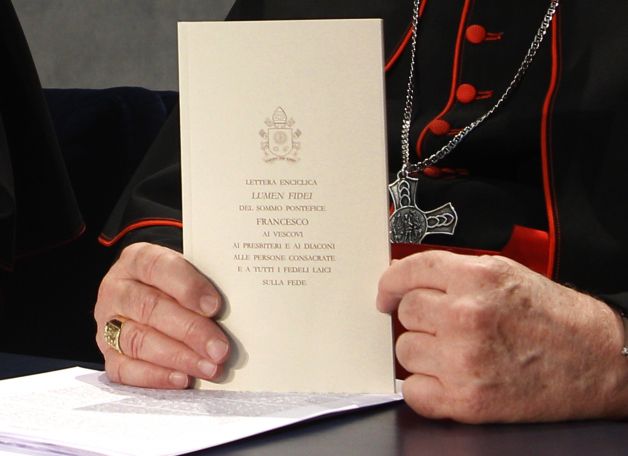 Lumen Fidei begins by addressing the very dilemma of faith in the contemporary world. Christian faith is so often seen by many as contrary to reason, not as a light that opens up the world but a darkness which stifles and even represses human creativity and the quest for knowledge. Even those who have sought to make room for faith have undermined it by promoting faith, erroneously, as a ‘leap in the dark’ driven by blind emotion. Others who champion autonomous reason as the answer to humanity’s future have often realised that their questions remain unanswered and this has led to an abandonment of the very search for truth itself in favour of “smaller lights which illumine the fleeting moment yet prove incapable of showing the way” (LF 3). Humanity remains hungry for a firm ground on which to stand and hence remains unfulfilled as it experiences the darkness and insufficiency of the world and itself.
On reading these opening remarks, the influence of Benedict stands out. His 1968 work Introduction to Christianity begins with this same confrontation of the very possibility of belief in the world of today. Indeed, the same temptations for the believer and unbeliever alluded to in Lumen Fidei (that of fideism or refuge in rationalism in the face of life’s questions) are raised by the early Ratzinger as prompts toward a fuller understanding of the ‘openness’ of faith, “Just as the believer knows himself to be constantly threatened by unbelief, which he must experience as a continual temptation, so for the unbeliever faith remains a temptation and a threat to his permanently closed world” (Ratzinger, Introduction to Christianity, 45). The recurring challenge of human finality and the quest for human understanding rescues both the believer and unbeliever from being shut up in their own worlds, resisting any tendency to self-satisfaction and urging humanity onwards in the search for truth.
 Lumen Fidei seeks to propose the light of faith as the guide to this truth that we seek, a light that illumines all aspects of our existence in illuminating God as one who addresses us personally. It notes that the word of God that called Abraham, ‘our father in faith’, is not alien to human experience but always present at the core of our being. It follows that Abraham’s response to that divine calling, Abraham’s faith, “sheds light on the depths of his being, it enables him to acknowledge the wellspring of goodness at the origin of all things and to realise that his life is not the product of non-being or chance, but the fruit of a personal call and a personal love” (LF 11). Faith in God, then, as one who creates and calls is not an extrinsic act or a merely ‘religious’ commitment but an integral and humanising project and gift which, when received, unveils our true vocation in the life of God himself.
The faith of Israel that would follow Abraham further reveals faith as a summons to a pilgrimage with the Lord that calls through the concrete events of our life. The history of Israel also sounds a note of warning, that of idolatry which reveals our own tendency toward control and vanity, as Lumen Fidei makes clear, “Idols exist, we begin to see, as a pretext for setting ourselves at the centre of reality and worshipping the work of our own hands” (LF 13). While commentators have seen in this discussion of idolatry the hand of Pope Francis, it is one that was certainly shared by his predecessor in his writings on the liturgy among others (see Ratzinger, Spirit of the Liturgy, 22f). The overall thrust of the text is to underline the paradox of faith, that is, as in all loving relationship, by our constant turn towards the one beyond our control, and by the surrender to what we did not initiate, we become more and not less ourselves, freed from the slavery of our own self-absorption and insecurities.
Ultimately, it is in Christ Jesus that the total manifestation of God’s faithfulness arrives in history, the crucifixion of Christ being the “culmination of the gaze of faith; in that hour the depth and breadth of God’s love shone forth” (LF 16). It is a total gift of self that precedes us and allows one to entrust themselves completely to the utter reliability of God’s love, manifest not only in this death-in-love but in his rising in love, a “tangible and powerful love which really does act in history and determines its final destiny, a love that can be encountered” (LF 17). It echoes the thought of Ratzinger for he affirms elsewhere, “Christian faith is more than the option of a spiritual ground to the world; its central formula is not ‘I believe in something’ but ‘I believe in you’. It is in the encounter with the man Jesus, and in this encounter it experiences the meaning of the world as a person.” (Ratzinger, Introduction to Christianity, 79).
After a brief word on the ecclesial form of faith, perhaps surprisingly brief given the demise of the Church’s credibility in the wake of the abuse scandal, the encyclical turns to the relation of faith to the truth which human beings seek (the theme of the Church is picked up again in Chapter 3 of Lumen Fidei though, again, without any theological treatment of sinfulness within the Church).
A Reasonable Faith
 Engaging an epistemology that may not be accessible to all, Lumen Fidei then goes on to underline the significance of truth for faith. Without truth, faith remains only “a beautiful story, the projection of our deep yearning for happiness, something capable of satisfying us to the extent that we are willing to deceive ourselves” (LF 24). Knowledge of the truth, Lumen Fidei asserts, is to be found in love which cannot be reduced to ephemeral emotion but is, most deeply understood, union with the Other. Without this love, “truth becomes cold, impersonal and oppressive for people’s day-to-day lives”; without truth, love becomes mere sentimentality, a fleeting emotion and cannot be a ground on which a future can be sustained. Love without truth “cannot stand the test of time” (LF 27). It is this discovery of love as a source of knowledge, as an interpersonal communion built upon truth that is capable of pointing us toward our ultimate fulfilment, that finds expression in the biblical understanding of “faith” (LF 28).
Returning to the concern of the opening paragraphs, Lumen Fidei then turns to the dialogue between faith and reason, drawing on the insights of John Paul II’s Fides et Ratio and also St Augustine, a perennial influence in Benedict’s own thought. As in the writing of John Paul II, faith and reason are presented not as opposed – as if faith were an irrational undertaking or that reason leaves behind the necessity of faith – but are recognised as having the same end or finality which is to know the truth. The reception of divine revelation and the ongoing human question for meaning, or philosophy, are not exterior to one another but intrinsically linked as Lumen Fidei seeks to show by the example of scientific inquiry,
The light of faith is an incarnate light radiating from the luminous life of Jesus. It also illumines the material world, trusts its inherent order and knows that is calls us to an ever widening path of harmony and understanding. The gaze of science thus benefits from faith: faith encourages the scientist to remain constantly open to reality in all its inexhaustible richness. Faith awakens the critical sense by preventing research from being satisfied with its own formulae and helps it to realize that nature is always greater. By stimulating wonder before the profound mystery of creation, faith broadens the horizons of reason to shed greater light on the world which discloses itself to scientific investigation (LF 34).
 As Fides et Ratio affirmed for philosophers so it may be said for the scientist, “it is necessary not to abandon the passion for ultimate truth, the eagerness to search for it or the audacity to forge new paths in the search. It is faith which stirs reason to move beyond all isolation and willingly to run risks so that it may attain whatever is beautiful, good and true. Faith thus becomes the convinced and convincing advocate of reason” (FR 56). As it has been said, it is faith that challenges reason to more audacious undertakings.
An Ecclesial Faith
The third and penultimate chapter of Lumen Fidei expands on the ecclesial context of faith that is only touched upon at the end of Chapter One (LF 22). Addressing the maternity of the Church, as one who brings about the birth of Christ in the believer, the encyclical draws attention to the living tradition of the Church.
The Church passes on the light of faith through the generations, “just as one candle is lighted from another”, an image that certainly recalls Pope Francis’ preaching style. Raising the question of the verification of knowledge, the encyclical underlines the relational way in which knowledge is transmitted, “Language itself, the words by which we make sense of our lives and the world around us, comes to us from others, preserved in the living memory of others. Self-knowledge is only possible when we share in a greater memory” (LF 38).
This sociological reality illuminates the theological significance of the Church as a “remembering subject” for it is this living communion that precedes us, and into which we are baptised, that teaches us the very language of faith. In plain terms, the Church came before us and rather than stifling our personal engagement with God in Christ, this very fact makes possible our personal faith with all the riches and insights of those that preceded us.
 In faith, we respond to a word which did not originate with us – in the language of Lumen Fidei, “Our belief is expressed in response to an invitation, to a word which must be heard and which is now my own; it exists as part of a dialogue and cannot be merely a profession originating in an individual” (LF 39). Ratzinger’s earlier text makes the point in a similar way, “Faith comes to man from outside. . . [It is] not something thought up by myself; it is something said to me . . . This double structure of ‘Do you believe? – I do believe!’, this form of call from outside and the reply to it is fundamental to it” (Ratzinger, Introduction to Christianity, 91-2).
The ecclesial form of faith also expresses itself in the Church’s sacraments which “communicate an incarnate memory” (LF 40). Lumen Fidei even intimates the sacramental structure of faith itself for “the awakening of faith is linked to the dawning of a new sacramental sense in our lives as human beings and as Christians, in which visible and material realities are seen to point beyond themselves to the mystery of the eternal” (LF 40). Following this there is catechesis on the sacraments of baptism, confirmation, Eucharist, the creed, the Decalogue and prayer before the fourth chapter turns to the social consequences of the nature of faith outlined.
An Incarnate Faith
In continuity with Pope Francis’ preaching on the sociality of faith and the Church’s mission, the encyclical concludes by relating faith to the common good, affirming faith not as a privatised journey of introspection or pious isolation but a “process of building, the preparing of a place in which human beings can dwell together with one another” (LF 50). Faith does not only provide interior firmness, it also allows the believer to see others in their inherent dignity and vocation, born of love for union with God’s own self. Faith, because it is loving, does not draw believers away from the world but ever deeper into the concrete concerns of the men and women of our time. Families and the young are called to be bearers of faith in the midst of the world (LF 52-53) while faith brings as well a respect for creation as a gift for which all are indebted.
 A powerful section of Lumen Fidei is its treatment of human suffering in which it recognises human pain, hunger and loss is not at all extinguished by faith but placed in a new context of meaning. The encyclical affirms in this regard, “Faith is not a light which scatters all our darkness, but a lamp which guides our steps in the night and suffices for the journey. To those who suffer, God does not provide arguments which explain everything; rather, his response is that of an accompanying presence, a history of goodness which touches every story of suffering and opens up a ray of light” (LF 57). Pope Francis reminds us that it is Christ who has occupied the place of suffering, in the Gethsemane Garden and on the Cross, and as the endurer of humanity’s suffering he will be “the pioneer and perfecter of our faith” (Heb. 12:2) (LF 57).
As is tradition, Lumen Fidei concludes with an affirmation of the ‘Marian profile’ of faith for it is Mary who demonstrates the fruitfulness of faith from the Annunciation to the Cross. As figure of the Church and as one whose motherhood extends to each of his disciples, Mary leads us always and only to the blessing of faith which is her Son.
Conclusion
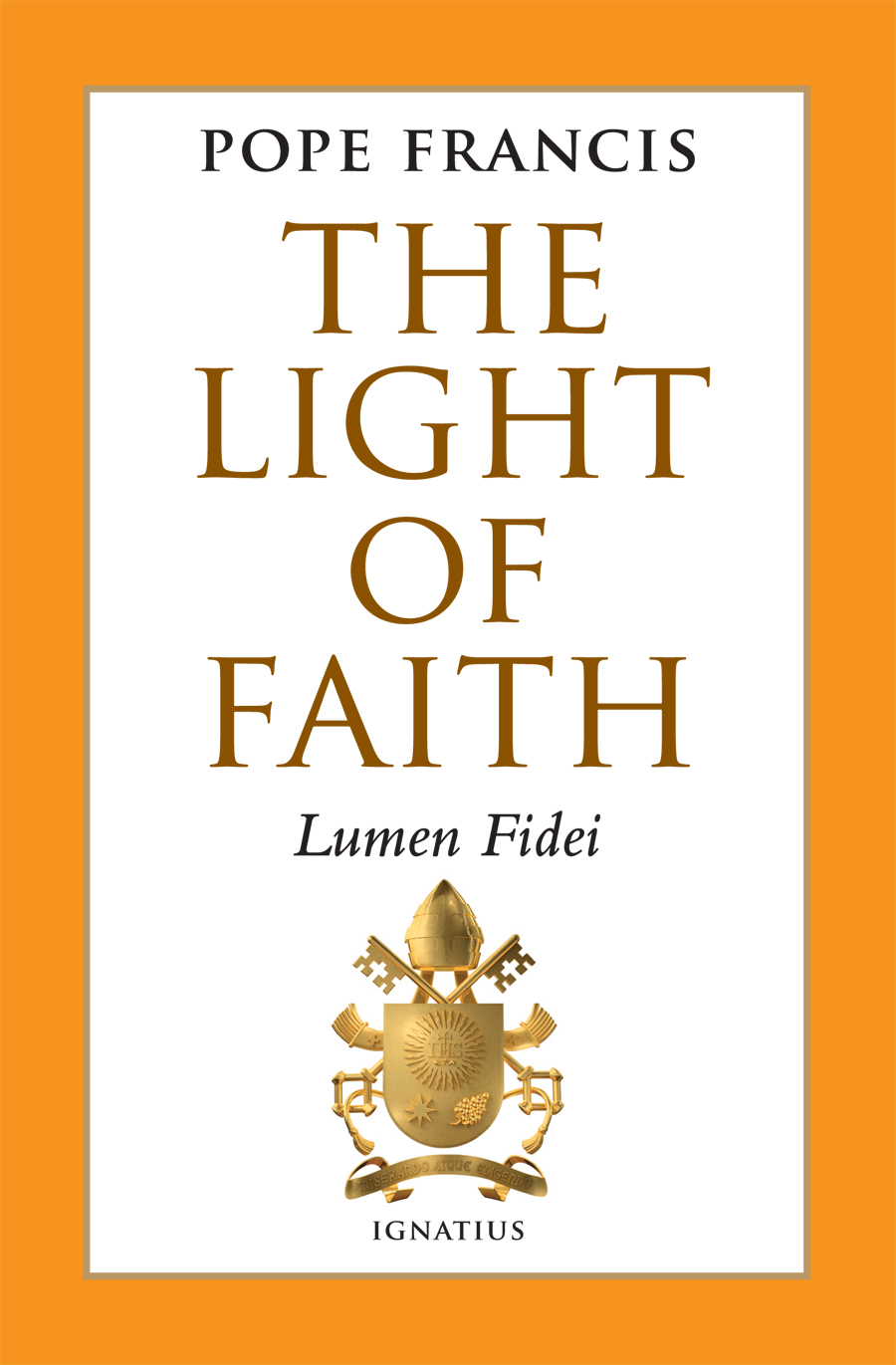 Lumen Fidei is a timely encyclical for a challenging moment in the Church’s history, calling for a return to the purity and plenitude of the faith that we have received and are called to live in the present. As this most recent teaching is received and settles within the tradition of the Church (and it calls for future reading together with its forebears Deus Caritas Est and Spe Salvi), many more insights and implications will no doubt come to light. What is obvious by its absence is significant reference to the “new evangelisation” as another manifestation of the Church’s self-understanding (with the exception of LF 42). We might hope that a future exhortation on this subject will build connections and so further expand the implications of faith for the Church’s mission in a new time, in the context of a globalised church and with a variety of ad intra and ad extra influences impacting on the Church’s relation to the world.








 timeofthechurch