

Recently, I came across a video clip from a “March for Australia” rally that took place in Australian state and territory capitals on 31 August 2025, in which a senior academic at a Catholic institution made remarks that left me deeply unsettled.
In the video, the speaker – entrusted with the moral and intellectual formation of young Catholics – appears to suggest that Australia, from the time of European settlement, has always rightfully belonged to Anglo-Europeans. The clear implication was that national identity is something primarily, or even exclusively, tied to British heritage – a view that presents the country’s history through a narrow, ethnically defined lens.
What makes this rhetoric particularly concerning is that it draws on a well-worn tradition in Australia’s history, in which racialised understandings of national belonging tend to emerge not as a constant, fully systemic reality, but in waves – often in response to economic stress, political uncertainty, or social change. These waves typically target specific groups, who are scapegoated for broader structural problems.
Today, the targets may be Indian migrants; in previous decades, it was Asians, Italians, Lebanese, and Greeks, among others. These groups have been blamed for everything from housing shortages to wage stagnation – issues that are far more complex than the presence of migrants, but which get recast into a familiar politics of grievance.
In this context, advocating for a return to a homogenous or “original” Australian identity – or even a dominant Anglo-Saxon cultural “supermajority” as advocated by the Catholic academic – becomes not only historically reductive, but deeply exclusionary. It erases the contributions of generations of migrants who have played a vital role in shaping this nation’s social, cultural, and economic life. It also ignores the profound diversity of contemporary Australia, built not on a single ethnic foundation but on mutual respect and the contributions of many cultures engaging across generations.
Such notions are also based on a flawed premise: that there exists a coherent, singular “ethnogenesis” of an Australian ethnicity, which can be traced back to a defined cultural moment and preserved in amber. In reality, this is in fact a qualified social constructivist fantasy, resting on arbitrary start and end dates, or imagined histories that never fully existed. National identity, like culture, is dynamic and evolving. To claim otherwise is to deny the complexity and multiplicity of the Australian story.
Perhaps the only genuinely systemic racial issue in Australia – one which has never arrived in waves but been embedded in our national foundations – is our unresolved relationship with First Nations Australians. Political and cultural institutions have operated as though colonial history is the only real beginning, failing to fully acknowledge and reconcile with the fact that this land was inhabited by First Nations peoples for millennia before British arrival. The presumption that modern Australia starts and ends with colonisation is itself a form of historical revisionism, so often built into the very way we tell our national story.

But racism in Australia is not confined to history, nor is it always directed from majority to minority. It also exists within and between migrant communities, some of whom define themselves in opposition to wider Australian society or to other minority groups. This complexity demands an honest reckoning, recognising that racial prejudice can be internalised, redirected, or replicated across communities, especially when identity feels precarious or under threat.
Catholic institutions, in particular, must be vigilant in how they navigate these dynamics. There is a sobering historical reality here: racism has existed within the Church itself. While the Church has made important strides since then, its members must continually examine how their message and witness either confront or reinforce such ideologies.
Today, the vitality of the Catholic Church in Australia is closely tied to migrant communities. With declining religious participation among the broader population, the continued health of parishes, vocations, and Catholic schools increasingly depends on those who have arrived from the Philippines, India, Vietnam, Africa, and the Middle East. Ongoing racism, especially when implied by Catholic leaders, risks alienating the very people who sustain the Church’s mission and presence in this country.
This is why the remarks at the rally a fortnight ago are so troubling. If such a worldview were to influence the ethos of our Catholic institutions, it would raise serious concerns about how the Western tradition and the Church’s vision of human community are being taught – and to whom they are seen as belonging.
The Western tradition is a profound and meaningful inheritance, forged in the synthesis of Greek philosophy and the Judeo-Christian faith, but it is not the exclusive property of any one people. To conflate it with whiteness or Britishness is to distort both its content and its purpose. At its best, this tradition is capacious – a treasure open to all who seek truth, beauty, and goodness. It is meant to be shaped by, and shared with, people from every nation and background, animated by the universal vision of the Catholic faith.
As Pope Benedict XVI frequently affirmed, the heart of the Christian intellectual tradition lies in its openness to truth wherever it is found, and in its call to unity grounded not in ethnicity, but in the inherent dignity of every human person. When a speaker espouses ethnocentric nationalism and simultaneously teaches the Western tradition, it raises a serious concern: that this tradition is at risk of being misused or subtly misrepresented – not as a source of communion, but as a Trojan horse for racial and cultural exclusion.
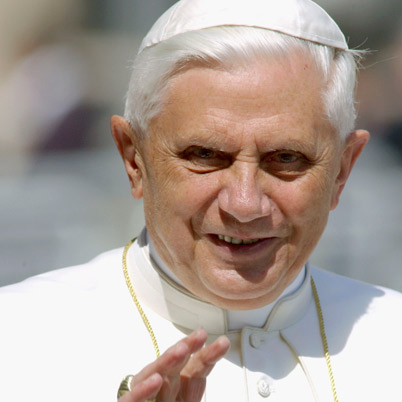
The speaker’s language – especially references to a unifying Anglo-European “crimson thread of blood,” which echoes Sir Henry Parkes but also carries troubling connotations of ethnic and racial purity – and the portrayal of Australia as fundamentally an Anglo-European project, dangerously approaches an ethnonationalism that the Church explicitly condemns. This is not the vision of nations embraced by Pope Benedict XVI, who warned against nationalism elevated above ethics and the rights of others, describing such tendencies as “a demonic force and the source of terrible disasters”.
When such ideas are voiced by figures in Catholic academic leadership and applauded by audiences that include far-right nationalists – met with triumphant shouts of “Amen” – they risk aligning Catholic witness with ideologies that are not only politically extreme but, as we have seen in countries like the United States, can escalate into acts of real-world violence when cloaked in religious or moral legitimacy.
As someone born in Western Sydney to migrant parents – whose family has worked diligently, contributed generously, and wholeheartedly embraced this country as their own – I find these implications deeply troubling. Regardless of the speaker’s intent, the message received is one that questions the belonging and legitimacy of many millions of Australians, simply because of their diverse origins. It strikes at the heart of a shared history, contribution, and identity.
Catholic institutions today face an urgent task: to form students not only with intellectual depth, but with a Gospel-rooted vision of the world – one that transcends race, class, and tribe. At a time when cultural forces seek to divide and categorise, our Catholic faith calls us to communion.
That’s why the implications of this video are so serious. This moment demands clarity – not silence or ambiguity. We must ensure that our faith and its traditions are never co-opted by narrow political or ethnic visions, which can lead people down deeply dangerous paths. The Church’s mission is universal. Her intellectual life is for all. And the future of Catholic education in this country depends on our ability to live and teach that truth with both conviction and humility. Our institutions have much to offer. But they must be courageous in defending the true scope of our tradition and the cultural wealth of our nation.
 timeofthechurch