the legacy of Joseph Ratzinger

The announcement overnight of Pope Benedict XVI’s resignation, brought on by age and ill health, brings to an end a remarkable contribution to the life and theology of the Catholic Church.
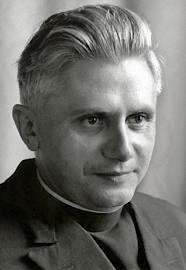
ratzingerFor those who have followed his vocation and studied his thought, Joseph Ratzinger stands out among a generation of European scholars who were integral to the reforms of the Second Vatican Council and who consequently shaped the faith of generations that followed.

Only 35 years old at the time of his appearance at Vatican II as peritus (theological expert), Ratzinger would go on to become the Prefect of the Congregation of the Doctrine of Faith (CDF), a position he held for some 24 years, serving with vigour and tenacity throughout the pontificate of his predecessor, John Paul II (some have described Ratzinger’s performance during this time, perhaps not unfairly, as ‘intellectually remorseless’).

The clarity of Ratzinger’s thought is expressed principally in his writings on liturgy (in which he is influenced by the liturgical movement of the 19th and early 20th centuries) and ecclesiology (grounded in patristic thought, especially St Augustine). The Spirit of the Liturgy and his Church, Ecumenism, Politics: New Essays in Ecclesiology stand out among others.

Those who have engaged his work will recognise the abiding influence of the ressourcement movement throughout Ratzinger’s corpus. This influence includes Henri de Lubac whose Catholicism was, in Ratzinger’s own words, ‘a key reading event’. It is an inspiration that goes some way to explaining the Bavarian’s subsequent focus on the liturgy as the bearer of faith, the Church Fathers as monuments of our tradition, and his development of a Eucharistic ecclesiology grounded in the concept of ‘communion’ (the Oxford scholar Aidan Nichols singles out Ratzinger as ‘one of the first Catholic thinkers to adopt a full-scale, systematically elaborated “Eucharistic ecclesiology”’).

Ratzinger’s theology of the Church has much to recommend itself for pastoral life today precisely because sound practice can only be established on the basis of a sound theology.

pope-benedict-xvi_19Grounded in the ecclesiology of Lumen Gentium, Ratzinger understands the Church not merely as a social organisation but as an organism of the Holy Spirit, encompassing us all from within and bringing about, by Word and sacrament, our genuine ‘contemporaneity’ with Christ in history.

For Ratzinger it is the essential sacramentality of the Church, as recognised by Vatican II, which brings out the twofold nature of the Church’s mystery – its visible, external aspect and its invisible, spiritual dimension which form a vital and paradoxical unity.

This mystery of the Church is well described in Ratzinger’s Introduction to Catholic Theology, in terms of God’s abiding holiness in the midst of the Church’s sinful humanity:

The holiness of the Church consists in that power of sanctification which God exerts in it in spite of human sinfulness. We come up here against the real mark of the ‘New Covenant’: in Christ God has bound himself to men, has let himself be bound by them. The New Covenant no longer rests on the reciprocal keeping of the agreement; it is granted by God as grace which abides even in the face of man’s faithlessness. It is the expression of God’s love, which will not let itself be defeated by man’s incapacity but always remains well-disposed towards him, welcomes him again and again precisely because he is sinful, turns to him, sanctifies him and loves him.

Because of the Lord’s devotion, never more to be revoked, the Church is the institution sanctified by him forever, an institution in which the holiness of the Lord becomes present among men. But it is really and truly the holiness of the Lord that becomes present in it and that chooses again and again as the vessel of its presence – with a paradoxical love – the dirty hands of men. It is holiness that radiates as the holiness of Christ from the midst of the Church’s sin. So to the faithful the paradoxical figure of the Church, in which the divine so often presents itself in such unworthy hands, in which the divine is only ever present in the form of a ‘nevertheless’, is the sign of the ‘nevertheless’ of the ever greater love shown by God. The existing interplay of God’s loyalty and man’s disloyalty which characterizes the structure of the Church is grace in dramatic form. . . One could actually say that precisely in its paradoxical combination of holiness and unholiness the Church is in fact the shape taken by grace in this world (p. 341-342).

The objective holiness of the Church as a sacrament of God’s grace, despite its human frailty, is inexplicably bound up for Ratzinger with the centrality of the Eucharist in the Church’s life and identity.

EucharistIn fact, Ratzinger locates the birth of the Church not so much at Pentecost but at the Last Supper, which signifies and effects the incorporation of the faithful into the body of Christ. Hence, the importance of the Eucharist in the realisation of the Church’s identity and mission as Christ’s body in the world.

Ratzinger’s recognition of the Church’s twofold nature and appreciation of the Eucharist as the sacrament of Christ’s holiness, and therefore of hope for the Church, brings great comfort as well as challenge to Catholic faith in this moment of history, particularly amid the ongoing scandal of the sexual abuse crisis which has cast a shadow over the promise of Catholic faith.

No doubt the news of the Pope’s resignation will focus not on the theological achievement of Joseph Ratzinger but on many broader issues including the state of the Catholic Church itself and calls for sweeping (and likely immoderate) ecclesial reform.

As one commentator noted overnight, the media will largely miss the significance of Ratzinger as it has over the past eight years of his pontificate. There will be a popular perception that he lacked the personality and impact of his predecessor but these judgments are more likely to be made by those who have never read his work.

For those who know as much about Catholicism as they do about the Bhagavad Gita, nothing much will have changed. However, for those who share faith and an appreciation of the Church’s living tradition, which demands the living and articulate faith of graced individuals, the contribution of this Bavarian theologian is cause for thanksgiving.

we can all learn from Boston

That is not something we could have said in 2002. After all, it was in that Archdiocese that the scandal of the sexual abuse crisis, including serious maladministration, broke across the front pages of the Boston Globe, sending the American (and universal) Church into a crisis which continues to impact the life and morale of individuals, parishes, and religious communities today. At that time, Boston could not be said to have modelled anything for the Church.

disciplesinmissionMore than a decade later and the reform in Boston continues under the leadership of Cardinal Sean O’Malley, though now with a particular focus that lies in its future. This year has seen the commencement of the first phase of Boston’s pastoral plan, ‘Disciples in Mission’.

What’s the essence of the diocese’s plan and what is its relevance for the rest of us? Boston is focused on the positioning of parishes more solidly for ‘the New Evangelisation’, meaning renewed outreach to ‘our brothers and sisters and drawing them more fully to Jesus Christ’. This is pretty much the focus of the magisterium – a concentration on the baptised who have lost a living sense of faith, without denying the importance of the traditional mission ad gentes. 

(You can think of it this way: the mission ad gentes, ‘to the nations’, is for those who ‘Don’t Know, Don’t Care’,  the mission of the new evangelisation is for those who ‘Know, but Don’t Care’).

In the name of renewal, the Diocese is reorganising all of its 288 parishes into approximately 135 ‘collaboratives’. Most of these parishes will retain their own canonical identity and integrity, with their own name, assets, liabilities and financial obligations but will placed under the governance of a single priest (or ‘pastor’ as they prefer to say in the U.S.). This approach is described locally as ‘twinning’ or ‘clustering’ parishes.

So, why this radical restructure across the Diocese? Boston is reorganising its life in the pursuit of one goal: to enhance its mission of evangelisation.

By introducing ‘collaboratives’, Boston notes the following gains:

  • parishes can unite to work together in pastoral actions based on a common vision;
  • the resources of parishes can be shared for the mutual benefit of all;
  • a greater shared consciousness can be fostered of the need to bring people back to an active practice of the faith;
  • a renewed focus on outreach to others will be supported by resources and training in the theology and practice of evangelisation, training in parish leadership and sound management (for both priests and lay ministers who will now work in two-parish or multi-parish groups).

evangelizationIn my experience the greatest obstacle to this type of bold renewal of pastoral life is neither finance or facility but a failure to recognise the mission of evangelisation as the central purpose for which all of our communities exist.

In other words, a lack of focus on our Christian mission leads to complacency and the isolation of our ministries and communities, one from another. Communities that are settled in an ‘exclusive unity’ will not grow, spiritually or numerically. This is because they will have neglected the central Gospel imperative to ‘go and make disciples’, a mission that calls for the uniting of gifts and combined witness.

The urgent need to focus beyond what we have, beyond ourselves and beyond even our own preferences, could be put this way: ‘If your parish or community closed today, would anyone but its members notice?’

We must recognise our existence is not for ourselves and organise our life and our structures accordingly. We exist for mission, for the making of new disciples and promoting growth in all those who follow Jesus. We can all learn from Boston and be challenged by its bold renewal. If we do, we have the opportunity to offer stronger, combined witness in faith, better manifest our identity as a communion, and realise a more effective mission than that which could be achieved on our own.

youth ministry in an adult church

I once heard youth ministry colourfully described as a ‘bandaid on a bleeding artery’. While those committed to the evangelisation and support of youth might resist such a diagnosis it nevertheless points to the fact that outreach to young people cannot be thought of apart from the health of the adult Church.

wydIt strikes me that if the adult Church is haemorrhaging – because of poor preaching and liturgy, a thin sense of belonging or a lack of support for instance – then there is little prospect that young members will be sustained in their faith as they mature. Young people graduate from the parochial youth group or youth movement much faster than we think. This leads us to consider what we are offering young people in our communities over the long term, for the flourishing and growth of their faith. All you need do is look at your adult Church for a sense of what’s coming.

There are other good reasons why nurturing the faith of adult Catholics is critical, even essential, to meaningful youth ministry in our parishes.

Adult Catholics witness to younger Catholics what a mature faith looks like. If we want to raise the standard of discipleship in the Church then adults who are prayerful, steeped in Scripture, theologically literate, articulate and committed to justice must become the new norm. Only then will the faith of young people naturally aspire to more than intergenerational conformism.

Naturally, we want young people in our communities for their vibrancy and energy as well as the tangible hope they bring for a Church we hold precious. However, we need to acknowledge that young people will not be attracted to parishes or communities that show no energy or dynamism in themselves.

prayerGiven the above, there is an argument for a renewed emphasis on adult catechesis in the local community, in addition to the traditional role of children’s and youth ministry in parish life. In my experience there is too little focus on adult formation in our parishes (apart from what is assumed to be taking place when homilies are preached or in the sign value of the sacraments).

In a well researched book on faith formation, Jane Regan argues that the strongest rationale for a focus on adult catechesis, as a necessary complementary to a focus on youth, is the mission of evangelisation:

It is the link between evangelisation and catechesis that provides the clearest mandate and the most convincing rationale for focusing on adults. Adults need to be continually formed in their faith so that they are able to fulfil their responsibilities in the mission of the church (Regan, Toward an Adult Church, p.24)

Of course, the responsibilities of adults include the evangelisation of youth. Without their catechesis, the formation of adults in faith, they are not likely to connect what takes place in liturgy with mission, the connection between faith practices and their life remains obscure, and so the connection between discipleship and evangelisation will be lost. In short, adult disciples need catechesis to be evangelisers, which includes being effective witnesses to the young people in their parish community and everyday lives.

So if you are involved in youth ministry, adults need to become an integral part of the overall vision of your parish if your ministry is not to be merely a temporary ‘moment’ in a longer story of unrealised potential.

If we want youth ministry to make a lasting difference we cannot afford to take our eyes off the adult members of our community which they will one day become.

start planning to be a better church

“For the vision still has its time, presses on to fulfillment and will not disappoint” (Habakkuk 2:3)

At a recent gathering I was asked what I did for work. I shared something of my role as a pastoral planner for the Catholic Church to which they responded with detached interest, “Oh I guess they would have to plan wouldn’t they”.

loaves and fish mosaicI suspect that many Catholics would be just as surprised that pastoral planning goes in the Church. And yet it is nothing new to us. From the very beginning of our history as disciples planning has been a common part of our life. In the Acts of the Apostles, for example, we see the community organising itself – identifying, preparing for and responding to the pastoral needs of their fellow believers and those beyond the nascent community. This includes providing for the care of Greek widows (6:1-6) and addressing the need to catechise the great numbers in Antioch (11:19-26). Hence, from the outset, the community and its leaders discovered particular pastoral needs, discerned ways to address them, and then selected one of the possible options. These activities constitute the essence of ‘pastoral planning.’

Many dioceses are dedicating considerable resources to ‘planners’ among the people of God and some parishes have also begun to take a more strategic approach to their life though these are fewer in number than is called for. Much work remains to be done here.

startplanning2Pastoral planning, for instance, is the reason for which pastoral councils exist (see Canon 536 §1 and Ecclesiae Imago n.204) . However in my experience these still too often get bogged down in ‘maintenance mode’ or end up acting like corporate management and so fail to achieve their potential as a body of prayerful discernment and missionary initiative (and this phenomenon deserves a blog all of its own).

So why is church planning indispensable and why does it need to be a priority for your faith community or ministry group? There are many reasons that could be raised. Below I list only a few to spark your own thinking about a more planned approach to mission.

  • The need to develop, articulate and promote a clearly owned vision within and beyond your group (i.e. ‘what are we about?’). Without such a vision, resources can be misdirected and significant energy can be lost; people have no way of engaging with a future approach. What is your community’s vision for making disciples?
  • The need to identify spiritual and social needs as well as gifts within the group so that the mission of Christ and the Church can be fulfilled. Intentional planning provides an opportunity to get to know the members of the group or community more intimately and engage their abilities toward the common good;
  • The opportunity to consult community members and listen intently to their faith, viewpoints and experience of the past and present with a view to the future. No one has a comprehensive view or can experience all of the Church’s life; as a communion of faith we depend on each other for the best view of things. St Paulinus of Nola reminds us, ‘Let us listen to what all the faithful say, because in every one of them the Spirit of God breathes’;
  • The need to match our structures with our mission, particularly in light of limited resources and increasing need. All structures and persons are at the service of, and therefore accountable to, the mission given to us by the Gospel in our particular context. We need to match the faith that we live with the mission we seek to fulfil;
  • To enable your faith community or group to respond effectively and proactively to change and to not be passively shaped by external forces. Intentional planning actually enables adaptability, flexibility and resourcefulness in the midst of changing circumstance.

Without the discipline of planning for the future life of your community or faith group it is unlikely to realise its greatest potential. When exercised well pastoral planning can move communities beyond complacency, from merely existing to communities of genuine missionary intent. It can forge a more united and creative vision and raise a self-awareness within the community that it does not exist for itself but for the greater purpose of mission. On the other hand, a lack of planning does not simply leave communities where they are but actually risks their diminishment. So start planning to be a better Church; it’s never too late to begin.

welcome

Daniel Ang9Welcome to timeofthechurch, my blog about the contemporary life of the Catholic Church. It aims to promote better pastoral practice and leadership in our parishes and ministries by bringing together the best of the Catholic tradition with the pastoral issues and concerns that affect the Catholic community today.

I believe the riches of our theological and spiritual traditions offer abundant resources to support the conversion of our communities and strengthening of our mission in the present. I believe that the Church, as both the bearer and receiver of God’s mystery, remains a place of possibility and hope for the future. By offering my thoughts on this blog I hope to contribute to that hope.

The name of my blog draws its inspiration from the work of the Dominican theologian Yves Congar OP (1904-1995) and the Jesuit scholar Henri de Lubac SJ (1896-1991) who, in their sacramental approach of the Church, underlined its life and activities as both inseparable from human history and at same time as transcending that history.

For these scholars it was in the mystery of the Church, ‘the bond between two worlds’, that past (memory), present (history) and future (eschaton) coincide, most especially in the Word and the Church’s sacramental life. This ‘time of the Church’ is not time as the world understands it, the mechanical plodding of one moment to the next, but a time of anticipation, witness and conversion to Christ who is even now the fulfillment of human history. It is a time that sends us forward in faith rather than simply affirming where we are.

I hope the articles, reflections and comments on this blog will serve as a source of hope and renewal in discipleship, ministry and community life. I hope you too will share your thoughts and reflections on the best of Christian leadership and the growth of faith in your part of the world.

Thank you for visiting and every good wish,

Daniel