towards a planning culture in our church

plannerA fortnight ago I was in Brisbane for a meeting of the executive of the National Pastoral Planners Network (NPPN). It is a privilege to hear and share the concerns and aspirations that are shaping our dioceses around the country as well as in New Zealand. The network and its members offer a unique insight into the backstories shaping ecclesial culture and decision-making in our midst.

To put the network in context, the NPPN is a professional pastoral planning body that promotes and advocates a culture of planning within the Catholic Church in Oceania. It promotes consultation, facilitates the exchange of knowledge, provision of resources as well as training among pastoral planners. It is entering a new phase of life with a new executive and a developing focus on education and increased communication with the wider Church.

While the importance and rationale of pastoral planning is obvious to those of us involved – and indeed noticeable in dioceses when absent – there remains a need to promote with greater vigour a planning culture in our parish and diocesan communities. This advocacy is especially important at a time when the ecclesial, political and social landscape is more complex than ever, when there is division within the communion of faith, when the need for best practice in the Catholic Church is indisputable given our past and present, and when new generations await a compelling invitation from the Church to embrace the Gospel and the mission it entails.

collaborationWhile pastoral planners offer no ‘silver bullet’ for the many challenges of the Church (if we did, we would sell it to the world!), we provide advice to bishops and diocesan curia, collaborate with business managers, church agencies, clergy and local communities in a variety of circumstances. As pointed out in a previous post, dioceses in Australia are at varying phases of progress and idleness in terms of a more strategic approach to their pastoral life and this is not without consequence for their vitality.

In order to promote a culture of planning in our Church, an advocacy that I believe is critical to our future, it is important to name and address the scepticism and even resistance that can exist toward pastoral planning at a diocesan and parish level. If we truly believe planning is essential to the Church’s life, then we need to tackle objections to it for the good of our Church and its mission.

A central objection that can be expressed and calls for specific response is the view that pastoral planning takes a rather bureaucratic and functional approach to the Church. With talk of community engagement and stakeholders, strategic plans, policy development and the like, pastoral planning can appear to be driven by principles more commonly found in the Business Review Weekly than the Gospel. Some would view the enterprise of planning for the Church to be Pelagian in spirit for it suggests a lack of faith in the capacity of God to lead us to greener pastures.

336280_lowHowever, I believe that position not only misrepresents how pastoral planning is actually exercised in the Church (operating as it does from ecclesiological and missionary principles not management techniques) but it also tends to abstract the Church out of history with an opposite tendency toward fideism. It fails to appreciate that the Church’s mission is not only a gift but a task, a mission exercised in history and that calls for human decision and agency as well as the graces we implore from God. (At the time of the last conclave, I reflected on the interaction of the Spirit and human decision-making here).

Indeed, pastoral planning, properly understood, is a response of faith to the mission with which we have been entrusted. It recognises as well the very sacramental nature of the Church – Christ present in and through the community of those who believe in Him – and values practices of consultation, discernment and prioritisation as a means of making the most of the faith, gifts and resources given to us as stewards of the Kingdom.

As intimated previously, planning can take on a determinative or self-satisfied spirit but only when it fails to acknowledges its own limits within an ‘open’ system such as the community of the Church. It is worth repeating that addressing pastoral dilemmas within a diocese is not the same as a problem of mathematics, such as solving an equation, nor is it the same as playing a game of chess. In the latter cases, it is clear when the problem has been resolved – the equation is solved or checkmate is declared.

For Church planners, however, the dilemmas never end because there is always something more that could be done in the name of Christ and his mission. More realistically, church leaders and planners will say, ‘that’s good enough’ or ‘this is the best we can do for now’ before reassessing priorities and remedies and/or any adjustments that need be made in subsequent phases of ecclesial life.

This ever changing and fluid nature of our dioceses and our parishes is more of a reason to plan than an excuse not to. Planning is an appropriate response to change and takes a pro-active stance towards the future rather than letting the Church be shaped passively by external forces which has been the reality in past stages of its history.

consultationUltimately, a planning culture will be fostered in our Church by dioceses and church organisations witnessing to the benefits of planning and consultation, as well as serious reflection on the consequences of not doing either. A refrain of this blog and the project in my own Diocese of Parramatta is that a failure to plan does not leave communities where they are but can actually speed their decline. Churches and parishes that grow are communities that plan, that express an intentionality about their life, have a clear Gospel vision and commit themselves to actions appropriate to context. We cannot rely on the charismatic fact that things will simply fall together; organisation and planning is indispensable for persons to do things together.

Responses to pastoral planning will largely be determined by our expectations and understanding of its practice. While it has an undeserved reputation for being in the business of closing parishes and responding to diminishing numbers of clergy (again, both misapprehensions of a broader missionary reality), pastoral planning is a vital resource for the Church’s mission without which our dioceses can be left only with vague decision-making processes, a deficit of shared vision and with that a lack of common commitment. It is hoped that through witness and best practice there will be more pastoral planning in our Church in the years and indeed the generations to come.

the state of the Australian church (part II)

australia-allThe Catholic Church now takes in a quarter of the Australian population (25.3%). It includes parishes, religious institutes, ecclesial movements, schools, tertiary institutions, hospitals, aged care facilities, social support services and various other expressions of Catholic identity and mission. For those engaged in the day-to-day activities of the Church, it is obvious that there is much to celebrate about the contribution and mission of the Church in Australian society. However, as will be recognised below, it is not all good news (if it ever was) and each of us is left to engage with the work yet to be done.

As intimated in my last review of the Australian scene, while statistics should never alone determine pastoral initiatives they do provide a helpful context in which good decisions can be made for the future. Ignorance of the sociological realities of the Church can lead to planning and decision-making ‘in the air’, a choice which can exacerbate problems or else leave potential unrecognised and unfulfilled.

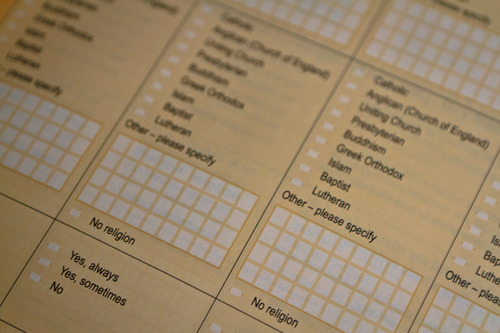
censusformIt won’t be a surprise that even the statistical realities of our Church can be contested. This is because there will be an element of selectivity in the data we choose to focus on and varying interpretations of that data depending even on our theological positions or presuppositions. These include the proper relation of the Church to the world, the meaning, purpose and expressions of Catholic mission, and the ultimate goal of Catholic education to name only a few.

For instance, we know from the most recent census that 52.8% of Catholic students attend Catholic schools. What does this say about ourselves, our schools and their role in the support of Catholic faith and families? What are the pastoral implications of the 10.8% of Catholics aged over 15 who are divorced or separated in our midst? Then, 35.3%, more than a third, of all Australian families have at least one Catholic within the family. Assessments about the potential or decline signalled by these statistics for our Church will be, in part, determined by our assumptions and priorities.

While some basic figures have already been outlined, below are further points of interest, some of which trace change within the Church over the past two decades or so (1991-2011). These might be of interest to priests and parishes, pastoral planners, adult educators, ministry groups and even students in their assessment of the scene here in Australia.

  • The Catholic population grew by 18.1% in the past 20 years. However, because the non-Catholic population grew even more in this period, Catholics fell from 27.3% of the general population in 1991 to 25.3% of the population in 2011.
  • Catholics are choosing to get married later. In 1991, 38% of all Catholics between 15-34 years of age were or had been married. In 2011, this had fallen to 22%.
  • In the past 20 years, the Philippines and India have risen to become major ‘source countries’ for the Catholic Church in Australia while migration from Italy and Malta has dried up almost completely. This must surely shape our activities and communication as a Church, now and in coming decades.
  • Now for the jaw-dropper of the 2011 census. Across all age groups it appears that more than 20,000 Australians every year are ceasing to identify themselves as Catholics. This growing ‘dis-identification’ in our midst is alarming and even takes into account that Catholics die, emigrate and travel overseas at about the same rate as Australians as a whole, that infants and newcomers are baptised and confirmed in the Church each year, and even compensates  for those young people at WYD Madrid at the time of the 2011 census. This dis-identification of 20,000 persons a year represents a net figure and a serious challenge for the Australian Church.
  • 61.2% of Australia’s Catholics live in NSW and Victoria (compared to 55.6% of the general population). This renders the pastoral life of dioceses and parishes within these states as vital to the future of the Church though inspiration may well come from elsewhere. (NB: for those looking for more census data and detailed analysis of the figures, see the April 2013 edition of the Australasian Catholic Record for a solid summary of the results).

SB004Effective planning in our Church can only begin with a plain recognition of the present reality and discussion about the implications of these statistics for our pastoral practice. While it is not uncommon to meet people with ‘the solution’ for all of the Church’s woes and the keys to its potential, the reality is far more complex than imagined. It follows from this that the appropriate responses will be anything but one-dimensional.

While an acknowledgement of the facts can be difficult to hear, as we know in this wintry season for the Church, they create a sense of urgency and open communities to accepting change. We cannot build a future and fulfil the mission God has given to us on the basis of illusions we hold about ourselves. As the English theologian Nicholas Lash would remark, “If you leave Calvary behind, you move, not into paradise, but fairyland.”

The contemporary statistics for the Australian Church are alarming but they are not a dead end. Instead, they invite the renewal and conversion that is the opportunity and challenge for disciples of every age.

on world youth day

wydrioWorld Youth Day has arrived. This time around it will take place in Rio de Janeiro, Brazil, between the 23-28th July, 2013, the 28th such event in the official count. It will see the first South American pontiff greet hundreds of thousands of young Catholics from around the world, bringing attention to the Church in the Americas and the surrounding social and political milieu to which Pope Francis will no doubt speak.

It is no revelation that opinions differ about the value of World Youth Day, both here in Australia and abroad. In my experience it tends to be fairly evenly split between those who uphold the event as a transforming experience for the young and the cities and nations which host them, while others dismiss World Youth Day as an expensive jamboree that proves of little lasting significance for the ordinary life of the Church.

I think it can be recognised that this triennial – or as it tends to be now, biennial – gathering does in fact shape young Catholic imaginations about the catholicity of the Church, understood as a reference not to the mere geographic reach of the Church but the inherent variety of expression or styles that it contains and embraces.

More fundamentally, it offers the young an experience of pilgrimage, a tradition reaching back to first centuries of the Church’s history (this practice has largely been rejected by Protestantism due to the devotions and relics often associated with such travel). What has been said of the life of the French theologian Yves Congar can be affirmed more generally, “a journey only becomes a pilgrimage through consciousness of the goal that gives meaning to the way”. Pilgrimage calls for interior work that brings together an outward practice with the person and message to which such an undertaking intends and World Youth Day provides just such an opportunity for such growth in faith.

A Mixed Picture

PIGLRIMS PRAY DURING EUCHARISTIC ADORATION AT WORLD YOUTH YOUTH DAY VIGIL IN MADRIDOf course, the real impact of World Youth Day – which epitomises on a grand scale the events-based approach to youth ministry which is becoming more popular in dioceses and even our parishes – depends largely on the receptivity of participants themselves.

As the American journalist John L. Allen noted some years ago, World Youth Day pilgrims can usually be divided up into three broad groups:

  • those attending with personal intent, commitment and fervour (described as a “gung-ho inner core”). These “evangelical Catholics” are devoted believers, often attend Mass more than once a week, accept Church teachings and have a strong sense of Catholic identity;
  • a more lukewarm cohort who are open, identify as Catholic but are not as zealous about the faith; are willing to agree with some Catholic teachings but don’t necessarily accept them all;
  • and then there are others who are just along for the ride, perhaps because friends are going or their parents were prepared to pay for World Youth Day but not a summer in the Bahamas. These are the kids you find playing handball or loitering outside during the catechetical sessions; they have a looser affiliation with the Church and low levels of religious practice.

As for the cities that host World Youth Days, the responses are now familiar. The initial announcement of the event is normally greeted with negativity (as it was in Sydney and has been the case for Rio which hosts two other world events in as many years), there are predictable fears of disorganisation and a cost blowout, but all this eventually gives way to a warmer reception as the prospect of a civic apocalypse recedes.

wydsydPope Benedict XVI himself recognised this gradual acceptance of World Youth Day in host cities, in remarks to a seminarian soon after the Sydney event (2008):

At first [Australians] looked at this World Youth Day with great scepticism because it would obviously cause a lot of bother and many inconveniences to daily life, such as traffic jams etc. However, in the end – as we also saw in the media whose prejudices crumbled, bit by bit – everyone felt involved in this atmosphere of joy and faith; they saw that young people come and do not create problems of security or of any other kind, but can be together joyfully. (L’Osservatore Romano, 13-20 August 2008).

Is It Worth It?

Catholics, too, can be tempted to take the line of scepticism or cynicism towards World Youth Day with the concerns being twofold: accessibility and impact.

SB050Given that for Australians World Youth Day involves a substantial airfare, insurances and accommodation, there can be concerns that the event is not only unsustainable for families, local churches (dioceses) and their parishes but that the expense involved restricts access to a privileged few unless participation is heavily subsidised. On average, the cost of attending World Youth Day from down here in the Antipodes ranges between $5,000-8,000 depending on destination and it is unlikely to get any cheaper in years to come. Hence the need for concerted fundraising to get people there.

The second concern is that World Youth Day has little impact or effect on the lives of young people let alone the dioceses and communities from which they come. The two polarised views we hear about the effect of World Youth Day – the conviction that absolutely each and every participant becomes a fully-fledged disciple of Jesus Christ following the event, and the opposite belief that no one is moved a jot – underscores the need for research in this area.

As a nod in that direction, study of World Youth Day Sydney has demonstrated that the impact of the event on a believer has much to do with their starting religious point. Those starting from a lower point of religiosity – there more for the social than the spiritual aspects of World Youth Day – tend to report some increase in confidence in their faith (“I’m not embarrassed now to let others see that I am a believer”, “I’m now more interesting in learning about my faith”). For those with a stronger religious starting point, World Youth Day often serves as a catalyst to make an even more decisive commitment to their faith (“To accept Jesus as Lord of my life”, “Now I want to live as a disciple of Jesus, a witness to Him”).

Notably, it is usually from among those in the second group that you’re likely to hear World Youth Day described as a “life-changing experience”. Perhaps it is because these young people are already devout that this large-scale, Spirit-filled event fires their energy and consolidates their identity in ways that just aren’t experienced by those of lesser conviction, hence the claims to its power of conversion.

You can read more about the impact of World Youth Days in this session of the Annual Meeting of the Society for the Scientific Study of Religion (2009), entitled “Shoring up the foundations:  the large-scale international youth festival as a strategy for the retention of Catholic youth”.

Most of us with involvement in youth ministry would view World Youth Day in positive terms while at the same time acknowledging it is no silver bullet for outreach to and engagement of youth.

Implications for youth ministry

wydsyd2For those close to the ground in ministry with youth, is the events-based approach – epitomised by World Youth Day – the way to go? As intimated, it has certainly become a dominant model in dioceses and some parishes, and the advantages are apparent.

Youth ministry programs and groups often fail or succeed on their ability to attract a “critical mass” of attenders. No young person wants to go to an event with only a handful of participants. In the youth ministry game, for better or worse, numbers matter. So, rather than the week-to-week youth program of old, some parishes and dioceses are favouring the occasional, bigger budget, showcase event.

The downside of this approach is that it can lead to a rather lazy form of youth ministry where one-off events are thrown on the parish or diocesan calendar without any thought to the faith development of young people over the medium to long term. Unfortunately, this is all too common today and the lack of continuity and personalisation of youth ministry can lead to a loss of potential young disciples who were open, maybe even seeking but who never quite found a place to land.

While large youth events make everyone feel good and may serve the youth minister well in terms of visible accountability (‘proving’ the position is justified), the capacity of such gatherings to bring about actual growth in faith can never be assumed. People turning up doesn’t mean people ‘turning on’ or people ‘turning around’. Holding an increasing number of youth events may actual divert energy from more intimate forms of ministry which may better generate disciples and help identify future leaders than the event-driven model.

SB051Whatever the preference, consistency in youth ministry is key because each generation deserves to hear the Gospel in the context of a community. Curiously, some would suggest there is too much emphasis on youth in our Church. Others would counter with humour, “Look around – everything we do seems to be for the elderly!”

While parishes do not hesitate in organising and funding services and outreach to the aged, primary school aged children and other distinct segments of the community, they often need real encouragement in responding to adolescents and young adults. One would have thought evangelisation and pastoral care admit of no exceptions.

As I’ve suggested in a previous blog, our parishes so often want these young people for their energy, witness and the hope that they bring to a greying Church but young people will not be attracted to communities that show no life, enthusiasm or generosity in themselves. I maintain that the absence or presence of young people in the life of the Church is, in part, a function of the vitality of its adult members whom they will one day become.

Conclusion

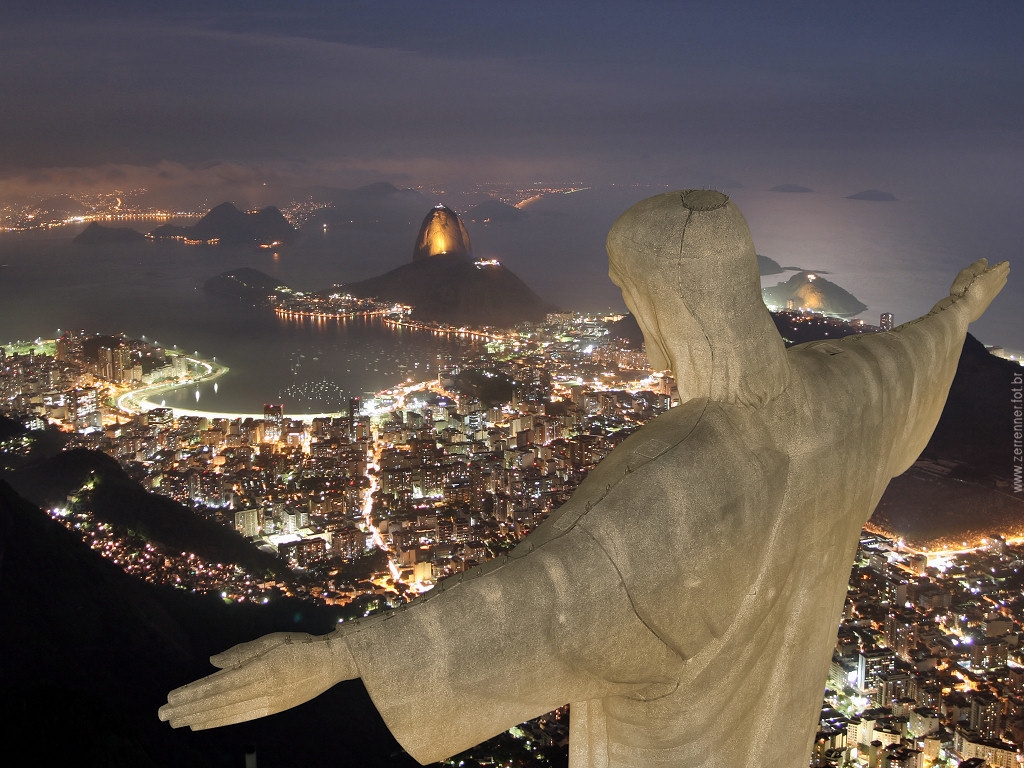
christtheredeemerAll in all, as a recurring feature of the Church’s outreach to youth, World Youth Days should be commended and supported. Of course, cynicism within and beyond the Church about this international event will continue to abound. However, cynicism is often a buffer against personal commitment and the folly of hacks and commentators who often make little effort themselves in this area of the Church’s life. An alternative to cynicism is hope and World Youth Day brings tonnes of it.

As for the next World Youth Day? The safe money is on Krakow, Poland, given John Paul II’s impending canonisation and his status as the originator of the World Youth Day events. 2015 also marks the 10th anniversary of the pontiff’s death so we could see the next World Youth Day a little sooner than expected. World Youth Day has been held in Poland just once before, in 1991, hosted by the southern city of Częstochowa.

As a local plug, you can read about the experiences of pilgrims in Rio from my own Diocese of Parramatta at their blog. Don’t hesitate to share your own views on World Youth Day and comment on how it might be better supported and integrated here in Australia.

lumen fidei

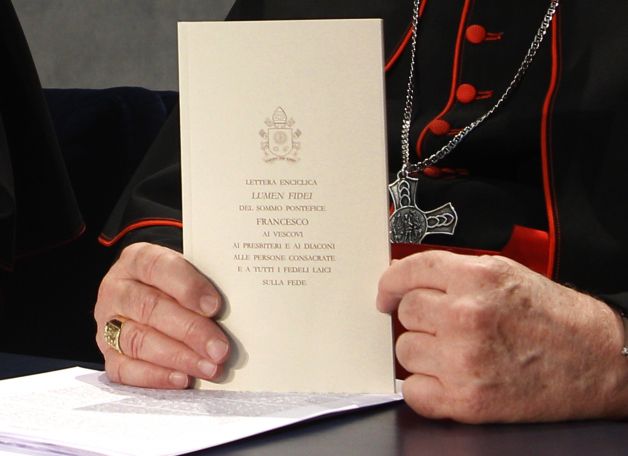
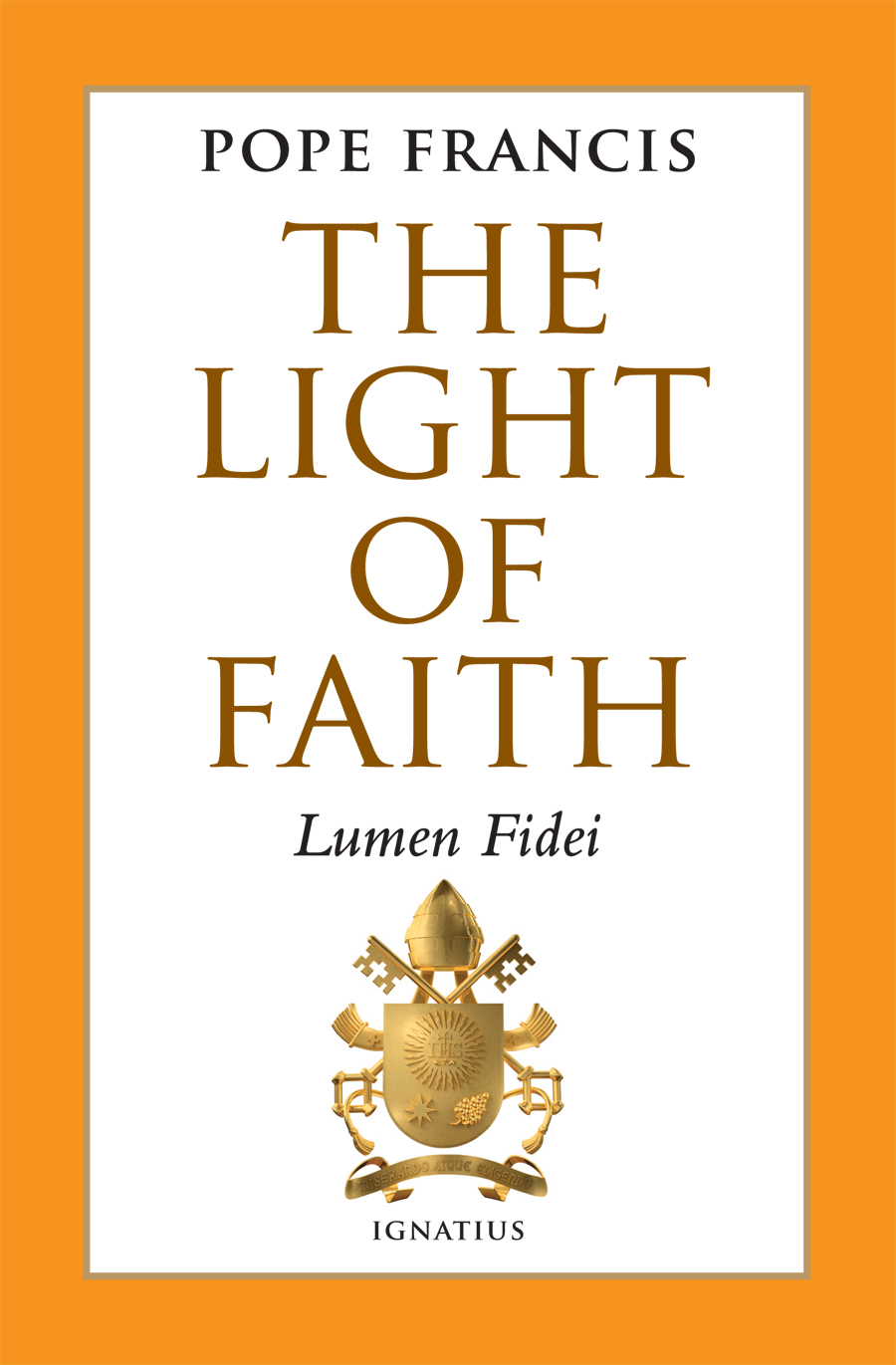
benedictfrancisOriginally intended for publication earlier this year as Pope Benedict’s fourth encyclical and the final in a trilogy on the theological virtues, Lumen Fidei (‘The Light of Faith’) was promulgated this past Friday in the name of Pope Francis.

In the same way as Benedict’s first encyclical in 2005, Deus Caritas Est, brought to completion the unfinished writings of John Paul II, so Francis’ inaugural encyclical represents to a significant degree the thought of his German predecessor on the meaning and implications of Christian faith. This inheritance and continuity between recent papal documents aligns well with Benedict’s own remarks, just days before his abdication, on the writings of ‘Peter’:

Peter was not alone in writing [his] Letter but it expresses the faith of a Church . . . He does not write alone, as an isolated individual; he writes with the assistance of the Church, of people who help him to deepen the faith, to enter into the depths of his thought, of his rationality, of his profundity. And this is very important: Peter is not speaking as an individual, he is speaking ex persona Ecclesiae, he is speaking as a man of the Church.

Likewise, Francis’ encyclical is received not as the word of a private individual apart from or above the Church but an expression of the faith of the communion of which he is called, in his person as ‘Peter‘, to be witness and shepherd.

The Possibility of Faith

lumenfideiLumen Fidei begins by addressing the very dilemma of faith in the contemporary world. Christian faith is so often seen by many as contrary to reason, not as a light that opens up the world but a darkness which stifles and even represses human creativity and the quest for knowledge. Even those who have sought to make room for faith have undermined it by promoting faith, erroneously, as a ‘leap in the dark’ driven by blind emotion. Others who champion autonomous reason as the answer to humanity’s future have often realised that their questions remain unanswered and this has led to an abandonment of the very search for truth itself in favour of “smaller lights which illumine the fleeting moment yet prove incapable of showing the way” (LF 3). Humanity remains hungry for a firm ground on which to stand and hence remains unfulfilled as it experiences the darkness and insufficiency of the world and itself.

On reading these opening remarks, the influence of Benedict stands out. His 1968 work Introduction to Christianity begins with this same confrontation of the very possibility of belief in the world of today. Indeed, the same temptations for the believer and unbeliever alluded to in Lumen Fidei (that of fideism or refuge in rationalism in the face of life’s questions) are raised by the early Ratzinger as prompts toward a fuller understanding of the ‘openness’ of faith, “Just as the believer knows himself to be constantly threatened by unbelief, which he must experience as a continual temptation, so for the unbeliever faith remains a temptation and a threat to his permanently closed world” (Ratzinger, Introduction to Christianity, 45). The recurring challenge of human finality and the quest for human understanding rescues both the believer and unbeliever from being shut up in their own worlds, resisting any tendency to self-satisfaction and urging humanity onwards in the search for truth.

9954008Lumen Fidei seeks to propose the light of faith as the guide to this truth that we seek, a light that illumines all aspects of our existence in illuminating God as one who addresses us personally. It notes that the word of God that called Abraham, ‘our father in faith’, is not alien to human experience but always present at the core of our being. It follows that Abraham’s response to that divine calling, Abraham’s faith, “sheds light on the depths of his being, it enables him to acknowledge the wellspring of goodness at the origin of all things and to realise that his life is not the product of non-being or chance, but the fruit of a personal call and a personal love” (LF 11). Faith in God, then, as one who creates and calls is not an extrinsic act or a merely ‘religious’ commitment but an integral and humanising project and gift which, when received, unveils our true vocation in the life of God himself.

The faith of Israel that would follow Abraham further reveals faith as a summons to a pilgrimage with the Lord that calls through the concrete events of our life. The history of Israel also sounds a note of warning, that of idolatry which reveals our own tendency toward control and vanity, as Lumen Fidei makes clear, “Idols exist, we begin to see, as a pretext for setting ourselves at the centre of reality and worshipping the work of our own hands” (LF 13). While commentators have seen in this discussion of idolatry the hand of Pope Francis, it is one that was certainly shared by his predecessor in his writings on the liturgy among others (see Ratzinger, Spirit of the Liturgy, 22f). The overall thrust of the text is to underline the paradox of faith, that is, as in all loving relationship, by our constant turn towards the one beyond our control, and by the surrender to what we did not initiate, we become more and not less ourselves, freed from the slavery of our own self-absorption and insecurities.

Ultimately, it is in Christ Jesus that the total manifestation of God’s faithfulness arrives in history, the crucifixion of Christ being the “culmination of the gaze of faith; in that hour the depth and breadth of God’s love shone forth” (LF 16). It is a total gift of self that precedes us and allows one to entrust themselves completely to the utter reliability of God’s love, manifest not only in this death-in-love but in his rising in love, a “tangible and powerful love which really does act in history and determines its final destiny, a love that can be encountered” (LF 17). It echoes the thought of Ratzinger for he affirms elsewhere, “Christian faith is more than the option of a spiritual ground to the world; its central formula is not ‘I believe in something’ but ‘I believe in you’. It is in the encounter with the man Jesus, and in this encounter it experiences the meaning of the world as a person.” (Ratzinger, Introduction to Christianity, 79).

After a brief word on the ecclesial form of faith, perhaps surprisingly brief given the demise of the Church’s credibility in the wake of the abuse scandal, the encyclical turns to the relation of faith to the truth which human beings seek (the theme of the Church is picked up again in Chapter 3 of Lumen Fidei though, again, without any theological treatment of sinfulness within the Church).

A Reasonable Faith

fidesEngaging an epistemology that may not be accessible to all, Lumen Fidei then goes on to underline the significance of truth for faith. Without truth, faith remains only “a beautiful story, the projection of our deep yearning for happiness, something capable of satisfying us to the extent that we are willing to deceive ourselves” (LF 24). Knowledge of the truth, Lumen Fidei asserts, is to be found in love which cannot be reduced to ephemeral emotion but is, most deeply understood, union with the Other. Without this love, “truth becomes cold, impersonal and oppressive for people’s day-to-day lives”; without truth, love becomes mere sentimentality, a fleeting emotion and cannot be a ground on which a future can be sustained. Love without truth “cannot stand the test of time” (LF 27). It is this discovery of love as a source of knowledge, as an interpersonal communion built upon truth that is capable of pointing us toward our ultimate fulfilment, that finds expression in the biblical understanding of “faith” (LF 28).

Returning to the concern of the opening paragraphs, Lumen Fidei then turns to the dialogue between faith and reason, drawing on the insights of John Paul II’s Fides et Ratio and also St Augustine, a perennial influence in Benedict’s own thought. As in the writing of John Paul II, faith and reason are presented not as opposed – as if faith were an irrational undertaking or that reason leaves behind the necessity of faith – but are recognised as having the same end or finality which is to know the truth. The reception of divine revelation and the ongoing human question for meaning, or philosophy, are not exterior to one another but intrinsically linked as Lumen Fidei seeks to show by the example of scientific inquiry,

The light of faith is an incarnate light radiating from the luminous life of Jesus. It also illumines the material world, trusts its inherent order and knows that is calls us to an ever widening path of harmony and understanding. The gaze of science thus benefits from faith: faith encourages the scientist to remain constantly open to reality in all its inexhaustible richness. Faith awakens the critical sense by preventing research from being satisfied with its own formulae and helps it to realize that nature is always greater. By stimulating wonder before the profound mystery of creation, faith broadens the horizons of reason to shed greater light on the world which discloses itself to scientific investigation (LF 34).

popejohnpauliiAs Fides et Ratio affirmed for philosophers so it may be said for the scientist, “it is necessary not to abandon the passion for ultimate truth, the eagerness to search for it or the audacity to forge new paths in the search. It is faith which stirs reason to move beyond all isolation and willingly to run risks so that it may attain whatever is beautiful, good and true. Faith thus becomes the convinced and convincing advocate of reason” (FR 56). As it has been said, it is faith that challenges reason to more audacious undertakings.

An Ecclesial Faith

The third and penultimate chapter of Lumen Fidei expands on the ecclesial context of faith that is only touched upon at the end of Chapter One (LF 22). Addressing the maternity of the Church, as one who brings about the birth of Christ in the believer, the encyclical draws attention to the living tradition of the Church.

The Church passes on the light of faith through the generations, “just as one candle is lighted from another”, an image that certainly recalls Pope Francis’ preaching style. Raising the question of the verification of knowledge, the encyclical underlines the relational way in which knowledge is transmitted, “Language itself, the words by which we make sense of our lives and the world around us, comes to us from others, preserved in the living memory of others. Self-knowledge is only possible when we share in a greater memory” (LF 38).

This sociological reality illuminates the theological significance of the Church as a “remembering subject” for it is this living communion that precedes us, and into which we are baptised, that teaches us the very language of faith. In plain terms, the Church came before us and rather than stifling our personal engagement with God in Christ, this very fact makes possible our personal faith with all the riches and insights of those that preceded us.

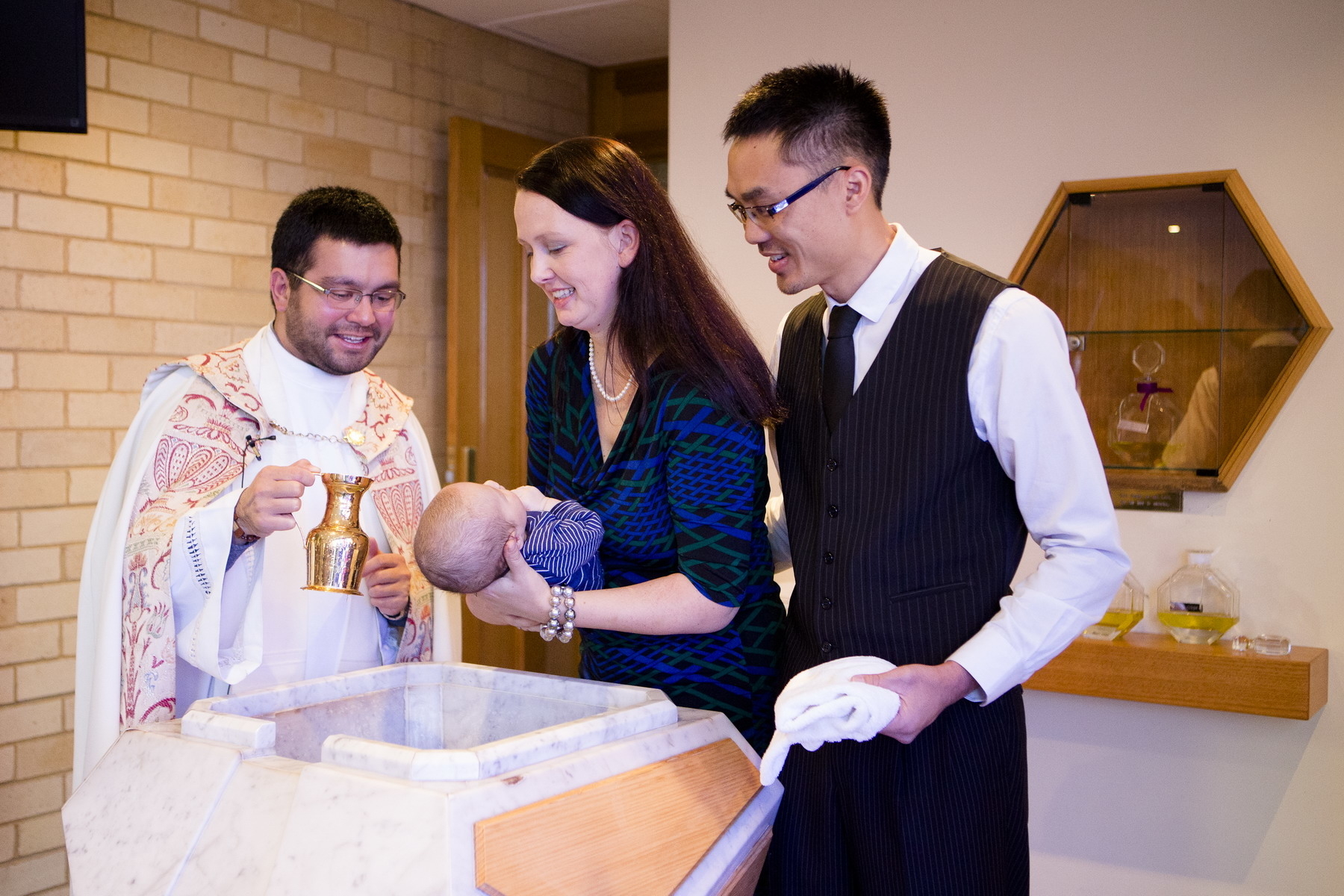
noahangbaptismP_041In faith, we respond to a word which did not originate with us – in the language of Lumen Fidei, “Our belief is expressed in response to an invitation, to a word which must be heard and which is now my own; it exists as part of a dialogue and cannot be merely a profession originating in an individual” (LF 39). Ratzinger’s earlier text makes the point in a similar way, “Faith comes to man from outside. . . [It is] not something thought up by myself; it is something said to me . . . This double structure of ‘Do you believe? – I do believe!’, this form of call from outside and the reply to it is fundamental to it” (Ratzinger, Introduction to Christianity, 91-2).

The ecclesial form of faith also expresses itself in the Church’s sacraments which “communicate an incarnate memory” (LF 40). Lumen Fidei even intimates the sacramental structure of faith itself for “the awakening of faith is linked to the dawning of a new sacramental sense in our lives as human beings and as Christians, in which visible and material realities are seen to point beyond themselves to the mystery of the eternal” (LF 40). Following this there is catechesis on the sacraments of baptism, confirmation, Eucharist, the creed, the Decalogue and prayer before the fourth chapter turns to the social consequences of the nature of faith outlined.

An Incarnate Faith

In continuity with Pope Francis’ preaching on the sociality of faith and the Church’s mission, the encyclical concludes by relating faith to the common good, affirming faith not as a privatised journey of introspection or pious isolation but a “process of building, the preparing of a place in which human beings can dwell together with one another” (LF 50). Faith does not only provide interior firmness, it also allows the believer to see others in their inherent dignity and vocation, born of love for union with God’s own self. Faith, because it is loving, does not draw believers away from the world but ever deeper into the concrete concerns of the men and women of our time. Families and the young are called to be bearers of faith in the midst of the world (LF 52-53) while faith brings as well a respect for creation as a gift for which all are indebted.

woodencrossA powerful section of Lumen Fidei is its treatment of human suffering in which it recognises human pain, hunger and loss is not at all extinguished by faith but placed in a new context of meaning. The encyclical affirms in this regard, “Faith is not a light which scatters all our darkness, but a lamp which guides our steps in the night and suffices for the journey. To those who suffer, God does not provide arguments which explain everything; rather, his response is that of an accompanying presence, a history of goodness which touches every story of suffering and opens up a ray of light” (LF 57). Pope Francis reminds us that it is Christ who has occupied the place of suffering, in the Gethsemane Garden and on the Cross, and as the endurer of humanity’s suffering he will be “the pioneer and perfecter of our faith” (Heb. 12:2) (LF 57).

As is tradition, Lumen Fidei concludes with an affirmation of the ‘Marian profile’ of faith for it is Mary who demonstrates the fruitfulness of faith from the Annunciation to the Cross. As figure of the Church and as one whose motherhood extends to each of his disciples, Mary leads us always and only to the blessing of faith which is her Son.

Conclusion

LUMEN FIDEI encyclical provisional cover_ B 13.inddLumen Fidei is a timely encyclical for a challenging moment in the Church’s history, calling for a return to the purity and plenitude of the faith that we have received and are called to live in the present. As this most recent teaching is received and settles within the tradition of the Church (and it calls for future reading together with its forebears Deus Caritas Est and Spe Salvi), many more insights and implications will no doubt come to light. What is obvious by its absence is significant reference to the “new evangelisation” as another manifestation of the Church’s self-understanding (with the exception of LF 42). We might hope that a future exhortation on this subject will build connections and so further expand the implications of faith for the Church’s mission in a new time, in the context of a globalised church and with a variety of ad intra and ad extra influences impacting on the Church’s relation to the world.

the future of tradition

tradition‘Tradition’ is not a word that is greeted with much enthusiasm in our time. Whether used in a religious context or otherwise, ‘tradition’ can be taken to refer to all that is past and therefore obsolete, the residue of a life once lived as it’s been described. Talk of tradition can seem especially off-putting in an age in which innovation and spontaneity are prized above all else and in a culture which interprets itself, quite naively, as the fulfilment or highpoint of all that went before (despite much evidence to the contrary).

In today’s climate, to be ‘traditional’ is to be irrelevant, behind the times, and trapped in misguided nostalgia for a mythical ‘Golden Age’ (as an aside, it was the late American poet and critic Randall Jarrell who said that even in a Golden Age people would go around complaining how yellow everything looks).

In contrast to that view, Catholic faith has understood ‘tradition’ as a dynamic, necessary and even creative force. Indeed, tradition has much more to do with keeping a fire going than preserving ashes. The inheritance of the past, including sacred texts, signs and practices, is read by the Church not as an obstacle to creative living in the present but as the very medium of Christian identity, growth and even development in the here and now.

SB012Tradition continually shapes our self-understanding and identity as disciples of one who came before us and, what is more, provides almost limitless possibilities for thinking and living faithfully into the future. This is because the ‘handing on’ involved with tradition is not an object or artefact but God’s revelation in the living Christ and so it can take us into the future rather than restricting us to the past.

Given its centrality to culture and the Christian tradition, it is fitting that the theme of tradition is being addressed by the University of Notre Dame, Sydney, at a conference next week. I’ll be attending when I can, in between work commitments and a road trip south to a neighbouring diocese. You can read more about the UNDA Tradition Conference here.

Perhaps a point to make on this subject is that all of us, knowingly or otherwise, are immersed in tradition. This is because we are not the first human beings to have ever lived. Each of us is born into a universe of words, concepts, symbols, and narratives that is not of our making, that was there before us and that we did not invent (even those who claim to be atheist or ‘spiritual but not religious’ for that matter operate, to some degree, in relation to an existing religious tradition, if only to reject it).

Tradition reminds us no one ‘starts from scratch’ or escapes their historical conditioning no matter how ‘contemporary’ or in vogue one seeks to be. In the arts, science and technology, as in religion, there is an inheritance or bequest from those who came before us that shapes – without ever completely determining – our present thinking and future aspirations at the deepest levels. Rather than being a source of embarrassment or condemning us to aggressive backwardness, tradition can open up fresh ways of interpreting the business of being human in a new time. The theologian Aidan Nichols concludes that, ‘contact with tradition is vital to every human generation because of the need for keeping open all possible imaginative options.’

christpreachingIt goes without saying that tradition is essential to a Catholic understanding of faith. The point of reference for Christian disciples is the life, death and resurrection of Jesus Christ, an historical event unchangeable in itself, that continues to be received by believers through their communal interpretation and expression of this experience through the ages and into the present. As individual believers we do not receive this event of revelation into our lives unmediated but depend on the communal memory, testimony and practices of those generations of disciples that went before us, that is, the Spirit-guided communion which is the Church.

Drawing on the language of Henri de Lubac, the Church is at heart ‘a life being passed on’ and it is the Church’s manifold tradition – including texts, teachings, images, embodied practices, narratives, theological insights, characteristic ways of speaking and acting, forms of sociality, worship and beyond – that transmits and makes accessible that sacred life from generation to generation.

massFinally, given the tendency to think of tradition in static terms, it is also important to insist that each generation of believers must make this inheritance of faith truly their own, by receiving it, seeking to understand it and applying it in their own lives and in the circumstances of their time. It is only by this active and ongoing participation in tradition by disciples today, under the guidance of the Spirit, that what has been received can be passed on in a living condition and not as a museum piece or relic.

The Jesuit scholar Edward Yarnold reminds us of this living dimension of tradition when he writes,

. . . tradition is not the handing on of tablets of stone for the guidance of every age. In this process [of tradition] the act of applying the word to the situation becomes itself part of the tradition. What the Church proclaims today becomes in its turn part of the reservoir of memory on which tomorrow’s proclamation will draw.

So, as disciples of our time, we are not only inheritors of a tradition, ‘the faith that was once for all delivered to the saints’ (Jude 3) but participants and ‘extenders’ of it, called to pass on through witness, testimony, practices and signs that baptismal and eucharistic unity we ourselves have received. I’m looking forward to the Tradition Conference as an opportunity to learn more about this dynamic at the heart of the Church’s life, growth and mission.

why parishes are not churches

pewsIt goes without saying that many Catholics, including even Mass attenders, experience the Church as a weight to be carried rather than a life to be lived. There are many reasons for this dim perspective and many of them have to do with the concrete realities of parish life.

When a research project was conducted in Australia in late 2005 to identify why Catholics had stopped going to Mass, many of the reasons offered by respondents related to parish community. These included problems with the parish priest, a lack of intellectual stimulation, people did not feel welcomed or a sense of belonging to the community, others felt that a previously-existing community spirit had eroded, there was the experience of unkind gossip, and the belief that the people at Mass lacked sincerity in their worship. People also dropped out because of ‘structural factors’ in the parish, including changes in Mass times, a negative experience of parish amalgamation and the like.

While it would not be fair to place all responsibility for disengagement at the feet of the Catholic parish (respondents also cited personal reasons for their absence, including family or household-related issues, the experience of a crisis of faith or the plain fact that going to Mass was simply not a priority for them; then there are wider cultural influences to consider), it is necessary to admit that our parishes are in need of reform. This means there is a need to develop those areas of pastoral life that are weakest, consider those structures and small ‘t’ traditions that no longer serve the parish’s mission, and build on those areas of strength that continue to serve well.

StonesWhen addressing parish renewal it has been my experience that parish councils, parish teams and parishioners can tend to jump, quite quickly, to the issue of buildings and infrastructure. It is true that many parishes need to undertake capital works due to the age of their facilities and changing needs (the demand for more carparking space, for example). However, these kinds of investment rarely build community in themselves or respond to those issues that disengaged Catholics, such as those surveyed above, have cited as motivating their withdrawal from community life.

I suspect that the reason that buildings tend to dominate conversations about parish renewal is that people like to see results and there is nothing more satisfying in this regard than a renovation. What is more, it is much easier to put up a building than grow a community.

widows-mite1In the U.S., when the formerly ‘unchurched’ were asked about their priorities before they became Christians, it is true that they named among the desirable qualities of a parish – adequate parking, clean and modern facilities, a variety of quality programs, relevant and quality music, clean bathrooms, friendly people, outgoing greeters, comfortable pews and chairs, and attention-holding preaching.

As commentators have recognised, however, while many of these expectations are quite reasonable and should be provided by the parish, the underlying mindset driving these desires can be “What can the parish or Church do for me?” rather than “What can I do to serve?” or, even more foundationally, “Whom I called to be here?” A consumerist mindset can dominate people’s  approach of the parish with consequences for the prospects of building a communion that is for mission. Even the most pristine, beautiful, well-organised and comfortable parishes can be spiritually dead if they do nothing but cater for our creaturely comforts and convenience.

If we are to refocus our communities on evangelisation, the maturing of disciples and the making of new ones, then the agenda must move from the simplicity of a facility focus to centre on the witness of discipleship itself, through good preaching and pastoral care, a genuine sociality supported by strengthening the bonds of faith, and a shared commitment to, and belief in, Christian mission in the wider community. We do need good spaces where people can gather, and beautiful churches in which to worship, but these are never sufficient. Those who have left the Church or found it wanting have told us so.

The Church and its parishes must seek to move even their present members from ‘consumers of services’ to ‘disciples on mission’. Only then can the new evangelisation be effective, issuing from a spiritual house of ‘living stones’ not communities of cosiness and contentment. It may well be that our parishes as a whole do not demand too much of our people but offer, in fact, too little challenge.

structural change

NPPN1301

Photo: Chris Ehler

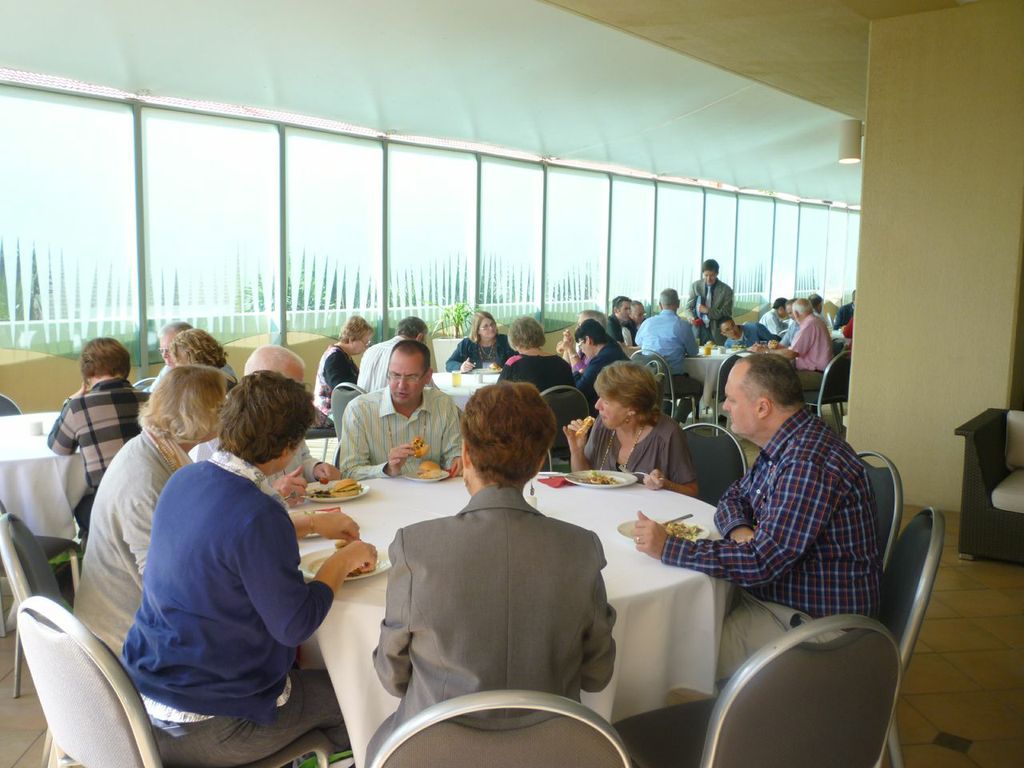
A conference is always richer than the sum of its parts and the biennial gathering of the National Pastoral Planners’ Network proved the rule. Held on the Gold Coast, Queensland, in late May 2013, the conference brought together those working in the area of church planning across Australia as well as in New Zealand.

Also part of the mix were representatives of the Pastoral Research Office, a Catholic agency which assists Australian dioceses to make sense of internal and Census data, and a number of bishops, vicars general, laypersons and priests seeking to exchange ideas on various levels. (You can find a blog about the conference keynote addresses on the Parramatta pastoral planning website here).

What struck me was the emphasis on structural change that was thread throughout the conversations, most notably the workshops I attended. In many dioceses in Australia there has been the need to twin or cluster parishes (communities share a priest while retaining their identity as separate parishes) or even amalgamate parishes on account of various factors. These reasons include, but are not limited to, the financial realities of church life, shifting populations, the need to redistribute parish priests to serve in greater areas of need, and then there is the desire to minimise duplication and to make the most of opportunities for increased collaboration.

NPPN1302

Photo: Chris Ehler

The whole business of parish reconfiguration, amendments to parish boundaries, even changes in models of parish leadership, and the re-allocation of resources is complex business, far more complex than popular accounts and external commentary on these changes convey. Structural change is always a controversial issue because people, quite rightly, have a deep attachment to their parish which is more than an administrative unit but, indeed, a spiritual home.

Nonetheless, the responsibilities of dioceses go well beyond a single parish and, as communities of communities, they are challenged to take into account distinct parish needs and circumstances right across their region all at once. The tensions between the parts and ‘the whole’, the particular and the universal, the needs of the parish and that of the greater diocese, manifest themselves for all those involved in this important work. (I’ve discussed some of the responsibilities of dioceses in a previous post).

In my experience, one of the reasons that the planning of a diocese can seem confounding or rather abstract for the average parishioner (if there is one) is that very few parishes themselves have had an experience of planning at a parish level. Without this commitment in a local context, the rationale of planning for an entire diocese can appear foreign, be viewed with scepticism or even considered unnecessary.

NPPN1303

Photo: Chris Ehler

When parishes do plan, it tends to be rather piecemeal, initiated for a particular event or else confined to planning for liturgy or the raising of parish funds. Meanwhile, the broader life of the community and the totality of its ministries are left to unfold year after year without a clear direction or a unifying vision. As just one example, a lack of succession planning for parish ministries often leads these groups in a bind when long-established leaders move on or retire while a more concerted effort to plan for ministries over the long term might help a parish community meet such changes with confidence.

(A helpful example of a parish pastoral plan was shown to us at the NPPN Conference, in the form of Surfers Paradise Parish whose pastoral plan is available here in PDF; 540KB).

So . . .  as a parish or a ministry group it may be well worth having a look at what dioceses and parishes are doing right across Australia and abroad in the area of planning as a potential inspiration for your own community. There are varying approaches – some may be paradigms of good process while others may be models of what not to do!

At this most recent conference I was delighted to join the Executive of the National Pastoral Planners’ Network. One of the commitments of the network is to share and communicate news of church planning across Australia and across the Tasman as well. So as a nod in that direction, here are some links to planning initiatives from the Church in Australia and NZ that I’ve been able to find and that might inspire action in your part of the world:

Parramatta Diocese

My own diocese launched its planning process in February 2012. This was followed by eight months of in-person consultation across 49 parish communities, an interim report (PDF; 1.2MB) that shared the responses from that process, and, more recently, a further call for feedback on draft parish goals (PDF; 1MB) which have been developed.

The final pastoral plan, entitled Faith in Our Future, is due to be released in February 2014. It will outline the future directions of Parramatta’s church agencies (CatholicCare Social Services, Catholic Youth Parramatta, and the like) as well as practical or grassroots recommendations for parishes to take up in their communities. Click here for the website which contains more information and regular updates.

Maitland-Newcastle Diocese

A leadership forum was held by the bishop of the diocese, Bp Bill Wright, in January 2013. From this flowed fourteen key areas of priority for the Diocese as well as the assignment of strategic actions for the immediate future. Click here for the website which provides an overview. The Pastoral Plan launched by the previous Ordinary of the diocese, Bishop Michael Malone, was to extend to 2014, and can be found here (PDF; 2.21MB).

Broken Bay Diocese

This diocese has some history of pastoral planning, with the previous plan entitled Pastoral Care for Evangelisation (2006-2010). In 2011, a diocesan synod was held. Interestingly, much of the synodal process was facilitated by external consultants who specialise in the area of leadership and management services. The diocese approached the synod primarily through a survey (I remember sighting them in the pews while on retreat at the Benedictine Abbey at Arcadia). A timeline is available here (PDF; 8KB) which could be used as the basis of a parish planning process, albeit on a smaller scale. The final statements and resources flowing from the Synod are available at this website.

Wollongong Diocese

This diocese launched its impressive pastoral plan, Bearers of Christ’s Love, in 2011 and it extends to 2015. A summary version can be downloaded here (PDF; 1.8MB). Wollongong is currently working towards achieving one of its key goals contained in its plan, which is to ensure its community structures respond to current and emerging needs. This link contains some excellent resources for a diocesan conversation about community change, resources that could well be applied to your own parish planning with some adjustment.

Sydney Archdiocese

The pastoral plan of the Sydney Archdiocese, Starting Afresh with Christ, was launched in late 2007 and extended from 2008 to 2011. The document can be accessed here (PDF; 2.8MB). The reason I make mention of this older plan is that the May 2013 edition of the Catholic Weekly alluded to an ‘iteration’ of the Pastoral Plan in one of its articles though the meaning of this is not yet clear.

Brisbane Archdiocese

A decade ago, the Archdiocese of Brisbane held a diocesan synod. Following the synod, nine priorities were formally promulgated by Bishop John Bathersby and the pastoral plan, Let Your Light Shine, soon followed which set out how the archdiocese would realise these priorities from 2004-2011. Click here for more website information.

Wellington Archdiocese

This diocese has developed a plan that appears to be focused on structural change, under Archbishop John Dew. Consultation was conducted through a number of focus groups, and the archdiocese is currently inviting responses to a series of proposals by the diocese. You can find the ‘proposal document’ here (PDF; 1.6MB). The final pages of the proposal document include templates for the response of individuals and parishes to potential changes. This seems a reasonable approach of inviting feedback for a diocese, given its scope. However, parishes may prefer to hold  in-person consultations when developing a pastoral plan, given their relatively smaller scale which tends to make the amount of feedback gathered more manageable.

Christchurch Diocese

Following the devastating earthquakes of 2011, the Diocese of Christchurch has, understandably, been focused on planning for the repair and rebuilding of not only churches but presbyteries, halls and parish centres as well. The latest diocesan documents on these plans are available here on their website. We wish them well in this complex but essential work.

coresponsibility in communion

jvaleroThis week I was privileged to attend and present at the Great Grace Conference, an event hosted by the Archdiocese of Sydney to commemorate 50 years since the opening of the Second Vatican Council. The keynote address and workshops proved dynamic and engaged head on with the issues that confront the Church and its mission, including the challenge of modernity, the need to address the education of the laity, and issues of authority and power, among others. Thank you to the 100 or so participants who attended my own workshop over the past two days which focused on the theme of ‘co-responsibility’ and lay leadership in the Church.

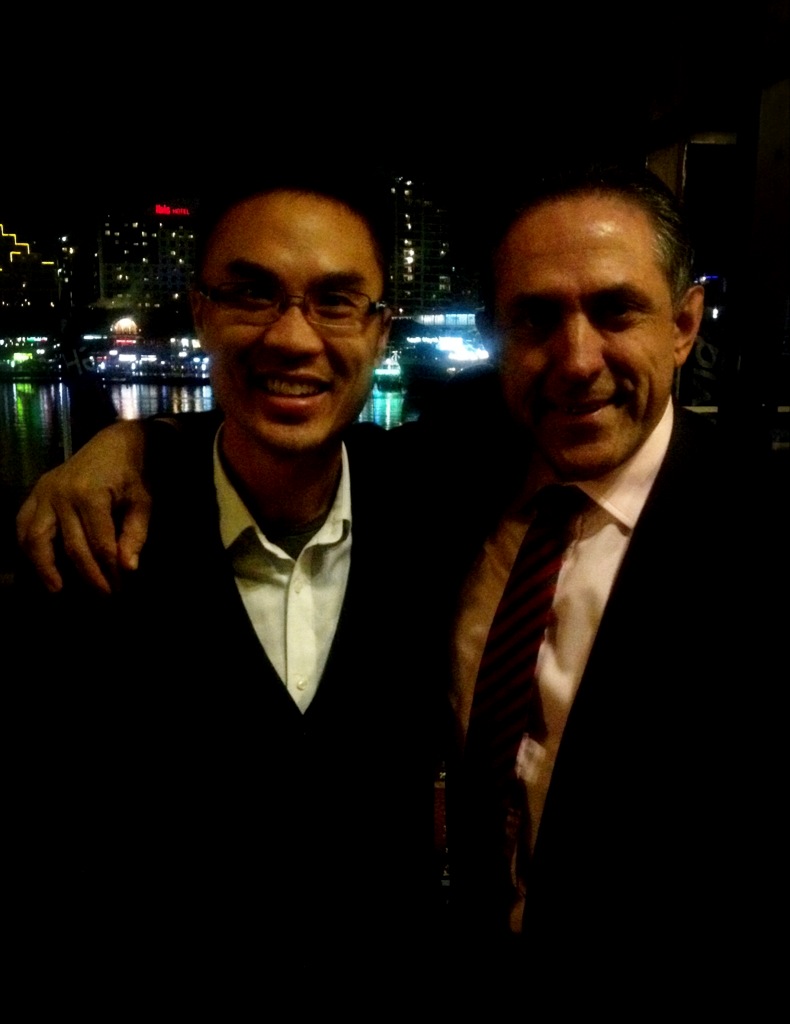
The conference dinner, held last night, brought together a remarkable mix of delegates, bishops, theologians and lay leaders in the Church. It was good to catch up with new and old friends, including Robert Tilley of the Catholic Institute of Sydney and the University of Notre Dame, Matthew Tan of Campion College, Byron and Francine Pirola of the Marriage Resource Centre in Zetland, an inspiring couple of the Neocatechumenal Way, and the UK’s Jack Valero of CatholicVoices (pictured), a bold and pioneering lay-led media initiative that began in 2010 and that has just established itself in Melbourne (I’ll be blogging more about this initiative in weeks to come). The conference concludes today with addresses from Tracey Rowland and Bishop Mark Coleridge. Next week takes me north to the Gold Coast for the National Pastoral Planners Network Conference where I’ll be presenting on strategic planning within church communities.

For now, here is a summary of my ‘Great Grace’ presentation on co-responsibility which may be of interest to laypersons, religious or clergy in service of the Church (for those who prefer to listen, an audio file of the live workshop is now available here):

Since the Second Vatican Council the concept of ‘collaboration’ has been the dominant framework through which the relationship of laity to the ministry of the clergy has been read. However, that began to change on 26 May, 2009, when Pope Benedict XVI, in an address to the Diocese of Rome, raised the term ‘co-responsibility’ as an appropriate hermeneutic through which to interpret the role of laypersons in the Church.

This concept of ‘co-responsibility’ has surfaced as an explicit theme of the Church’s self-understanding only in recent decades. Even then, the idea appears in outline, and occasionally, rather than in a fully elaborated or systematic manner. When it does appear, the primary contexts in which the term ‘co-responsibility’ is employed in the official documents of the Church include the relationship between local churches, the workings of the college of bishops, the bond between nations, and the relationship of the Church and Christians to civil society. The term appears in the Catechism of the Catholic Church only once, again in the context of the duties of Christians toward the common good (cf. CCC n.2240).

To my knowledge, the first magisterial application of the term ‘co-responsibility’ to the laity appears in John Paul II’s 1988 Apostolic Exhortation Christifideles Laici, Article 21:

The Church is directed and guided by the Holy Spirit, who lavishes diverse hierarchical and charismatic gifts on all the baptised, calling them to be, each in an individual way, active and coresponsible.

The third chapter of the exhortation makes clear the context of this common responsibility – it is for the Church’s mission in the world which includes witness and proclamation of their communion with Christ. The document gives sparse attention to the responsibilities of laity within the Church, more concerned as John Paul II was at the time with a perceived “‘clericalisation’ of the lay faithful” and associated violations of church law.
jp11 version 2The term is repeated ten years later in John Paul II’s comments at General Audience on the Holy Spirit. Here he remarked, “[the laity’s] participation and co-responsibility in the life of the Christian community and the many forms of their apostolate and service in society give us reason, at the dawn of the third millennium, to await with hope a mature and fruitful ‘epiphany’ of the laity.” In this instance ‘co-responsibility’ is understood to embrace both the active contribution of laity within the Church’s life as well as their social mission beyond it.

Taken together, these early references do not supply us with a fully elaborated theology of co-responsibility. However, they do express an increasing consciousness of the agency of laypersons in the world as well as some recognition of their involvement in the Church. Laypersons contribute in both spheres, ad intra and ad extra, through their Spirit-led witness and baptismal discipleship.

Benedict XVI’s interventions

It was on the 26 May, 2009, that the term ‘co-responsibility’ first appeared in the thought of Pope Benedict, in continuity with the outline offered by John Paul II but with an added, distinguishing element that raises the profile of the concept for the Church’s self-understanding. The occasion was the opening of the annual Ecclesial Convention of the Diocese of Rome. Expressing the need for renewed efforts for the formation of the whole Church, Benedict insisted on the need to improve pastoral structures,

. . . in such a way that the co-responsibility of all the members of the People of God in their entirety is gradually promoted, with respect for vocations and for the respective roles of the consecrated and of lay people. This demands a change in mindset, particularly concerning lay people. They must no longer be viewed as ‘collaborators’ of the clergy but truly recognised as ‘co-responsible’ for the Church’s being and action, thereby fostering the consolidation of a mature and committed laity.
popebxviIt’s important to affirm that Benedict’s appeal for a new mentality and recognition of co-responsibility falls within the specific context of lay ministry in the Church, and not simply their involvement in worldly mission. In this statement, Benedict has in mind those “working hard in the parishes” who “form the core of the community that will act as a leaven for the others.” These ideas recur, almost verbatim, three years later in Benedict’s message to the International Forum of Catholic Action.

While, again, no systematic theology of co-responsibility appears in Benedict’s thought, he has introduced a degree of specificity to the term by way of a significant negation. The co-responsibility of the laity is not to be interpreted as a ‘collaboration’ in church ministry fitting to clergy alone, and therefore not as derivative in nature, but as an integral and authentic participation, an ecclesial responsibility, that is proper to laypersons themselves. It is because this contribution of laypersons is real, legitimate and essential to the Church’s life that it is to be given practical support in the form of appropriate structures.  The significance of this statement by Benedict is best appreciated in the light of previous statements of the magisterium on the role of the laity vis-à-vis the Church and ordained ministry.

The 1997 Instruction

Pope Benedict’s application of the term ‘co-responsibility’ to laypersons is particularly striking when read beside the 1997 instruction, issued by the Holy See some 15 years earlier, entitled “On Certain Questions Regarding Collaboration of the Lay Faithful in the Ministry of Priests.”

I singled out this document for it well represents the predominant thinking of the magisterium on the relation of the laity and ordained within the Church’s unity. The instruction sought to reinforce the essential difference between the clergy and laity in the light of a perceived blurring of the boundaries in ministry that risked “serious negative consequences” including damage to a “correct understanding of true ecclesial communion.” While the document affirms the common priesthood of all the baptised and sets the ministerial priesthood within that context, the Instruction nevertheless promotes what Richard Gaillerdetz describes as a “contrastive” or categorical theology of the laity.

Specifically, the Instruction defines laypersons from a hierarchiological perspective with their theological status determined by two points of contrast with the ordained – the first, the ultimately secular character of the lay vocation in contradistinction to the ‘spiritual’ concerns of the ordained, and, secondly, the ministry of the baptised is differentiated from the ministry of the ordained by “the sacred power” (sacra potestas) uniquely possessed by the latter. Indeed, as Gaillerdetz observes, the Vatican instruction suggests that the fullness of ministry resides, by virtue of this sacral power, with the ordained alone.

On the basis of these two theological presuppositions – the ascription of laity to the secular realm and the ‘fullness of ministry’ to the ordained – the activity of the laypersons within the Church is cast as a ‘collaboration’ in the ministry of the ordained without a positive or integrated theological basis of its own. It must be said that the absence of such a theology can be explained, in part, by the purpose of the Instruction – it is a corrective, disciplinary document that seeks to uphold, quite rightly, the unique charism of the ordained. Still, as the Australian theologian Richard Lennan observes,

While that concern is proper, [such] documents tend to provide little encouragement to further reflection on the meaning of baptism, the possibility of ‘ministry’ for the non-ordained as other than a response to an emergency or an exception, or the implications of church membership for witnessing to the gospel in the communion of the church, rather than simply ‘in the world.’

The apprehension or hesitancy of this early Vatican instruction toward the status of lay involvement in Church ministry makes the “change in mindset” advocated by Benedict all the more significant. If laypersons are to be viewed not simply as collaborators in a ministry that belongs to another, but genuinely co-responsible in ecclesial life, as Benedict avers, then renewed reflection is called for regarding the positive theological status of laypersons and of their service in the Church, one that stretches beyond the paradigm of ‘collaboration’ that has dominated the lay-clergy relation to date.

I find possibilities for this positive, more constructive, and less contrastive, approach of the laity in the documents of the Second Vatican Council itself. Here we identify sound ecclesiological bases for the form of co-responsibility endorsed by Pope Benedict, flowing from the idea of communion that underpins the Council’s thought.

The Church as Communion

Andrej Rublev TrinityReturning to deeper biblical, patristic and liturgical sources clear of the juridical, extrinsicist tendencies of neoscholasticism, the communio ecclesiology of Vatican II expresses two primary insights. The first, a recovery of baptism as the primal sacrament of Christian life – prior to subsequent distinctions in charism, vocation or office; the second, a renewed appreciation of the Church as an icon of the Trinity, a relationship that promotes a mutuality of exchange between believers as an expression of the unity-in-diversity, the communion, that God is.

Lumen Gentium sought to ground all Christian vocations in what Kenan Osborne describes as a “common matrix” of baptismal faith for it is the entire people of God that are “by regeneration and anointing of the Holy Spirit… consecrated into a spiritual house and a holy priesthood,” “made one body with Christ, sharers in the priestly, prophetic and kingly functions of Christ” and so “share a common dignity from their rebirth in Christ, a true equality.” As Chapter 5 of Lumen Gentium avers, each member of the ecclesial body, baptised and confirmed in the Holy Spirit, shares “the same vocation to perfection” and all people are commissioned to the mission of the Church, not in a derivative way, but as Lumen Gentium 33 emphasises, they are called to this mission “by the Lord Himself”.

However, it is important to note that these gifts – baptismal regeneration, the tria munera of Christ, an equality in dignity and in the call to the heights of holiness – are ascribed to the entire christifideles, to all the faithful or People of God in their Christian vocation, and are not particular or distinguishing of the laity per se.

A Theology of the Laity

In seeking to identify a unique or distinctive element apropos the laity, scholars have pointed elsewhere in the conciliar documents, especially Lumen Gentium 31. This text directs attention to the distinct ‘secular character’ of the lay vocation in contrast to the ‘sacred’ ministry of the ordained: “to be secular is the special characteristic of the laity . . . the laity, by their very vocation, seek the kingdom of God by engaging in temporal affairs and by ordering them according to the plan of God.”

The overall thrust of this and other documents leads the theologian Aurelie Hagstrom to conclude, “this secular character must be an essential part of any theology of the laity since it gives the specific element in any description of the laity’s identity and function. The peculiar character of the laity is not only a sociological fact about the laity, but also a theological datum.” In short, Hagstrom interprets these documents as raising the ‘secular character’ of the laity to the level of metaphysics, as belonging to the ontological status of the lay vocation as such. To be lay is to be immersed in the secular, or so it is proposed.

laityHowever, questions can be raised about the theological adequacy of such a presentation and its support in the breadth of the conciliar documents. For one, the subcommittee responsible for Lumen Gentium 31 – that section of the constitution that refers to the laity’s ‘secular character’ – did not intend this to stand as a reference to their ontology, as pertaining to the core of their being, but rather a ‘typological description’ of the situation of the laity, that is, a description of how lay men and women typically live, but not exclusively so (cf. the relatio of John Cardinal Wright). This original intent of the Council Fathers challenges a view that would limit the proper responsibility of laypersons to the external life of the Church, that is, ‘in the world’ alone.

What is more, as Archbishop Bruno Forte points out, it is in fact the whole Church that the Council situates within the world as a leaven, in both Lumen Gentium and Gaudium et Spes. Forte goes as far as to predicate ‘laicity’ not of a specific subset of the Church – that is, of its non-ordained members – but of the entire Church that serves the world as the “universal sacrament of salvation.” These conciliar perspectives challenge a conception of the Church in dichotomous terms, of clergy as the apolitical men of the Church; the laity as the less ecclesially committed, politically involved, ‘men of the world.’

The heart of the issue is that to define laypersons by an exclusively ‘secular character’ in contradistinction to the ‘sacred’, ecclesial ministry of clergy renders genuine co-responsibility within the life of the Church difficult if not problematic. As intimated, as long as laypersons are defined exclusively by an identity and function in ‘the world’ without taking into adequate account the reality of their witness within the Church, then their involvement in Church ministry can appear only a concession, an anomaly or even a usurpation of Church service that belongs properly and fully to the ordained alone. What is more, the definition of laity by a secular vocation stands in contrast to the pastoral reality of many thousands of laypeople engaged in church ministries which are obviously not secular. As Lennan concludes, the practice of Church ministry by lay men and women, the very reality of their co-responsibility within the contemporary Church, presently outstrips the theology and church policy regarding such matters. Lay ecclesial ministers such as ourselves are doing something in the Church that, ontologically speaking, appears incongruous for their ‘proper’ place has been read as being ‘in the world.’

Co-responsibility of Order and Charism

19238374In moving beyond  a “dividing-line model”, a hardened distinction of laity and clergy in isolated realms, it is helpful to consider the place given by the Council to the exercise of charisms within the Church’s mystery. Prior to the Council, the charismatic gifts of the Spirit were treated by theology primarily within the context of spirituality, as the indwelling of the Holy Spirit in the human soul of the individual believer. Considered extraordinary, transient and isolated in experience, the charisms of the Spirit were not integrated into a broader ecclesiological framework and so their relation to the sacraments, the life and mission of the Church remained largely overlooked.
CongarBuilding on the insights of Congar and other proponents of the ressourcement movement, Vatican II witnessed a recovery of the pneumatological foundations of the Church as presented in the writings of St Paul. A strong integration of the activity of the Spirit within the Church can be found in Lumen Gentium 12 with consequence for our theme of co-responsibility:

It is not only through the sacraments and the ministries of the Church that the Holy Spirit sanctifies and leads the people of God and enriches it with virtues, but, “allotting his gifts to everyone according as He wills,” He distributes special graces among the faithful of every rank. By these gifts, He makes them fit and ready to undertake the various tasks and offices which contribute toward the renewal and building up of the Church . . . Those who have charge over the Church should judge the genuineness and orderly use of these gifts and it is especially their office not indeed to extinguish the Spirit but to test all things and hold fast to that which is good.

While it is true that the Council is not here making an explicit link between charism and lay ministry per se, it does provide a foundation for understanding leadership by laypersons as something other than an exception, usurpation or offshoot of ordained ministry. In grounding the life of the Church in the work of the Spirit, the Spirit of Christ who ‘co-institutes’ the Church by the giving of gifts, the Council grounds all ecclesial activity, all “tasks and offices,” in the inseparable divine missions of both the Word and Spirit.

In the post-conciliar era it was Congar especially who would bring out the consequence of this unity of Christ and Spirit in the Church’s being for our understanding of ministry, including on the part of laity. In a 1972 article Congar takes issue with the largely ‘christomonist’ approach of the Church and ministry that had dominated Catholic ecclesiology since the age of high scholasticism. Congar critiques this linear and predominantly vertical perspective with acuity:

“Christ makes the hierarchy and the hierarchy makes the Church as a community of the faithful.” Such a scheme, even if it contains a part of the truth, presents inconveniences. At least in temporal priority it places the ministerial priest before and outside the community. Put into actuality, it would in fact reduce the building of the community to the action of the hierarchical ministry. Pastoral reality as well as the New Testament presses on us a much richer view. It is God, it is Christ who by his Holy Spirit does not cease building up his Church.

This richer view of the ‘building up’ of the Church’s life is indeed offered by Lumen Gentium 12 in its recognition of the Spirit’s bestowal of gifts on “the faithful of every rank,” on the entire christifideles. In renewing and building up the Church’s life, the Spirit is understood to operate throughout the entire community of God’s people, disclosing the Church as other than a pyramid whose passive base receives everything from the apex. The laity are indeed subjects of the Spirit’s action as persons of baptismal faith.
NTChurchThis appreciation of the entire Church as anointed by the Holy Spirit (LG 4), as entrusted with Scripture and tradition as Dei Verbum 10 insists, and with charisms of the Spirit that bear structural value for the Church, opens the way for recognition of lay ministry qua ministry for the life of the Church and its mission. In the light of a pneumatological ecclesiology, the activity of laity surfaces not as derivative, a mere collaboration in the ministry of another, but, as Benedict intimates, a genuine co-responsibility for the sake of communion with God in Christ by the Holy Spirit.

While affirming the Spirit’s guidance by “hierarchical and charismatic gifts”, the Council never successfully integrated these christological and pneumatological aspects of ecclesial life. They were simply placed side by side (cf. LG 4). As long as this integration of hierarchical order and charism remains lacking, the co-responsibility of laypersons within the Church risks being read by Catholics against, or even as a threat, to the unique charism of the ordained who act uniquely “in the person of Christ the Head.” In other words, there is a risk of distinguishing ordained ministries from lay ministries by associating Christ with the former and the Holy Spirit with the latter, a solution that is clearly inadequate. If the co-responsibility of the laity is to be fruitfully realised in the life of the Church, its future theology must hold charism and order, the missions of the Spirit and Christ, in unity without confusion or separation.

It has been suggested by Gaillardetz that the ordained priest, in that “discovery of gifts” described by the Council, directs and oversees the entire local community while, for the most part, the lay minister serves only within a particular area of ministry and does not exercise leadership of the community as a whole. To locate the charism of the ordained in the particular gift of leadership of the entire community upholds the principle that no matter how much pastoral work one does or how competent one becomes, the non-ordained person never ‘forms’ or ‘rules’ a community as a leader in the sense in which a cleric does. However, such an understanding of the unique charism of the ordained still permits recognition of other forms of Spirit-led leadership within the communion, under the oversight and with the encouragement of the ordained.

Though the integration of charism and order within the Council’s document was never achieved, there are within its letter foundations for an appreciation of ordained ministry not in opposition or above the Spirit-filled reality of the body but firmly within it as the apostolic principle of order and oversight of the local community. It is in recognising the Church’s constitution by both the missions of the Word and Spirit, in the ministry of the apostles and the Spirit given at Pentecost, that we can move toward a theology of co-responsibility that supports and extends the reality of both lay and ordained ministry vivifying the life of the contemporary Church.

14546210As a final observation, it may well be the unfolding momentum of ‘the new evangelisation’ that offers the zeal and occasion for co-responsibility to be practiced with greater intensity in the mission and ministries of the Church. The new ecclesial movements, for one, have manifest the way in which the historical shape of the Church can be shaped by a renewed appreciation of the work of Christ and the Spirit, order and charism, clergy and the laity within a communion of faith, as endorsed by my conference paper.

Conclusion

‘Co-responsibility’ remains a developing concept that is to be understood in the context of the Church’s life as a communion. Tracing the appearance of the term within magisterial thought, I see the interventions of Pope Benedict XVI on the subject as particularly significant for the Church’s self-understanding. In differentiating ‘co-responsibility’ from mere ‘collaboration’, Benedict has prompted renewed thinking about the theological integrity of ministry by laypersons and the relationship of this growing service within the Church to divinely-given hierarchical order. It is through ongoing reflection on both the christological and Spirit-filled foundations of the Church, the missions of Christ and the Spirit in the ecclesial body, that the practice of co-responsibility, already growing at the level of pastoral practice, may be matched by a coherent theology that strengthens the contribution of laypersons in the decades to come.

our Catholic schools

It is conference season with a gathering in the Sydney Archdiocese on Vatican II, clergy formation days, and a meeting of the National Pastoral Planners Network on the Gold Coast, all in the next three weeks. I’ll be kicking it off by travelling to Canberra next week for a keynote address at a colloquium of Marist teachers and school leaders.

It will no doubt be a diverse audience with various experiences and understandings of the Church and the role of schools within its mission. After reading the documents of the Congregation of Catholic Education and bringing to mind the momentum of the new evangelisation, I entitled the address “The Evangelising School: Educating In and For Communion” and aim to present something accessible and personally evocative for the participants. Here are some excerpts from the address which may stir your own thoughts about the role, intentionality and influence of our Catholic schools with regards to faith:

dangLast year I travelled throughout the Diocese of Parramatta, which encompasses the Western suburbs of Sydney, and spoke with some 2,000 people about their hopes and aspirations for our Church. The role of our Catholic schools in the faith of our children was high on the agenda. What became apparent is that the rationale and expected outcomes of Catholic schools in regards to religion is anything but a settled question.

Is the Catholic school genuinely responsible for the spiritual lives of our children and to what extent? As participation in Catholic parishes continues to decline, how does this position schools as centres of evangelisation for young people and their families? What responsibility lies with school families themselves for the faith of the young, named as they are by the Church as the primary educators and nurturers of baptismal faith? Then there are the increasing numbers of non-Catholic students in our schools. What impact should this phenomenon have, if any, on our goals and self-understanding as Catholic schools, as avowedly Catholic institutions? One suspects that in the face of such questions and the variety of views that surround them that many Catholics, both the loosely affiliated and the deeply committed, are ambivalent about the school as a centre of faith and evangelisation. Indeed, it would be fair to suggest that for some observers the Catholic faith and schools appear a ‘forced fit’, partners that would be better off going their separate ways; still others argue that the divorce has already taken place – schools have left the faith or the faith has left our schools – and we are now left to bicker about the children.

While such a fatalistic reaction is easy, even tempting, demanding little effort or commitment to change, it is as deficient as the ‘spotless sunshine’ of the optimist – both attitudes are too certain of the outcome. The social and cultural context in which we live and teach has changed, irrevocably, and not always in a positive direction. However, the proper Christian response to changing circumstance is hope, recognising the past and present moment do not exhaust all possibilities and that all times and cultures can yet encounter Christ as the path of life. In that spirit, I would like to share a few comments on Catholic schools as centres of evangelisation in the twenty-first century. In particular, I bear in mind our many lay teachers who increasingly shape our Catholic schools once dominated by religious brothers and sisters, and their significant influence in the lives of not only students but school families and indeed colleagues within the learning community.

The Year of Faith and ‘The New Evangelisation’

PopeBenedictIn October 2012, Pope Benedict XVI inaugurated a Year of Faith to bring the task of evangelisation to the fore. Commemorating fifty years since the opening of the Second Vatican Council (1962-5), the pontiff invited the universal Church to reflect anew on the meaning of faith and the mission that flows from faith – the mission to proclaim the Risen Jesus “to the ends of the earth” (Acts 1:8). Pope Benedict and his predecessor, John Paul II, spoke often of ‘a new evangelisation’ that sought to be realised, including within our Catholic school communities which share the joys and demands of faith. To what does this term, ‘the new evangelisation,’ refer and what claim does it make on the life of our Catholic school communities?

While it is anticipated that Pope Francis will soon issue an encyclical on this very subject, we can already detect something of its meaning in the writings of previous popes, including Blessed John Paul II. In 1990, the polish pontiff remarked that the Church directs its missionary activity to basically three situations:

. . . peoples, human groups, socio-cultural contexts in which Christ and his Gospel are not known . . . Then there are Christian communities which have adequate and solid ecclesial structures, are fervent in faith and life . . . Finally, there exists an intermediate situation, often in countries of ancient Christian tradition, but at times also in younger Churches, where entire groups of the baptised have lost the living sense of the faith or even no longer recognise themselves as members of the Church, leading an existence which is far from Christ and from his Gospel. In this case there is a need for a ‘new evangelisation’ or a ‘re-evangelisation.’ (John Paul II, Redemptoris Missio 33).

The ‘new evangelisation’ appeals to an ‘in between’ or intermediate group of people who have indeed heard the Gospel, and so are not new to its announcement, but who nevertheless do not participate actively or regularly in the Church’s life. That is, we could not yet describe this last group of Catholics as intentional disciples of Jesus. By ‘the new evangelisation,’ John Paul II sought to direct the Church toward missionary outreach in traditionally Christian nations to whom the Gospel is known but whose faith nevertheless lacks fervour and genuine witness in life. As the New Testament reminds us, not all those who encounter Jesus find him convincing or compelling as the face of God.

It would also be fair to suggest that this third group represents many of our school families and even teachers – baptised Catholics who no longer feel close to the Church, whose practice is perhaps occasional rather than continuous, and who have become distant from their faith. Australia has certainly been recognised on an official basis as one of those nations where Christian faith has played an integral part in the development of our culture, law and society and yet remains today on the sidelines rather than at the heart of the nation. Pope Benedict himself would aver,

This is certainly a form of suffering which, I would say, fits into our time in history, and in which we generally see that the so-called ‘great’ Churches seem to be dying. This is true particularly in Australia, also in Europe, but not so much in the United States. (Benedict XVI, “Address to the Diocesan Clergy of Aosta: On Critical Issues in the Life of the Church”)

If our Catholic schools are to become centres of a new evangelisation, reaching out to school families, students and staff with the vitality of the Gospel, then we need to acknowledge, with candour, the challenges that face us at this time, both within the Church and in the wider culture.

Challenges and Promise

pewsOf course, the most glaring challenge for ‘a new evangelisation,’ a renewed outreach to others in faith, whether in the school or the parish, is the sexual abuse crisis which has undermined the credibility of the Church not only in Australia but around the world. In an address delivered in Glasgow, Cardinal George Pell noted with realism, “It does not need to be said that this [the sexual abuse crisis] is the most important and powerful barrier to the New Evangelisation” (Address at St Andrew’s Conference, Glasgow).

In the light of terrible crimes committed by some clergy and maladministration on the part of some bishops and religious orders, many Catholics, including our school families, can feel less than inclined to engage with the larger Church or ‘institutional church’ as it is often put. Thus, the divide between what happens in the school and the wider Church can seem unbridgeable, even desirable in the wake of the false witness of a few. The Australian theologian Richard Lennan comments on this situation,

It is surely undeniable . . . that in its structures of authority that the church today seems to be for many people not simply ‘other,’ but alien. It is in its ordained leaders and their actions and decrees that the church seems particularly unattractive: prone to intolerance, authoritarian attitudes, and, most shockingly and tragically of all, even to abusive and corrupt behaviours. As a result it is common for Catholics to group such features together as the expression of the ‘institutional church,’ which tends to mean the church that I do not like and would not want to be a part of. It is, perhaps, a particular temptation for those in schools to think that way: our school community tries to live by Gospel values and to give students a positive experience of discipleship, but it is not our job to promote, to defend, or even to accept a connection with the ‘institutional church’ (Richard Lennan, “Holiness, ‘Otherness’ and the Catholic School,” 404).

Lennan goes on to suggest that the practical upshot of this situation is the neat division between the school and the Church expressed in the claim that “our kids are good kids even if they don’t go to Mass.”

While not denying the reality and scandal of abuse, it is important to underline, for one, that such crimes and violations of trust do not represent a fulfilment of the Church’s nature or mission as Christ’s body but the gravest contradiction of it, an utter rejection and betrayal of the Gospel which the Church has been entrusted to proclaim from generation to generation. It should also be recalled that such abuse does not represent the total sum of the Church’s life. The Church has always done and will continue to do good in the Australian community. Many people still meet Christ in our Church’s life and are supported by our parishes and schools, as well as by the Church’s many works of charity, especially in welfare, health and aged care.

Forgetfulness of this ‘bigger picture’ in the midst of the current crisis can lead to Catholic school families and even teachers to turn away from the wider Church and its worshipping life or to remain silent on, or disengage from, its social advocacy on important issues. However, it is precisely the engagement of everyday Catholics ‘from below’ in the liturgy and the active mission of the Church that is needed now more than ever. In the long-term effort to restore credible witness to the house of God, our schools are critical in fostering future generations of Catholic believers who are not only well-informed, intelligent and critical thinkers but also holy men and women, disciples who bring life to faith and faith to life. The Second Vatican Council well describes this potential of the Catholic school:

. . . its proper function is to create for the school community a special atmosphere animated by the Gospel spirit of freedom and charity, to help youth grow according to the new creatures they were made through baptism as they develop their own personalities, and finally to order the whole of human culture to the news of salvation so that the knowledge the students gradually acquire of the world, life and humanity is illumined by faith. (Vatican II, Gravissimum Educationis 8).

While some Catholics have not lived this faith well, it does not render the Gospel any less integral to the human flourishing of our young people, the formation of their whole person and, indeed, the building up, through them, of what has been described as “a civilisation of love.”

School communities and teachers are well placed to bring about this new creation for it is they who face, firsthand, the array of issues that impact our social fabric. This includes alarming rates of suicide among young people, brought on by depression, family crises and social isolation, and the cult of a dehumanising materialism in which people have never had more but remain deeply and even dangerously unfulfilled.

communionIn the midst of this fragmentation, which reveals a crisis in the idea of the human itself, Catholic schools stand to manifest before the wider community and before its own eyes the true meaning of the human person and the nature of authentic relationship. Grounded in the life of the Trinity, the divine unity of diverse persons, our schools can stand beside the family as a space of communion, characterised by mutual recognition and self-giving love, nowhere more so than in the primary school where young people are being socialised and grafted into concrete relationships with others, both their peers and the adults whom they trust. The stark reality is that for some of our young people the school community may provide a deeper experience of communion and unconditional love than the home, and these children can indeed be more valued here than in the marketplace where they are often regarded only for their status as consumers.

By educating in and for communion, Catholic schools can also serve as an evangelising centre for entire families who may never darken the door of a church or have any other experience of the Catholic faith beyond the walls of the school grounds. As I have proposed elsewhere, it is especially schools such as those of the Marists, filled with charism, an awareness of God’s Spirit manifest in human history, that can bring together the Church and the world. Marist schools can accomplish this by mediating or serving as a bridge between the traditional, mainstream Church and the lives of students and parents who may not be connected to parish or regular practice. As the theologian David Ranson has observed, religious institutes including the Marists are, in a sense, both ‘Church’ and ‘beyond Church,’ working at the margins with those who may never feel comfortable within the ordinary life and structures of the Church. On this note, a school principal once remarked to me that while some of his school families did not identify strongly as ‘Catholic’ they certainly felt ‘Marist.’ Such a sentiment points to the way in which schools can mediate the meaning of Catholic faith and a sense of belonging to a contemporary culture that remains hungry for a narrative by which to live and a community in which to live it.

The Practice of Evangelisation

While affirming all that our Catholic schools promise and already bring about through their care and nurturance of the young, our theme of evangelisation also presents forward challenges for each and all of us who represent the Church, whether we are conscious of this ecclesial witness or otherwise. The new evangelisation is not a phase or moment but the perennial mission of all the Catholic faithful, a deep and abiding responsibility to “speak the truth in love” (Eph. 4:15). In terms of its practice, it has been my experience that among the first responses of schools, as it is for parishes and dioceses as well, is to create appropriate structures to support that goal. This is to be commended. The establishment of committees for evangelisation, dedicated personnel as well as practical resources remind us that wanting to evangelise is never enough. We have to be organised to do so and reveal the power of evangelisation as something other than a Platonic dream. The Great Commission given to us by the Gospel, to “go and make disciples” (Matt. 29:18), should shape all of who we are as Catholic communities, including our structures, budgets, professional development, and the organisation and priorities of our time.

StonesHowever, it must also be said that evangelisation should not be approached as yet another task of the school community, squeezed in between existing commitments, for such an approach inevitably leads to a rather bureaucratic response to the Church’s mission of outreach. Boxes are ticked and prayers are said, usually before and after meetings, but the deepest meaning of evangelisation can be missed, as a continuing conversion to the Gospel in all aspects of school and professional life. Of course, it is proper for schools and school systems to set benchmarks, to define goals and measures of evangelising activity, but these of themselves cannot ensure fruit without a conversion of heart on the part of teachers and school leaders.

While recognising the importance of structures in coordinating efforts and marshalling resources, the risk is that ‘evangelisation’ comes to be understood by the school community as the responsibility of one person, one group or one department rather than the entire body of students, teachers and parents that form the school community. The adult educator Jane Regan points out that it may be better to speak of the evangelising school or parish, noting,

When we use the [noun] evangelisation, there is the temptation to set it out as another activity the parish [or school] does – catechesis, liturgy, pastoral care, and evangelisation . . . Using the [verb] evangelising strengthens the commitment that who we are as Church – our mission and identity – is rooted in engaging in all activities through the lens of evangelisation (Jane Regan, Toward an Adult Church, 23-4).

Thus, for the evangelising school, the school sports day is not unconnected to the human flourishing which the Gospel promotes, social justice activities are not simply about good citizenship but involve recognising the dignity of others, and ourselves, made in the one image of God, and that the ‘faith of the school’ does not simply refer us to the school motto or point backwards to its origins but also points forwards to its aspiration, its witness of Gospel values as an ecclesial community, and its future commitment to ongoing conversion. The evangelising school will therefore relate all that it is and does to the evangelion, the Good News of the Gospel, which comes to us not only as a gift but an invitation to renewal, even change.

Conversion for each and for all

19238374Ultimately, all discussion of evangelisation is self-implicating in that it presses us to consider the quality of our own discipleship and the extent to which we manifest the holiness that we seek to awaken in others. As Pope Paul VI points out, “The Church is an evangeliser, but she begins by being evangelised herself” (Evangelii Nuntiandi 15). By this statement, the pontiff recognised that we can only share what we ourselves have received into our life, that our own passion for, or else disinterest in, evangelisation reflects the extent to which we have been convinced by the person and message of Jesus of Nazareth, Son of God. The fruits that this self-conversion yields for others are manifold, as Paul VI would note, “Modern man listens more willingly to witnesses than to teachers, and if he does listen to teachers, it is because they are witnesses.” It is the quality of our Christian discipleship that is the most powerful form of evangelisation that we can offer students, their families and our colleagues, leaving an imprint in the experience and memories of others that can last a lifetime and shape their own discipleship, experience and perception of the Church.

Of course, conversion is never an easy business and demands of us an unvarnished reflection on any gap between who we profess to be as Catholic teachers, and as school communities, and who we really are. It could be suggested that too many of us are admirers of holiness but not enough of us seek to possess it for ourselves. The startling gift and project of ‘the new evangelisation’ is this – to realise that we are the Church we are waiting for.
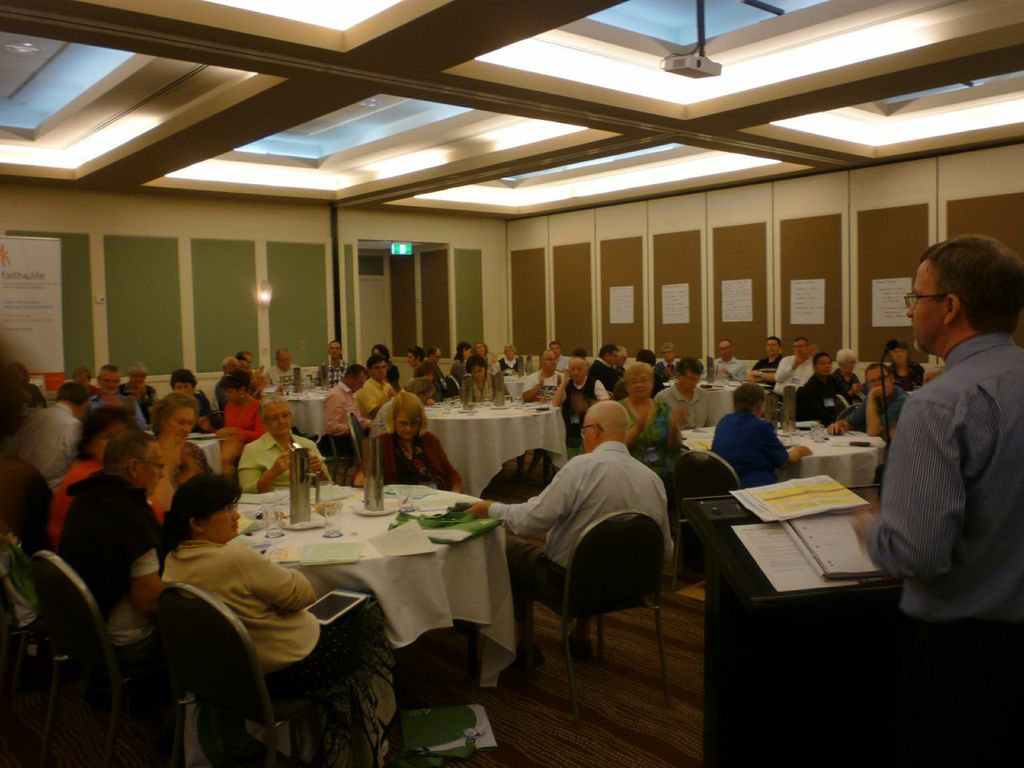
In Season Four of the American political drama, the West Wing, a young man, Sam Seaborn, is running for a seat in the United States Congress. He returns backstage after an exuberant political rally organised to garner votes and complains to his campaign manager, “I’m preaching to the choir. You had me out there preaching to the choir. Why?!” The campaign manager replies with calm, “Because that’s how you get them to sing.” So it is for the Church – the first who need to hear the call of the new evangelisation are ourselves, those of us closest to the mission of our Church as it is lived in our parish and school communities. The depth of our listening to this call will express itself in the strength of our commitment to proclaim the Gospel to the young people in our care.

Our Catholic schools bear enormous potential as centres of evangelisation, bridging the gap between the traditional Church and those not embedded in parish or regular practice. The new evangelisation calls us to attend especially to those baptised Catholics among us who have lost a living sense of the beauty, goodness and truth of our faith, who no longer recognise the Gospel as the way of life. While structures and committees are a necessary part of this important work, the task of evangelisation ultimately demands something of each of us, our ongoing conversion and willingness to receive the Gospel as the heart of our identity and mission as Catholic disciples and the heart of our life and calling as Catholic schools.

getting started in ministry

planningLast week I met with a diocesan youth minister who was seeking advice on planning for parish communities and better coordinating their activities toward a unified mission. For me it was an opportunity to learn more about the organisation of other dioceses and their parishes which differ quite considerably across the country.

One of the recommendations that I made was that whether you are working within the context of a parish ministry, a religious order, or for a diocese it is essential to put aside some specific time for planning rather than jumping headfirst into frenetic activity.

Gregory of Nyssa, the fourth century Cappadocian Father, warned that the mere appearance of Christian activity and practice does not mean any genuine progress is being made. He likened directionless activity to

. . . those who toil endlessly as they climb uphill in sand. Even though they take long steps, their footing in the sand always slips downhill, so that, although there is much motion, no progress results from it. (The Life of Moses)

Genuine progress demands beginning on firm ground, including the effort to plan, otherwise we risk expending a lot of energy in ministries that make little progress or have little impact. As it has been put, without proper planning, direction and goals, we can be ‘paying people to be nice’.

Here are a few pointers which may be helpful for those just beginning in ministry as well as those further along in experience. These can assist both lay and ordained ministers to make the most of their opportunities and reduce the amount of energy lost to initiatives that are uncoordinated or ill-conceived from the start:

  • windowUnderstand the ecclesial context, history and organisational structure. One of the first things I did, and found helpful, was to request an organisational map of the diocese before all else. One of the advantages of working within the Catholic Church is that there will be a relatively firm structure, that is for sure! A map of these structures and relevant organisations within your diocese, parish, or religious network will help you identify who the stakeholders are, to identify those who link with your work and help you to avoid stepping on anyone’s toes! It is also important to quickly become familiar with the history of the context you are working in. This helps you understand people’s attitudes, opinions and actions in the present. All of this takes time, though after a year or so you should be picking up the ‘lay of the land’. If you don’t have a clear picture of the ecclesial landscape and dynamics you are working in it can be difficult to make genuine progress. After all, you can’t do it alone and need to collaborate with others.
  • Ensure ownership of your ministry by those you report to, as well as the provision of adequate resources to fulfil your ministry. This includes the need for your own ongoing formation. Accountability and governance are not only important dimensions of the Church as a human organisation but a part of the Church’s self-understanding as a theological reality. The Church is structured in such a way as to not only safeguard but to strengthen an apostolic proclamation from generation to generation. This means that those you report to, often an ordained minister, a vicar, a head of a religious institute or perhaps even a bishop, need to exercise oversight and take ownership of the work you have undertaken. Sometimes a helpful distinction is made between ‘responsibility’ and ‘accountability’ – you may be responsible for a particular work but someone ‘higher up the chain’ will be ultimately accountable for it. So regular meetings with your superior are a must. Your overseer also has responsibilities and they should support you not only in rhetoric but also in practical resources. All church organisations should be resourcing their people to succeed, not to fail, so it is important to ask for a budget that allows you to get the job done. If they could have done it for less or without expense, they would not have employed you in the first place! Finally, securing resources for your ministry also means ensuring you are not working in isolation and that you have opportunities to network with others and receive formation and/or supervision of some kind. Working in the Church means working with people and there is nothing more rewarding and challenging than that. Good supervision, networking with others and ongoing formation are essential for your longevity as a leader.
  • Establish a coherent framework for your ministry. Take youth ministry in a diocese for example. Is your ministry going to be parish-based, diocesan events-based, or a combination of these and in what proportion? No one can ‘do it all’ so what will your approach be, your principle message for young people, and what are the three goals you seek to achieve in the first year? Clarifying these basic goals and approaches to your ministry are important. It strikes me that in speaking of a ‘framework’ for your ministry those who take up an existing role often feel an expectation to simply duplicate what was before. However, again, if what had gone before was so successful or sustainable, it is doubtful that your predecessor would have moved on or that the organisation would have employed you to take it up. Once you familiarise yourself with the context and history, have the courage to begin to shape the goals that you discern as critical to the life of your community. You, also, need to own the work if you are to carry it out not only with competence but personal passion.
  • Build a reliable team throughout the planning process yet still assert leadership. As I’ve mentioned before, often Church organisations have strategic plans that no one really cares about other than its authors. No one else feels invested in the plan and so few are likely to respond to its initiatives. When you start out in your ministry, start collecting names and remembering profiles of good people with a proven record for getting things done. Remember, these may not be the people recommended to you by predecessors or the people currently in place! Ask the skilled and capable people you have identified for their views as you plan for your ministry. Not only are you getting wise advice from a gifted cohort but they may also form a future team that can help you turn the vision of your ministry into a reality. By having their say, people become genuine owners of a plan and you are on your way to building and nurturing a reliable team. Keep in mind this does not mean handing everything over to committee – it remains important to lead from the front and it is indeed an old saying that ‘if you want to kill something off send it to committee’. Work towards a style of leadership that is genuinely consultative but is unafraid to make decisions and exercise leadership when called for.

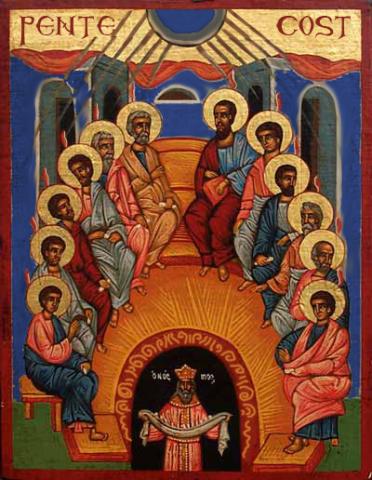
There are many other dimensions of good planning in ministry and while few of us, including myself, manage to apply or appropriate them all, it is helpful to have them before us as a resource for future thinking.

greatgrace2013For those interested in further reflection on ministry, especially since the Second Vatican Council, the Sydney Archdiocese is hosting the “Great Grace” conference next month. It is well worth attending if you can. I’ll be there speaking on the subject of “co-responsibility” and you can read my abstract and those of others here.

As the landscape of ministry develops across our Church, I will be suggesting that it is indeed possible to affirm the integrity of ministry by the non-ordained and uphold the unique charism of the ordained without compromise or a diminishment of either. As so often happens in the Church, the practice of co-responsibility is outpacing the theology and Church policy in this area. Yet this does not necessarily mean a distortion is taking place. In fact, it can herald development that is authentic to our tradition, including our self-understanding as a ‘communion’.

I hope to share more reports on the Conference and reflections on ministry in posts to come.